"A mound is a way that I organize information. Like
things pop up around anywhere I move, these mounds seem
to move with me."
"Color has to have some sort of a meaning if Im
going to use it. Its hard for me to just choose random
color and use that as information because I start to feel
disconnected from it."
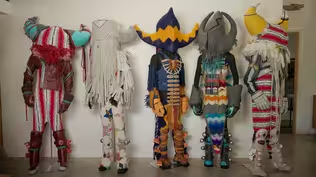
"I see each character as a separate part of me. I can
separate one aspect of my being out and then put it in front
of me and then look at it. And its kind of like all
of these things are inside me at once, battling each other."
"The idea of these beautiful storiesthese archetypes
of heroes going through toil and trouble and coming out
all the better for it, or teaching us all a lesson not to
go through...to take a different pathI wanted to incorporate
that kind of thing into the way that I tell stories."
"In asking a question you can then have an epiphany
because itll open up the floodgate to twenty new questions.
And from there you just keep going and it snowballs."
Your paintings and
installations
are but moments in the larger
narrative that is the story
of the Mounds. Can you summarize that story?
HANCOCK:
Okay...but first I should explain
a little bit about what Mounds are. Mounds are these half-human,
half-plant mutants that came to life about fifty thousand
years ago, when an ape man masturbated in a field of flowers
and up sprang these creatures and theyre called Mounds.
Since then many of them have died off for various reasons,
but the main cause of death of Mounds is the premature death
caused by creatures called Vegans who are evil creatures who
cant stand Mounds at all. And over the past few years
I have worked through the first major chapter about Mounds
and its called "The Life and Death of Number 1."
And Number 1The Legendis named that because he was the
very first Mound to exist. And hes the oldest Mound.
And the Vegans hate him with all of their being, and so it
was their mission to take him out. And so the Vegans plotted
and they achieved their goal.
There are some protectors that are supposed to protect these
creatures, but the one main protector was busy at the time
so he couldnt come to the Mounds' aid in time. His name
is Torpedo Boy. Torpedo Boy is kind of my alter-ego.
Hes who you see sitting before you right now in the
yellow shirt and pink 'T'. And hes super strong except
he has an inflated ego. And his pride and all of his other
human emotions get in the way of him performing his duties.
So hes very limited by his flesh.
Before there was Torpedo Boy there were Painter and Loid.
Painter is a spirit energy who is kind of a mothering type
of an energy, who is all about color. Any time you see colors
within the paintings, thats as a result of Painters
presence. And the other energy is called Loid. Loid is kind
of a father type of an energy and he takes care of any time
theres words within the paintingsthats his
doing. And hes also all about black and white, theres
no in-between. So when you see black and white or words within
paintings its Loid, and Painter is the color. So all
of these characters are just ways for me to break my aesthetics
down into something that I can use in my palette.
ART:21:
When did you start to develop
the story of the Mounds and the individual characters? How
did they get their names?
HANCOCK:
Ill start with the Mounds.
The Mounds came from, or the name of the Mounds kind of came
from a series of drawings that I was doing when I was an undergraduate.
That was the name I would give to groups of things. Its
like a mound of information. And I had other friends that
also did drawings that related to that same kind of a thing.
So it was something Ive always done, like, I like to
group lots of things on one page. But also a mound is a way
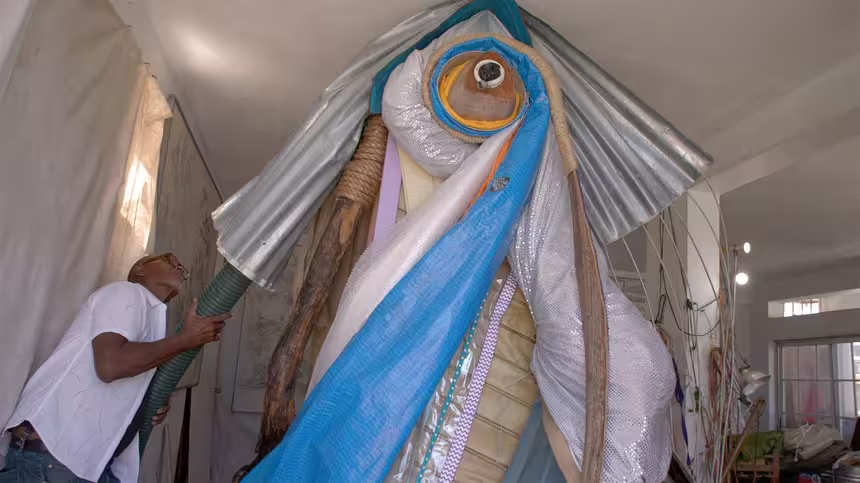
that I organize information. Like things pop up around anywhere
I move, these mounds seem to move with me. In my car theres
like a pile of thingsthats a mound. In my studio
there are piles of things all over the place and I pick from
these pilesthose are my traveling mounds. A mound is a
way to describe how I organize things.
Torpedo Boy has always been with me, more or less in the form
that you see him now. Hes a super hero: he can fly,
he can lift things. I created him when I was, Id say,
in the fourth grade. And hes pretty much the same as
he is now, except now hes a lot more flawed and his
uniform is yellow when it used to be white. And thats
pretty much the only difference.
Painter is...well...Ive always been drawn to color,
but it always has to be necessary. Color has to have some
sort of a meaning if Im going to use it. Its hard
for me to just choose random color and use that as information
because I start to feel disconnected from it. So especially
lately in the work, every color, every time it appears it's
there for a specific reason. And if theres no reason
for color to be there, then the piece will probably just end
up being black and white, which Im perfectly okay with.
And thats where Painter comes from.
And then Loid is just this love that I have with both the
lyrical nature of the spoken word and also the way language
looks when its written. So Loid operates in both this
space where he can convey something to you and you fully understand
it, or it can totally be abstract,
which is what language has the capability of doing, either
including or excluding you. And thats what Loid is all
about.
ART:21:
Can you talk a little more about
how you use color to drive the narrative aspect of your work?
HANCOCK:
One of the colors that pops up
most often in my palette
is pink. Its a color Ive always been drawn to
because its so loaded with meaningcontradictory
meanings. It can either be naughty or it can simply be the
color of our skin. Its the color of our muscle, like
if you peel the skin away, you know its pink under there!
Its also the color of innocence, like in a little childs
room you see pink. It operates on so many different levels
that it had no choice but to keep coming back up in the work.
Torpedo Boys uniform is pink and yellow and thats
one of the most obnoxious color combinations I could think
of. Pink and yellowits very loud and thats
kind of what Torpedo Boy is all about. His ego is his force
field. Thats just how he takes on the world. And I thought
he needed to have a uniform that reflected what he was all
about. So pink and yellow became his color combination.
The Moundsthey also have pink within, but on the outside
they're all black and white. And Id say the white and
the black first came from a lot of drawings that I was doing
that had to do with identity politics and race and things.
And I was doing a lot of things that became really literal
to me in approaching that kind of subject matter. You know,
the fact that Im a black artist and there was something
at one point that I wanted to explore. And I did that thing
to a point and I just got really bored with how things were
turning out. Its like everything was kind of given already
and it was just something that I already knew in my heartall
of these issuesand I was very comfortable with who I
was anyway. It wasnt something I wanted to explore any
deeper.
But the black and the white motif:
I wanted to retain that and make it something that became
a little bit more universal. So the black and the white morphed
from that kind of subject matter into something that I could
use as a module. And these stripes became what we now come
to know as the Mounds. And the pink is there because these
Mounds are wounded characters. You start to see underneath
these sores that start to emerge and interrupt the black and
white bands. Thats what the pink is. So the Mounds ended
up being pink, black, and white.
Painter is in a way synonymous with color. So it would only
make sense that her energy would be all of the colors, a rainbow
of colors. Painter, with her array of colors, with her spectrum,
she represents hope and tolerance within the universe. Whenever
bad things happen she can come in and present us with a layer
of color over the top of things to, I dont know, just
to give you a little something else to look for or hope for.
I think thats where the tolerance comes in the work.
You can tolerate the bad stuff because of that little bit
of color that youre given. Its kind of like "the
spoon full of sugar helps the medicine go down."
And Loid is devoid of emotion. Theres no real range,
theres no rainbow: its either black or its
white. Its either all the colors, which kind of negate
each other, or its no color at all.
ART:21:
You describe Torpedo Boy as an
alter-ego. Whats your vision of yourself in your work?
How do the characters relate to your identity?
HANCOCK:
I see each character as a separate
part of me. I can separate one aspect of my being out and
then put it in front of me and then look at it. And its
kind of like all of these things are inside me at once, battling
each other. And at certain points one is dominant. Like at
one point I may be Torpedo Boy: I might have the biggest ego
ever. And then at another point I could be one of the Mounds:
I could be this stationary object whos kind of pathetic
and a bit stubborn and kind of sad. And then at another time
I might be one of the Vegans whos self-righteous and
looks to make others around him or her like him. So its
up to each of those other parts of myself to balance that
dominant side out and make it come down in size.
ART:21:
And yet while Torpedo Boy is
your artistic persona,
he also has a religious or mythical
dimension. Are biblical narratives a big influence on your
work?
HANCOCK:
I grew up in a very religious
family. My stepfather is a Baptist minister. There were several
ministers in my family. My mom and all of her sisters, my
grandmother, they are all, very, very religious. We went to
church at least two times a week. And you know thats
just how I grew up and it was a sense of community. The church
was filled with beautiful stories and great music and it was
a very visceral type of experience. And that type of experience
also spills over into how you live the rest of your life.
You know things were dealt with in those terms. Like its
very, very old-fashioned, you know. Punishment meant a different
thing than it means nowadays. Like it was very "if you
dont feel the punishment, then it doesnt count."
So it was that kind of a mentality. The idea of these beautiful
storiesthese archetypes of heroes going through toil
and trouble and coming out all the better for it, or teaching
us all a lesson not to go through, to take a different pathI
wanted to incorporate that kind of thing into the way that
I tell stories.
And also a lot of it comes back to my mother. She is Painter
and she is Loid wrapped up into one. She is the smiling face
of Painter. She is the color that you get from Painter, but
at the same time she could be stern. When she put her foot
down, when she spoke her word, you had to listen and if you
didnt she made you know sure that you listened the next
time. So she was also Loid. So in a way the mother and father
energy in my universe are both my mother.
ART:21:
Are there any biblical stories
that still resonate for you?
HANCOCK:
Theres one particular Bible
story that always stuck with me when I was a child and I like
to kind of relive it in my head, and thats the story
of Jonah and the whale. The idea of this prophet who kind
of knew that he was a prophet, he knew that he had a calling,
except he didnt act on it, or he chose to deny it and
choose another route. And God let him know: "Im
going to give you a chance to think about what you need to
do with your life." So he had him be swallowed up by
this whale in which he had time to think about his plight,
where hes been and where he should be going. And he
had to do it in the stinky belly of this whale. And I just
thought that was a wonderful story growing up. And I always
wondered, well is there water inside of a whale stomach? You
know, does he have to swim around in there? What must it smell
like, dead fish? The smell of dead fish, that must be horrible
in there! That stuck with me: always listen to whats
really your calling, whats in your heart. And you know
it may sound corny or whatever but those stories do actually
mean a lot when you get down to the meat of the stories. Theyre
beautiful things that you can just kind of take along in your
pocket and take out whenever you need them. Jonah and the
whale was pretty cool.
ART:21:
And the story of the Mounds...you
say it comes to you in flashes. It's like your own personal
calling.
HANCOCK:
The story comes to me. I like
to refer to it as visions. But when you break it down, you
can actually break down a vision into a series of questions.
Like after I realized what Mounds were, I had a lot of questions
for myself. So where do they come from? How tall are they?
Do they eat? Like just all of these types of things. In asking
a question you can then have an epiphany because itll
open up the floodgate to twenty new questions. And from there
you just keep going and it snowballs. And to me thats
what the vision is all about. Its taking notice of things
that are around you and then questioning them. And out of
those questions will come answers but hopefully a lot more
questions. And from there you can just keep your vision growing.