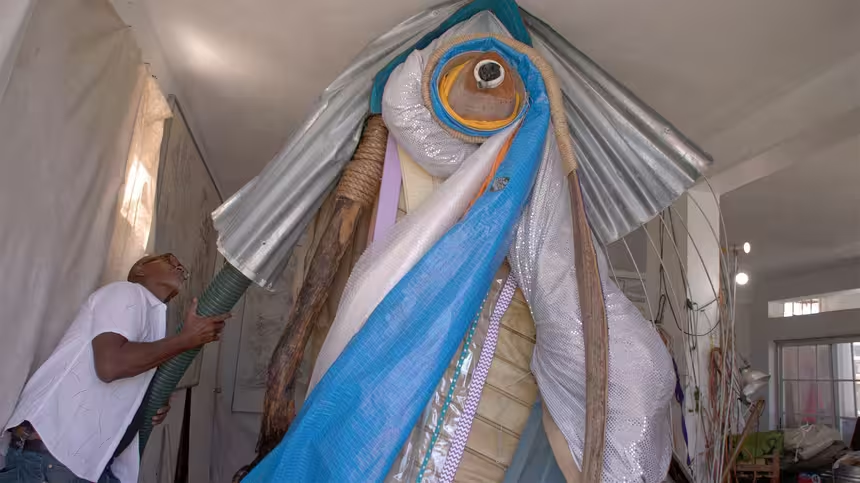
"...I have spent most of my working life making work
that may seem to be carved but which in fact is constructed,
made from parts and put together."
"One of the most important elements when you're coming
up with a work is the scale or how big it needs to be. And
for me that's always been in some ways the most difficult
but also the most crucial part of a project..."
"...It really is meant to be a monolith. It certainly
suggests a head, a colossal head "
"...The choice of material was in some ways suggested
by the fact that it was Japan, because they have such a
tradition of working with stone there."
"Japan is a society that's produced an enormous and
incredible material culturewhich is like falling into
a well. I mean, you can get so involved in it. And it's
so deep and so complex and interesting..."
"It's important to also have a flow and have things
be able to germinate and not get caught in the trap of perfection because
that can be a real trap for anybody who makes things."
What was the process like for
the stone piece in Japan?
PURYEAR:
I think the big challenge was
that it was a piece that was carved, and I have spent most
of my working life making work that may seem to be carved
but which in fact is constructed, made from parts and put
together. And although this was made from eighteen blocks
assembled, essentially the process
of shaping the blocks was one of carving from solid material.
And I haven't carved stone since I left college really. And
of course, with a piece of this scale,
the carving is done industrially at a big stone fabricator
facility and requires diamond tools and water and everything
to do it efficiently.
I had to find a way to really transmit my idea as an artist
to artisans and on an industrial scale, which required making
the wooden model at one tenth scale which was carved from
solid blocks, assembled exactly like the blocks would be assembled
in the ultimate stone piece. Because the model was done exactly
to scale, the model could be disassembled and the tracings
made of each block, those tracings could be enlarged ten times
and that's the basis that they used for making the final piece.
There was so much that was done through simply just pointing
and transmitting ideas through sign language and just sketches
and drawings.
The language barrier was not too great. In China it was a
little complicated because I had to translate in two stages.
I had a person with me who spoke Japanese and English and
the person at the stone yard spoke fluent Japanese, and he
was Chinese. So it had to go from my person, from Japanese
into Chinese. And ultimately, when I was in the stone yard
working with the people and trying to make the corrections
that were needed to be made, it was really more or less pantomime.
Just showing them by grabbing a straight edge or by making
a sketch and showing them what needed to be changed from what
they were doing.
I think that one of the major challenges is the sheer scale
of it. The sheer size of working with blocks that large and
finding blocks that large. They had to be located in a very
remote part of China and then brought to the coast where they
were worked at a city that has a very large stone industry.
Mostly architectural
stone but also some stone carving and fabrication of various
stone objects. So they had the facilities and I was rather
surprised at how low tech it was. I mean, I guess manpower
is very cheap but a lot of the processes that I know would
have been done in the U.S. using certain kinds of saws that
can saw and shape contours in stone were done there using
hammers and chisels. It was really interesting to watch.
ART:21:
How did you specify the type
of stone? You didn't, yourself, go to harvest the blocks.
PURYEAR:
No I didn't. I was shown a number
of samples. The choice of material reduced itself pretty quickly
because of just the size of those blocks. There's not a lot
of stone that the Japanese were able to locate that would
have produced a lot of blocks of that size. They were quite
large. And I had a range of colors that I wanted and it was
a case of looking at the samples and choosing the one that
I liked. I liked it quite a bit. It was a fairly monochromatic,
rather quiet stone which, when polished, would be close to
black. But of course I wanted it to be finished rough, so
it has a sort of pale charcoal gray or medium gray color.
ART:21:
Do other colors come through?
PURYEAR:
No it's pretty monochromatic.
It doesn't have a lot of activity. What you really see in
this stone is the shape that you're making with it, rather
than a lot of surface beauty. It's just a fairly monochromatic
stone, very quiet.
ART:21:
How did you conceive a piece
for a space that wasn't yet made?
PURYEAR:
For my first visit to Japan the
building was under construction so I could see what the context
for the work would be and I'd also been looking sensitively
at the drawings. And I had made a model of the building and
the space in front of the building.
One of the most important elements when you're coming up with
a work is the scale or how big it needs to be. And for me
that's always been in some ways the most difficult but also
the most crucial part of a project like that. I'm not comfortable
with the idea of decorating a building or putting a piece
of sculpture right in front of a building. So I tend to want
to pull it as far away from the building as possible. And
in this case there was planned a Japanese garden with a traditional
feel. Its a modern garden but it's got a traditional
field. And this work would be near the garden, but on the
edge and very near where people walk and actually not so far
from where cars drive. So it's a place where a lot of traffic
goes past it, and I like that. I like the fact that people
would actually be walking right past this object as they walked
into the garden to walk in to the building. And it's on a
turn in the path and I had some control over just exactly
how the circulation pattern worked around the piece.
And so by working with the site the scale of the work kind
of suggested itself. And for me, once you pull the work away
from the building it seems more important to make the work
be of a scale that makes sense with the human scale, rather
than to try to relate it to the size of a given building.
I know that architects like to have sculpture in front of
a building because, I've heard this said, that it humanizes
the space. And my own sense is that it's the job of the architect
to make the space human. Sculpture is its own realityits
own thingand it should have a life independent of the
architecture.
Perhaps if it's in a building it needs to acknowledge where
it is, but like I said, I prefer to have work that doesn't
have to relate to a building. So this relates more to the
garden and relates more to the people, hopefully, who are
going to be circulating around it.
ART:21:
Does it reflect any new thinking
about your work?
PURYEAR:
Well, it's perhaps an opening
to the idea of working more with stone, which I have done
previous to this. But it's been more architectural, more in
the way of making benches and designing
bases for sculpture. Like the Battery Park projectthose
columns have stone foundations or bases. The bottom element
is granite. And this is really a work that is a sculpture.
This is really a work that has no function except to be a
shape in space that hopefully will have some kind of a life
as art. And so that's a different thing. And also to be working
with shapes that are clearly sculptural and that are compound
shapes. This was an opening for me. Now that I know where
to get the work done and about how the work gets done, I look
forward to doing more.
ART:21:
What metaphors
does this work evoke in you, what references to the world?
PURYEAR:
I think of it as a monolith.
It's not really, strictly speaking, a monolith because it's
made from eighteen stones. But it's carved in a way so that
it becomes a single contoured unit. A single object, a space.
The joints are meant to be quiet. They're not by any means
invisible. They are very visible, but they are meant to be
fairly tight. And they were fairly tight. But it really is
meant to be a monolith. It certainly suggests a head, a colossal
head. And, I've done various pieces in the past that have
been based on that same idea of an enormous cranium or enormous
head. And I've been wanting to do something in stone using
this kind of form for a long time. That's about as much as
I can say about it in terms of associations or references
that it contains. It's so much about the work that goes into
producing it for me. And the kind of process that produces
it.
ART:21:
Each time you work with a master
craftsman, do you feel like you've learned something tremendous?
PURYEAR:
Yes. Obviously each time I do.
I don't aspire to be a stone carver. Nor do I aspire to be
a stone mason. I've done some stone masonry and I have learned
enough about that to do that when I need to it myself. But
I've learned that these people who have these incredible skills,
I've learned to let them help me with the work rather than
try to take it over. And I learned a lot of that from Mr.
Domenically, the stone mason who did the piece on Steve Oliver's
ranch.
They're much better to work "with" than to try to
master what they know. They know an enormous amount. And I've
learned a lot of things on my own about how to do things,
how to put things together, how to make things. But this is
a relatively recent thingworking with people who have
expertise and knowledge and the ability to realize work for
someone else. And it's a little bit humbling in a way, to
turn your work over to somebody else. It's a little scary
because there's always the worry about are they going to get
it right? So there's a tremendous responsibility for the artist
to develop ways of transmitting information, very, very clearly,
so there's little or no room for error. Making models that
are very, very accurate. Making drawings that are clear, and
then making sure that everything, every detail of it, is understood.
Knowing, of course, that like any art object it's going to
be subject to some change as you start to see it take shape
in space. Usually there's not a lot of change, but you always
have to reserve that possibility.
ART:21:
Do you want to say anything else
about the piece in Japan?
PURYEAR:
Just that the choice of material was in some ways suggested
by the fact that it was Japan, because they have such a
tradition of working with stone there. And when I was notified
that there was an interest of having a commission of mine
in Japan and when I was informed about where it would be
and who the architect was and so forth and saw more of the
building...
Originally they had an idea, having seen my work in books
and catalogues, for a certain kind of work which I felt
was much less appropriate. There was an idea that it would
be a piece indoors, in the lobby. And possibly a piece outdoorstwo
pieces. I very strongly felt that the piece needed to move
away from the building. As much as I respect the building
and the architect, it needed to be out on its own. And not
relating to that rather graceful curving glass faČade,
but really be out on its own, in space, more in nature.
I feel that my work works better in nature in some ways
or not relating to a man-made environment if possible. I've
done plenty of things in man-made environments, but I'm
always more comfortable thinking that the work is going
to be in a place that is more garden-like than corporate,
if you will.
I had gone to Japan in the early 80s for a visit of
little over a month. I just traveled all over Japan, did
a lot of walking. Shrines, farmhouses, templeslooking
at as much as I could of the vernacular trades and crafts
that you could see there, of all kinds. Just taking it all
in. Japan is a society that's produced an enormous and incredible
material culturewhich
is like falling into a well. I mean, you can get so involved
in it. And it's so deep and so complex and interesting that
as a Westerner it's like stepping into taryou can
get really stuck in it and not come out.
I know people who have gotten into Japanese woodworking.
The level of craft that's practiced there is so extraordinary
that if you have the right kind of mind, you really just
get pulled along into that. And the results are extraordinary.
But it's also a society where these practices are extremely
specialized. And the people who reach that level of mastery
are just so...I don't want to say "tunnel-vision"
because that sounds a little bit too negative, but they
are extremely specialized. And so I felt there was something
to skirt around. Just at the same time as I was admiring
so much of this, I felt that there was already a tendency
on my part to be drawn toward different ways of doing things
well.
And for an artist, it just seems to me it's not so important
to have that level of technical perfection. It's important
to also have a flow and have things be able to germinate
and not get caught in the trap of perfectionbecause
that can be a real trap for anybody who makes things. It
can be a real trap. It has to do with a kind of idealized
view of the world. That there's a perfectibility to everything
that one does. It's a complicated thing to talk about because
also within Japanese aesthetics
there is a whole notion of the imperfect and the spontaneous.
This very sophisticated notion of beauty that has some imperfection,
or some spirit that's very close to nature. It's very complex
for Westerners to try to grasp. It isn't always about absolute
and pure perfection and idealism. There's a whole way that
things can flow...
The bottom line is I'm not Japanese. I'm American and I
looked at that with an enormous awe and admiration and I
walked on. I just kept going. I mean in terms of my own
growth as an artist, as a person, certainly I was influenced
by it. But I never felt the need to apprentice to a Japanese
carpenter or woodworker or stonecutter or anything else.
I see it as a place that produces enormous material culture
and I respect it. The thing is I've been influenced by so
many things. I've seen in the world. I've traveled a lot
and I take things in wherever I go. And Japan was a rich
place but it's not the only place.
The other thing is I've gone through a Western art training,
like most contemporary artists in the West and certainly
in the United States. So there's all of that and all of
my exposure to the history of Western art and the art of
other cultures. I don't know if I'd want to pull out any
special thread of that that's been any more influential
than others. I have a curiosity about everything.