Visit Your Local PBS Station PBS Home PBS Home Programs A-Z TV Schedules Watch Video Support PBS Shop PBS Search PBS
art:21
art in the twenty-first century the series the artists education events discuss

teaching materials:
search the online lesson library:
Technology & Systems
overview

Lesson 1 | Summary

Introduction
Activities
Objectives
Critical Questions
Reflection & Evaluation
Standards
Going Further

Activity Pages
Systems & Creativity
The Presence of Time
The Power of Repetition
Bodies as Machines
Narrative Structures
Freedom & Constraint
what do you think?
E-mail your comments on Art:21 educational materials
Submit student art & class projects inspired by Art:21
detail of Zittel artwork
Artwork Survey
SLIDESHOW | ZITTEL
detail of Zittel artwork
"A-Z Six Month Seasonal Uniforms"
ARTWORK | ZITTEL
lesson 1 | systems & styles
activity | freedom & constraint

Time Period: One to two 45 minute sessions
Art:21 Film Consumption (Andrea Zittel segment)
Web Clips: Zittel—"A-Z Bathroom"
Zittel—"A-Z Pocket Property"
Zittel—"A-Z Seasonal Uniforms"
Zittel—"A-Z Living Unit"
Interview: Zittel—"A-Z Pocket Property"
Zittel—Influences
Slideshow: Zittel—Artwork Survey

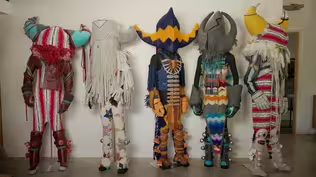
Andrea Zittel uses systems as the focal point for her art. Interested in the relationship between freedom and security in the organization of daily life and the systems we create to navigate and structure our experiences, Zittel’s sculptures and installations transform everything necessary for life—such as eating, sleeping, bathing, and socializing—into artful experiments in living. In her New York home (which is also a work of art) “A-Z Administrative Services,” Zittel organized her bathroom under the following headings: Corrections, Tools and Implements, Subtractions, and Additions. These categories and organizational structures become the defining elements of both her life and her work. Her “A-Z Travel Trailer Units” offer customized mobile units for cross-country travel that were actually used by friends and family in cross-country journeys. With “A-Z Six Month Seasonal Uniforms,” Zittel created a unique set of constraints such as the use of squares or triangles of fabric, or a single thread or string (accomplished through crochet) to create a collection of clothes that she will wear for the duration of the season.

Seeking to attain a sense of freedom through structure, Zittel is more interested in revealing the human need for order than in prescribing a single unifying design principle or style. “People say my work is all about control, but it’s not really,” she remarks. “I am always looking for the gray area between freedom—which can sometimes feel too open-ended and vast—and security—which may easily turn into confinement.” Zittel says, “Things that you think are liberating can actually be extremely confining or restrictive, and things that you think are controlling can actually give you a greater sense of security and liberation in the end.” Embodying both of these sensibilities while creating both living environments and the organizational systems to accompany them, Zittel’s work creates complete environments for modern living.

Introduce students to Zittels work using the links listed above. Discuss how Zittel's work addresses the two poles of freedom and constraint. Ask students to consider the ways that rules can sometimes offer inspiration and how the freedom of infinite possibilities can often be creatively stifling. Cite specific examples such as homework assignments, chores, and time limitations. Generate a list of examples of when they have experienced freedom to constrictive and rules or regulations to be liberating. Ask students to select one theme, object, or subject and write about it in as many ways as possible by incorporating a new genre, writing style, voice, tone, or form in each new version. After sharing their versions, ask students to discuss how the limitations of a single theme, object, or subject affected their writing.
the next activity for this lesson

Systems & Creativity
This activity explores the idea of systems and asks students to consider the systems that define their creative working process whether in writing or visual art.

Copyright Art21, Inc. 2001-2006. All Right Rreserved. terms of use site map help credits go to top