 |
America’s First Road Trip
A Word from Ken Burns
Broadcast Schedule
Filmmaker Bios
Production Credits
Horatio's Drive at ShopPBS
|
 |
I love to drive. I love to drive. I can think of only a few pleasures in life that are more satisfying than getting in a car and starting out on a road trip. Especially if it's new territory. I love realizing -- and it is a constant and sustaining realization -- that I am on a road I've never been on before, that what I am seeing unfolding before me is brand-new, and it is only a short leap in my mind before I start thinking about who were the first Europeans to see this exact view and what they thought, and then it is an even shorter leap and I am trying to imagine what this looked like to Native Americans: a pristine, unspoiled Nature ready to silently accept whatever those contradictory and ambiguous humans would do to it over succeeding ages. In those moments, it seems as if it could be possible to comprehend the entire United States, to know it -- this beautiful, fragile land -- like one knows a familiar and beloved poem; that if one just kept on the road, kept going down new highways, it would be possible to not only express in words but to actually experience, to apprehend in scope, as perhaps a single blood cell does the whole body, this country I love so much.
Such are the dreams of the road, and while I am perfectly
content to do all of this alone -- and have, in good times
and bad -- there is something about sharing the journey that
magnifies and intensifies all of those thoughts and vistas.
An unforgettable trip along the Skyline Drive in the Blue
Ridge Mountains with my usually distracted father when I
was five (and its equally memorable complement forty-two
years later with my then fourteen-year-old youngest daughter)
comes to mind, as does the slightly sad image of my family,
including my desperately sick mother, packed into a huge
rented station wagon, groaning under the weight of everything
we could not bear to entrust to movers, moving our worries
and hopes from Newark, Delaware to Ann Arbor, Michigan when
I was nearly ten. I recall a trip to an utterly exotic Florida
complete with a dramatic tire blow-out and exquisite pauses
to chase armadillos through the "jungle," and an all-nighter
with other hippies to an anti-war march in Washington, D.
C. when I almost choked to death on a lemon drop on the Ohio
Turnpike and won fifteen dollars at bingo to the chagrin
of the regular patrons at the Volunteer Fire Department of
Pikesville, Maryland.
I have an almost perfect memory of every route and approach
we have taken over the last thirteen straight summers as
my daughters and I headed to the Telluride Film Festival
in the majestic and breathtaking San Juan Mountains of Colorado.
I can remember as if it were yesterday a trip we took back
from Massachusetts at age nine when I looked out the window
and counted under my breath to eight thousand or something
equally ridiculous, and the time after my mother died when
we survivors drove to the biological station at Mountain
Lake, Virginia, where my brother and I would be parked with
relatives, and my father made up, on the spot, what seemed
like dozens of hilarious, nonsensical verses to a blues tune
he titled "Twenty Miles From Athens" (Ohio). And then there
was a more recent trip through a very long night from Michigan
with my father's ashes and memorabilia from his disappointing,
truncated life slowing me down, my aloneness mitigated by
friends and loved ones who gently urged me onward with perfectly
timed cell-phone calls.
But it is the trips I have taken with my dear friend and
colleague Dayton Duncan that have meant the most to me over
the years and have brought me the most sustained joy and
happy memories that I can summon from the road. I first "met" Dayton
fifteen years ago on a road trip I had yet to take. We had
been then just casual acquaintances when he shared with me
his remarkable first book, Out
West, in which he retraced and retold Lewis and Clark's stunning and heroic journey in humorous and unusually moving ways. I loved the book. It was eloquent and generous and spoke to a part in me, as yet unarticulated, that yearned for more experiences of the road. In the highest compliment I can give, no one loves his country more than Dayton and it is a love tested along hundreds of thousands of miles of roads in the blood system of America. Reading his book and discovering that we shared many other common interests and enthusiasms propelled us into a friendship I treasure as much as any other and launched a completely satisfying professional association that has produced over the last dozen years several films and companion books, including The
West, Mark Twain, and of course Lewis and Clark: The Journey
of the Corps of Discovery. Discovery, indeed.
That project took us again and again to nearly every spot along the Lewis and
Clark trail as we strained to see and record what the earlier explorers had experienced.
Traveling along steep mountain roads or the dusty dirt tracks of the prairie
in our trusty Suburban, our friendship deepened. It was clear that we both loved
maps and navigating and doing the driving, and while I cannot speak for Dayton,
I know now that he is one of the few people I trust unhesitatingly behind the
wheel. We both loved to get up early, to "steal a march" on some remote location, or shot, or sunset, and sometime, I'm not sure exactly when, during that earlier production we began to play a game with each other. Mindful of the rather limited cuisine at the local cafes of the dozens of small towns we passed through, one of us, just before lunch or supper, would ask the other, "What are you planning to eat once we get into (say) Geraldine, Montana?" (At that point, the town would be just visible off in the distance maybe ten miles away.) With a straight face, the other would launch into the most elaborate description of the most amazing multi-course gourmet meal this side of Paris, France, at which point, the other would say simply, "So, what do you want on your cheeseburger?" Then,
we would silently drive the rest of the way into Geraldine, Montana (or such
like town) and have . . . a cheeseburger.
As I took more road trips with Dayton -- for the Lewis and Clark film and other
projects -- an old Spanish proverb that the late great animation genius Chuck
Jones had once told me came to mind again and again: "It's not the inn at the end of the day," he said, "but the road." Like
the country Dayton and I both love, dedicated to a pursuit of happiness, always in the process of becoming, the open road, leading us onward, was the perfect metaphor for our own personal and collective search. Somewhere out there, we would find something out about our country and ourselves, and like Lewis and Clark, it would always be for us a journey of discovery.
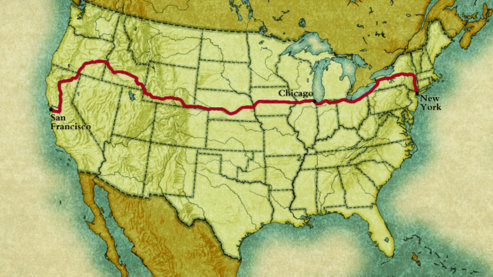
And somewhere along that road, in the American West, in the mid-1990's (though Dayton insists he told me years before in 1990), I began to realize that he was trying to interest me in making a film on the story of Horatio Nelson Jackson. It was the little known story of the first cross-country automobile trip, accomplished with exquisite historical symmetry, he regaled me, exactly one hundred years after Meriwether Lewis got his marching orders from Thomas Jefferson to find out what the fifteen million dollars he'd spent for the Louisiana Territory had bought.
Jackson's trip had been made "on a dare, a fifty dollar bet," Dayton said, "in a men's club in San Francisco, when in front of Jackson, some gentlemen had pooh-poohed the future of the horseless carriage." Jackson
had had almost no automotive experience, Dayton continued, and yet he was going
to try to do what many automotive experts had tried and failed miserably to do:
to drive all the way to New York City in less than ninety days. The story, he
said, had everything. It was about freedom, good old American perseverance, the
open road; there was humor and the overcoming of obstacles, and because others
joined the quest, it was like a race, too, he went on, and it showed the country,
all of it, on the cusp of extraordinary change.
At first, I have to admit that I wasn't that impressed. I didn't yet see a film
in it, and besides I was distracted by several other projects in production that
were demanding all of my attention. But over the years, Dayton continued to champion
doing a film and book on what he now called "Horatio's Drive," and he began to
dig even more: tracing Jackson's exact route on maps; contacting local historical
societies and newspapers in the little Western towns along the way, where Jackson's
trip had stirred up so much excitement and curiosity; and following the trail
in Vermont, where Jackson had lived, turning up there some tantalizing newspaper
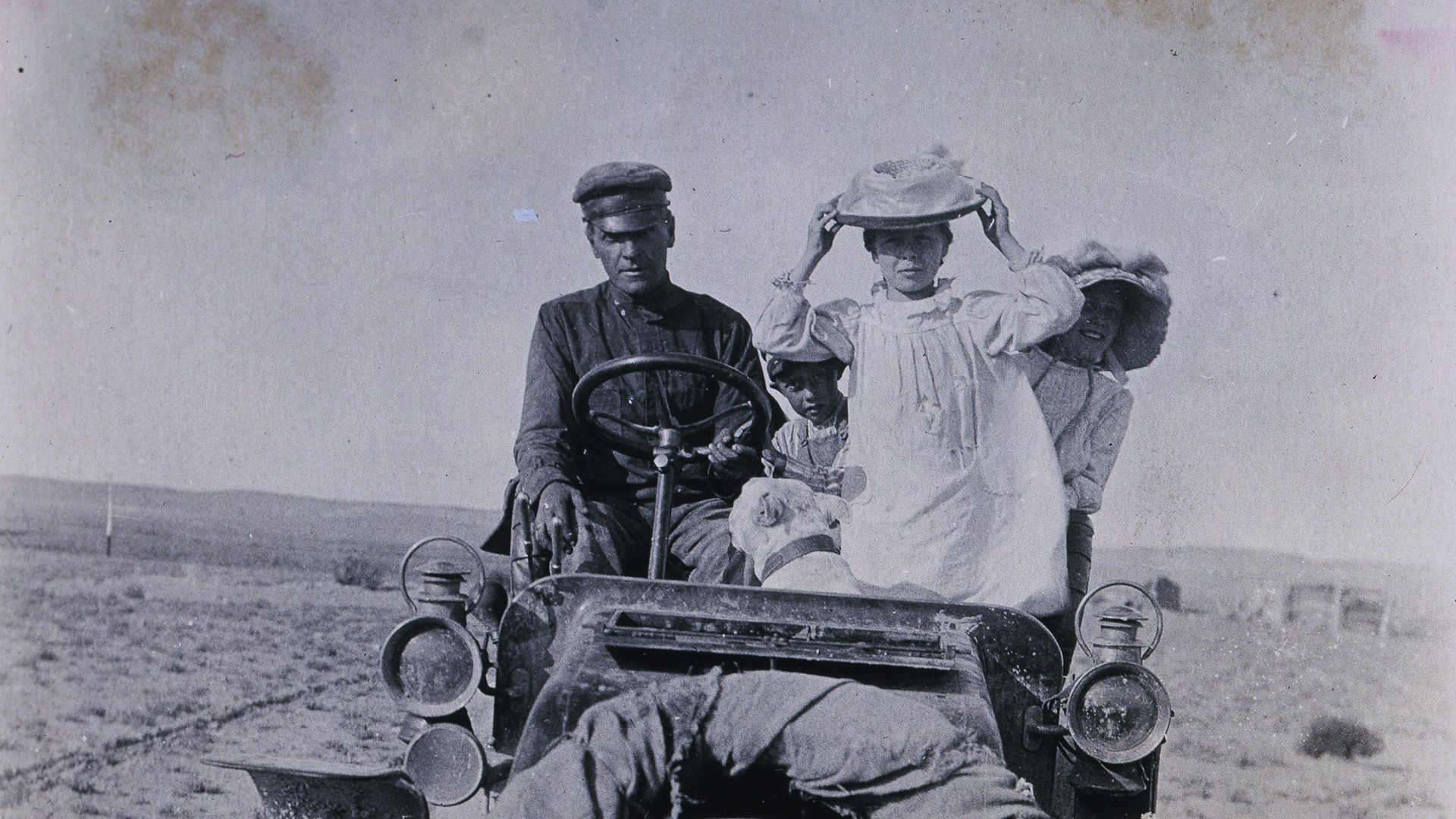
clippings and a treasure trove of nearly 100 snapshots Jackson had taken along
the way. He visited the Smithsonian in Washington, where the car is still on
display, and found a scrapbook filled with newspaper accounts of the journey.
At each step, I was impressed with Dayton's dogged determination (not too dissimilar
from Jackson's own marvelous optimism), but still not quite sure he had amassed
the critical mass to turn this fascinating story into a film and book. Dayton
was adamant, however, and so I relented (I trusted him implicitly) and we all
started to move forward on the project.
Although we would like to believe that our films offer a fresh and dramatic perspective on the subjects we take on, they rarely break new scholarly ground, offer up new facts unknown to specialists in the field or do ground-breaking original research. We are content, under the watchful eyes of our beloved historical advisors, to arrange and re-arrange existing materials in an artful and dramatic fashion that we hope a national public television audience and general readers will find compelling. But because of Dayton Duncan and his wife Dianne's stubborn perseverance, Horatio's Drive will feature new research and add significantly to future understanding of the trip.
Checking obituaries, death certificates and funeral records for possible descendants,
and making literally hundreds of "cold calls," Dianne was able to track down
two granddaughters of Jackson's, who not only generously agreed to share memories
of their grandfather with us on film, but produced heretofore unpublished letters
and telegrams that Jackson had sent back from nearly every stop along the way,
detailing nearly every moment of his arduous, hilarious, historic, now clearly
impressive road trip. The letters helped to fill in huge gaps in the story and
to settle discrepancies that had cropped up in conflicting newspaper accounts.
But most of all, they made Horatio Nelson Jackson come alive as never before.
He was a real person now, and now we had a real film. (A little later, Tom Hanks
would agree to read, off-camera, Horatio's words for our film, and together with
a superb supporting cast reading a chorus of other first-person accounts, we
felt at times as if we were actually there with Jackson.)
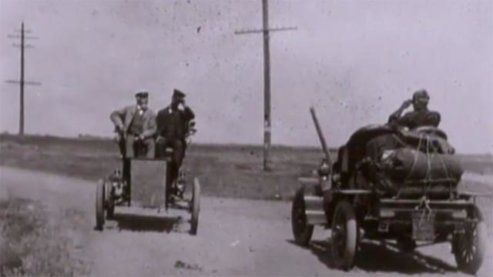
Armed with Dayton's script, we set out to retrace Horatio's drive just as we sought to evoke, with live modern cinematography, Lewis and Clark's progress on that earlier project. We ended up covering more than 10,000 miles -- nearly twice as many miles as Jackson --because we had to search back and forth for those dirt tracks and old trails that resembled the nearly impossible conditions Jackson faced at every bend in the road.
During our expeditions, we went up rocky mountain trails, forded any number of streams and creeks, drove through orchards and alkali flats, went careening down red rock canyons, and bumped along railroad tracks -- just like Horatio Nelson Jackson. We chased the massive terrifying storms that still patrol the prairies, just as we are sure Jackson tried to avoid or outrun them. We stood in awe in front of an old Pony Express way station that Jackson passed a century earlier, and one late afternoon in southwestern Wyoming we filmed along a dirt track that was at once a part of the Oregon, California, Pony Express and Mormon Trails.
Not far from that spot, we, like Jackson, got lost. We didn't go without food for thirty-six hours, as Jackson did, but after eating too big a meal at Cruel Jack's, a truck stop near Rock Springs, a few of us might have wanted to. Once, coming into Chicago, where three major interstates converge, we saw more cars in an hour's time than the number of cars that existed in America in 1903, the year Horatio made his impulsive trip.
We outfitted our wonderful cinematographer Allen Moore with a canvas harness
and strapped him to the hood of our Chevy Suburban so that our filming would
not just have the painterly style of our previous work, but the visceral, sometimes
gut-wrenching perspective that Horatio and his companions surely had. (Later,
we would "distress" this footage to give it just the right look we wanted, to give our viewers a sense of what it must have been like on the road back then.) In the Cascade Mountains of northern California, two Indians watched in amazement as we charged a mountain stream, Allen mounted on the front, just a few feet from a perfectly good bridge. Near Farson, Wyoming, a ranch hand watched Allen put his bra-like harness on for a drive near the historic South Pass, and then turned to his cowboy friend and said, "I'll
be getting free drinks at the bar for a month for telling this story."
Along the route, we stopped at country museums, modest libraries and proud historical societies in many of the small towns Jackson had passed through and found even more great photos: some of Horatio we never knew existed, and some of town life at the turn of the twentieth century that helped us immeasurably in conjuring up that earlier era and the excitement townspeople obviously felt at his arrival. Newspaper morgues in those same small towns added many colorful local accounts of the trip we weren't aware of.
Through it all, we could not help but drink up the powerful tonic, the powerful medicine, which moving across this extraordinary country always is. It sustained and inspired and overwhelmed us. We felt often as if we were moving through time as well as through the landscape, and came to understand, as no armchair surveyor ever can, the immense size and almost stupefying distance that is the American West, both today and yesterday, when Horatio Nelson Jackson made his bold, and now to us almost unbelievable, run.
In an interview for our film on Mark Twain, the novelist Russell Banks said that
despite our common "threads of history" with Europe, we Americans have had to write our own epics, our own Iliads and Odysseys, that illuminate the differences between us and our European forebears. And the elements, he said, "that make us different are essentially two: race and space." As
filmmakers who have been interested in learning ever more about the mechanics
of our complicated and often dysfunctional Republic, we have returned again and
again to the question of race in many of our films, trying to come to terms with
the monumental hypocrisy born at our inception when our founders attempted to
reconcile chattel slavery in a new nation that had just proclaimed the universal
rights of all men.
But we have also been equally drawn over the years to the power and magnetism of the American landscape, this huge space of ours, and its central role in the formation of a distinct American sensibility and character. It, too, has figured in some way in nearly every film we have made. Sometimes, as in The
West, Lewis and Clark and Mark Twain, Banks' twin themes intertwine and co-mingle in almost equal and obvious measure. (In other films, these themes are somewhat distinct, though the fact that race may have been dominant in The
Civil War, Baseball and Jazz did not mean that the question of space wasn't always close by, continually influencing the American narrative we sought to explore.)
In Horatio's Drive, we have tried to paint a seemingly simpler story, one of history from the bottom up, not top down, but one that gets its energy from the sheer physicality of these United States and the extraordinary human beings who have inhabited that space. The virtues and qualities and strengths that we hope radiate out from this story are seemingly simpler, too, though, as my friend Dayton Duncan knows in his gut, the medicinal force of a great road trip, like the horseless carriage or this still wild American landscape itself, cannot be pooh-poohed.
Maybe, William Least Heat-Moon, author of the magnificent Blue Highways and a commentator in this film, put it best:
There's nothing that we can do that is more American than getting in a car and striking out across country. I think as a nation we can think of few things that draws us more strongly than a piece of roadway heading we know not where. This is the way we grow up, this is the way we enter our history: get in a car and find the country.
And ourselves.
Ken Burns
Walpole, New Hampshire
Excerpted from Horatio's Drive: America's First Road Trip by Dayton Duncan and Ken Burns, a Borzoi Book published by Alfred A. Knopf. Copyright © 2003 by The American Lives II Film Project, LLC. All rights reserved.
|
 |