
|
|
 |
 |
 |
Go back to 1801 - 1804 |
 |
January
The Mandans perform their sacred buffalo calling ceremony
and a few days later, a herd shows up. The Indians and explorers hunt buffalo together. Several expedition members get frostbite, as does an Indian boy whose toes Lewis has to amputate, without anesthesia or a surgical saw.
|

Sacagawea
|
February 11
Sacagawea gives birth to a baby boy, Jean Baptiste. Lewis assists
in speeding the delivery by giving her a potion made by crushing the rings of a rattlesnakes rattle into powder.
April 7
Lewis and Clark dispatch the big keelboat and roughly a dozen
men back downriver, along with maps, reports, Indian artifacts, and boxes of scientific specimens for Jefferson (Indian corn, animal skins and skeletons, mineral samples, and five live animals including the prairie dog).
|

Prarie Dogs
|
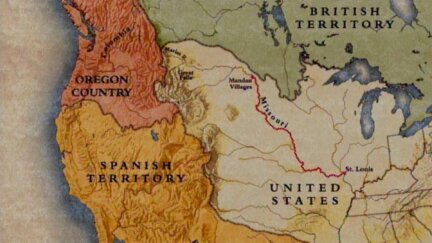
The same day, the permanent party heads west, traveling in the two pirogues and six smaller dugout canoes. The expedition totals 33 now, including Charbonneau, Sacagawea, and her baby boy. We were now about to penetrate a country at least two thousand miles in width, on which the foot of civilized man had never trodden, Lewis wrote, adding that I could but esteem this moment of my departure as among the most happy of my life.
April 29
Proceeding into what is now Montana farther west than
any white men had ever gone on the Missouri they are astounded by the wildlife: herds of buffalo numbering up to 10,000, and other game so plenty and tame, John Ordway writes, that some of the party clubbed them out of their way. (The men are eating 9 pounds of buffalo meat a day.)
|

Corps Member Treed by Grizzly
|
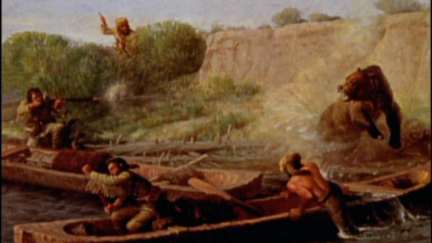
This day, past the mouth of the Yellowstone River, Lewis and another hunter kill an enormous bear a grizzly, never before described for science. At first, Lewis believes that Indian accounts of the bears ferocity were exaggerated, but in the days to come, as grizzly after grizzly chases the men across the Plains and prove nearly impossible to kill, he writes that the curiosity of our party is pretty well satisfied with respect to this animal.
May 20
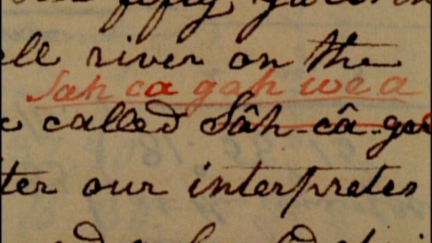
The captains name a river Sah-ca-gah-we-a or bird womans
River, after our interpreter the Snake [Shoshone] woman. As they map new territory, the captains eventually give the names of every expedition member to some landmark.
|

William Clark
|
May 29
Clark comes across a stream he considers particularly clear and
pretty, and names it the Judith River, in honor of a young girl back in Virginia he hopes will one day marry him.
May 31
The Corps of Discovery enters what are now called the White
Cliffs of the Missouri remarkable sandstone formations that the men compare to the ruins of an ancient city. (This section of the river is now protected by Congress and remains the most unspoiled section of the entire Lewis and Clark route.) As we passed on, Lewis writes, it seemed as if those scenes of visionary enchantment would never have an end.
June 2
The expedition comes to a stop at a fork in the river. All the
men believe the northern fork is the true Missouri; Lewis and Clark think its the south fork. After several days of scouting, the captains are still convinced theyre right and name the other fork the Marias (after a cousin of Lewis in Virginia). The men still think otherwise but tell the captains they were ready to follow us any where we thought proper to direct, according to Lewis. Based on information gleaned from the Hidatsas, they know that if they find a big waterfall, theyre on the right track.
|

Falls of the Missouri
|
June 13
Scouting ahead of the rest of the expedition, Lewis comes across
the grandest sight I ever beheld the Great Falls of the Missouri, proof the captains had been correct. But then he discovers four more waterfalls immediately upriver. They will have to portage eighteen and a half miles to get around them all.
When the rest of the expedition arrives, they make crude carts from cottonwoods, bury some of their cargo, and begin hauling the canoes and remaining supplies over the broken terrain. Broiling heat, hail storms, prickly pear cactus, and other obstacles mark the difficult portage, which instead of the half day the captains had planned the previous winter, takes nearly a month.
July 4
The party celebrates its second Independence Day on the trail (as
well as the completion of the portage) by dancing late into the night and drinking the last of their supply of whiskey.
Late July
The expedition reaches the Three Forks of the Missouri, which
the captains name the Gallatin (after the Secretary of the Treasury, Albert Gallatin), the Madison (after Secretary of State James Madison), and the Jefferson, in honor of that illustrious personage Thomas Jefferson, the author of our enterprise.
|

Hidatsa woman
|
Sacagawea begins recognizing familiar landmarks (up until now, the route has been as unknown to her as to the explorers) and points out the place where the Hidatsas had captured her five years earlier.
The expedition heads southwest, up the Jefferson. The river is shallow and swift and difficult for the men to drag their canoes upstream.
August 8
Sacagawea recognizes another landmark Beaverhead Rock,
north of present-day Dillon, Montana and says they are nearing the rivers headwaters and home of her people, the Shoshones. Desperate to find the Indians and their horses, Lewis decides to scout ahead with three men.
August 11
Lewis comes across a single, mounted Indian the first the
expedition had seen since leaving Fort Mandan and tries to signal his friendly intentions, but the Indian rides off.
August 12
The shipment sent from Fort Mandan finally arrives in the East.
Jefferson will plant the Indian corn in his Monticello garden, hang elk antlers in his foyer, and send the surviving animals a magpie and the prairie dog to a natural science museum located in Philadelphias Independence Hall. Reading Lewiss confident letter, he would imagine the expedition having already reached the Pacific.
|

Source of the Missouri
|
That same day, Lewis ascends the final ridge toward the Continental Divide and the most distant fountain of the waters of the Mighty Missouri, in search of which we have spent so many toilsome days and restless nights and joyously drinks from an ice-cold spring. Climbing the rest of the ridge Lemhi Pass, on the present-day border between Montana and Idaho he expects to see from the summit a vast plain to the west, with a large river flowing to the Pacific: the Northwest Passage that had been the goal of explorers since the time of Columbus. Instead, all he sees are more mountains.
August 17
Having discovered a village of Shoshones, Lewis tries to
negotiate for the horses he now knows are all-important to cross the daunting mountains. On this day, Clark and the rest of the expedition arrive and Sacagawea is brought in to help translate. Remarkably, the Shoshone chief, Cameahwait, turns out to be her brother. The captains name the spot Camp Fortunate.
August 18
Lewiss 31s birthday. Though he has just become the first
American citizen to reach the Continental Divide and has concluded successful negotiations for horses, in his journal entry he turns introspective, writing that I had as yet done but little, very little indeed. He vows in future, to live for mankind, as I have heretofore lived for myself.
|

Shoshone Robe
|
August 31
With 29 horses, one mule, and a Shoshone guide called Old
Toby, the expedition sets off overland. They head north, over a mountain pass and into the valley of a beautiful river, now called the Bitterroot.
September 9
They camp south of present-day Missoula, Montana, at a spot the
captains call Travelers Rest, preparing for the mountain crossing. Indians tell them that by following the Missouri to its source, they missed a shortcut from the Great Falls which could have brought them here in 4 days. Instead, it has taken them 53.
September 11
The Corps of Discovery ascends into the Bitterroot Mountains,
which Sergeant Patrick Gass calls the most terrible mountains I ever beheld. Old Toby loses the trail in the steep and heavily wooded mountains. They run short of provisions and butcher a horse for food; snows begin to fall; worst of all, John Ordway writes on September 18th, the mountains continue as far as our eyes could extend. They extend much further than we expected. Clark names a stream Hungry Creek to describe their condition.
11 days later, on the brink of starvation, the entire expedition staggers out of the Bitterroots near modern-day Weippe, Idaho.
|

Nez Perce Man
|
Late September
After debating what to do about the strangers who have suddenly arrived in their homeland, the Nez Percé (on the advice of an old woman named Watkuweis) decide to befriend them. The men get sick from gorging themselves on salmon and camas roots. A chief named Twisted Hair shows them how to use fire to hollow out pine trees and make new canoes.
October 7
Near what is now Orofino, Idaho, the expedition pushes its five
new canoes into the Clearwater River, and for the first time since leaving St. Louis has a rivers current at its back.
|

Columbia River
|
October 16
Having raced down the Clearwater, then the Snake rivers, they
reach the Columbia. The river teems with salmon Clark estimates 10,000 pounds of salmon drying in one village but the men want meat to eat, so they buy dogs from the Indians.
October 18
Clark sees Mount Hood in the distance. Seen and named by a
British sea captain in 1792, it is a fixed point on the expeditions map, proof they are at last approaching the ocean. Soon they pass through the raging falls of the Columbia and into the Gorge, emerging from the arid semi-deserts of eastern Washington and Oregon into the dense rainforests of the Pacific Northwest.
November 7
Thinking he sees the end of land in the distance, Clark writes his
most famous journal entry: Ocian in view! O! the joy. [His spelling.] But theyre actually only at the eastern end of Grays Bay, still 20 miles from sea. Fierce Pacific storms, rolling waters, and high winds pin them down for nearly three weeks, the most disagreeable time I have experienced, according to Clark.
Later, Clark estimates they have traveled 4,162 miles from the mouth of the Missouri to the Pacific. His estimate, based on dead reckoning, will turn out to be within 40 miles of the actual distance.
November 24
To make the crucial decision of where to spend the winter, the
captains decide to put the matter to a vote. Significantly, in addition to the others, Clarks slave, York, is allowed to vote nearly 60 years before slaves in the U. S. would be emancipated and enfranchised. Sacagawea, the Indian woman, votes too more than a century before either women or Indians are granted the full rights of citizenship.
The majority decides to cross to the south side of the Columbia, near modern-day Astoria, Oregon, to build winter quarters.
|

Fort Clatsop
|
December 25
An entire continent between them and home, the expedition
celebrates Christmas in its new quarters, Fort Clatsop, named for a neighboring Indian tribe. The captains hand out handkerchiefs and the last of the expeditions tobacco supply as presents.
Continue on to 1806 - 1838
|
|