

Now Streaming
Chart the last five years of the women’s movement and its re-energized, intersectional fight for equality. Activists, journalists, entertainers, athletes, and politicians report from the frontlines of the feminist tidal wave.
A MAKERS film by Verizon Media and McGee Media. Proudly supported by P&G.
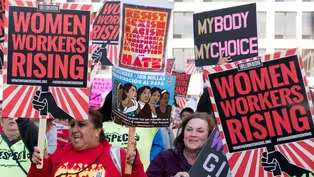
Not Done: Women Remaking America
Video has Closed Captions
Special | 54m 37s | Chart the last 5 years of the women's movement and its intersectional fight for equality. (54m 37s)
Providing Support for PBS.org
Learn Moreabout PBS online sponsorshipProviding Support for PBS.org
Learn Moreabout PBS online sponsorshipHow to Watch Not Done: Women Remaking America
Not Done: Women Remaking America is available to stream on pbs.org and the free PBS App, available on iPhone, Apple TV, Android TV, Android smartphones, Amazon Fire TV, Amazon Fire Tablet, Roku, Samsung Smart TV, LG TV, and Vizio.
Buy Now
About "Not Done: Women Remaking America"
MAKERS made television history in 2013 with its three-part PBS documentary which told the story of the modern American women’s movement for the first time. But a lot has happened since then. From the defeat of the first female presidential nominee to the historic inclusion of a woman of color on a major-party ticket, from the Women’s March to #MeToo and #TimesUp, from Black Lives Matter to the fight for trans lives, a new chapter in this storied movement is unfolding before our eyes.
There has been tremendous progress, but we are so clearly not done. Envisioned as an hour-long capstone to the three-part original series, "Not Done: Women Remaking America" chronicles the seismic eruption of women's organizing from the 2016 election through today, and the intersectional fight for equality that has now gone mainstream. Like the movement it documents, this story is told collectively: through the firsthand experiences and narratives of frontline activists, writers, celebrities, artists, and politicians who are remaking culture, policy, and most radically, our notions about gender. Premiering against the backdrop of an unprecedented pandemic and widespread social upheaval, "Not Done" shines a light on the next generation of feminists who are unafraid to take on complex problems and are leading the way to true equality.
A few highlights include: the behind-the-scenes story of the intersectional organizing that birthed the 2017 Women’s March, told by co-chair Linda Sarsour; New York Times reporters Jodi Kantor and Megan Twohey giving the play-by-play of how they helped bring down Harvey Weinstein; America Ferrera, Shonda Rhimes, Natalie Portman, Joey Soloway, Tina Tchen, and Mónica Ramírez sharing the never-before-told inside story behind Time’s Up; Black Lives Matter co-founders Alicia Garza and Patrisse Cullors on the birth of the first social media movement and how it paved the way for a convergence of feminism and racial justice.
We are living in a vastly different world than we were in 2013. While we can’t deny how strong the forces of sexism and racism remain, that awareness has galvanized a new generation of politically active, truth-speaking, change-making women who have already changed our norms and will continue to fight – intersectionally – to bring us ever closer to equality.
Not Done: Women Remaking America
Get a closer look at the film with more from MAKERS.
Women protest sexual harassment in the workplace.
1/20
Photo Credit: Joshua Lott/ACLU

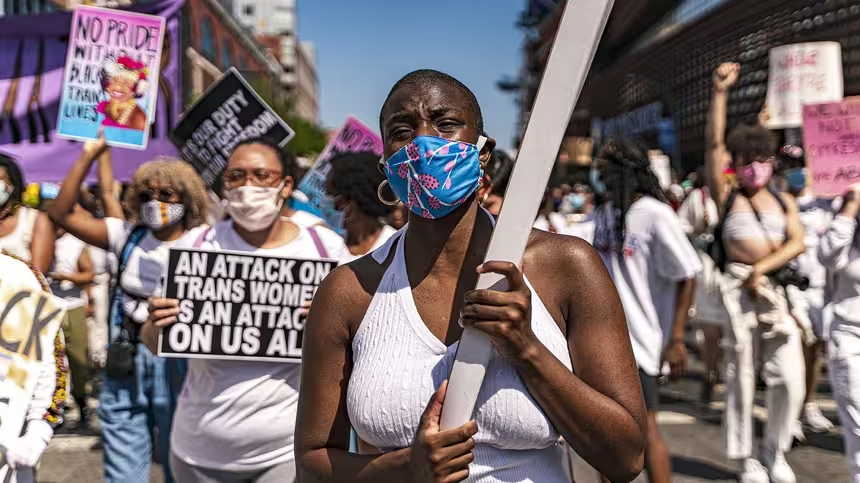
Woman marching in a Black Trans Lives Matter protest.
2/20
Photo Credit: Josh Pacheco

Mónica Ramírez, founder and president, Justice for Migrant Women, speaks at a meeting for TIME’S UP.
3/20
Photo Credit: Devan King/TIME'S UP Foundation

Ingrid Vaca, an organizer with the National Domestic Workers Alliance, speaks at a rally to end workplace harassment.
4/20
Photo Credit: Devan King/TIME’S UP Foundation

Attendants of the historic 2017 Women’s March create a sea of pink hats in Washington, D.C.
5/20
Photo Credit: VOA

Actress, Director, and TIME’S UP Co-founder Natalie Portman speaks at a meeting organized by the group.
6/20
Photo Credit: Devan King/TIME’S UP Foundation

Political Strategist and Co-founder of Black Lives Matter, Alicia Garza, with fellow activists.
7/20
Photo Credit: Kristin Little

Nina Shaw, entertainment lawyer and a co-founder of TIME’S UP, speaks at a meeting organized by the group.
8/20
Photo Credit: Devan King/TIME’S UP Foundation

Members of the National Domestic Workers Alliance rally in front of the U.S. Capitol Building.
9/20
Photo Credit: The National Domestic Workers Alliance

Participants at a meeting for TIME’S UP.
10/20
Photo Credit: TIME’S UP NOW

Participants at a meeting for TIME’S UP.
11/20
Photo Credit: TIME’S UP NOW

One of the many “consciousness raising” groups organized by women, circa 1970.
12/20
Photo Credit: Bettye Lane

Women embrace during a rally in support of Black Trans Lives.
13/20
Photo Credit: Cole Witter

Marchers at a Black Trans Lives Matter protest in Brooklyn.
14/20
Photo Credit: Cole Witter

Protesters attend a rally in Brooklyn in support of Black Trans Lives.
15/20
Photo Credit: Cole Witter

A protester lies a bouquet of flowers at the site of a vigil for slain activist Oluwatoyin “Toyin” Salau.
16/20
Photo Credit: Josh Pacheco

Women marching in Black Trans Lives Matter protest.
17/20
Photo Credit: Josh Pacheco

Mónica Ramírez, the founder and president of Justice for Migrant Women holds up a letter that women farmworkers published in solidarity with Hollywood actresses as the Me Too movement exploded.
18/20
Courtesy of Mónica Ramírez

A "sister" Women’s March in Antarctica in 2017.
19/20
Photo Credit: Linda Zunas

Advocate for women’s suffrage Nannie Helen Burroughs (left, holding banner), with other women.
20/20
Photo Credit: Library of Congress













Support for PBS provided by:
A MAKERS film by Verizon Media and McGee Media. Proudly supported by P&G.