|
|  |
 |
 |
 |
 |
French
Youth Protest Labor Law |
Posted:
03.27.06
|
 |
 |
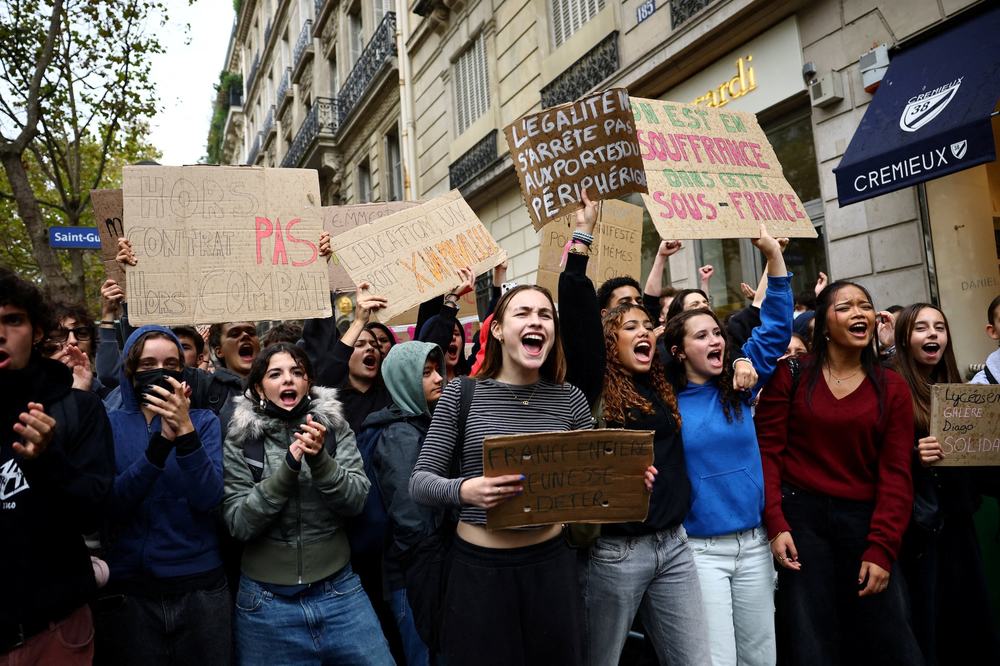
A new French law intended to fix the high youth unemployment
rate by making it easier to fire young people has sparked violent
protests.
Printer-friendly versions: PDF
|
 |
 |
 |
 |

Under the law, employers can fire any worker under age 26 without
reason during a two-year trial period of employment.
If companies are able to fire young people more easily than older
workers, the lawmakers reasoned, employers would be more likely
to hire them.
But the measure has angered French university students and trade
unions, who have held weeks of protests and demonstrations - some
of them violent.
The French government is refusing to back down, however, and
now faces a nation-wide strike that could paralyze the city on
Tuesday.
"We want to block access to important roads or maybe in
shopping malls," said Juliette Griffond, head of a student
coordination group, according to Bloomberg news.
"The idea is to be visible. The idea is also to alert the
population about the youth movement, to inform them. We want to
have an impact on economic life."
"We hope that after the protests the government
withdraws
the text," said the opposition Socialist Party's spokesman
Julien Dray, Reuters reported. "There is no other solution."
|
 |
 |
 |
 |
 |
 |
Law intended
to help students |
 |
 |
 |
 |
 |

The new law, known by its French acronym CPE, was introduced
by Prime Minister Dominique de Villepin, who is expected to be
a presidential candidate in 2007.
De Villepin says old-fashioned labor laws discourage companies
from hiring new workers. In France, unemployment for all workers
is high - at nearly 10 percent. By comparison, the rate in the
United States is around 5 percent.
Overall, youth unemployment in France is 23 percent. However,
in poor, immigrant communities around Paris, almost half of the
youths are unemployed.
|
 |
 |
 |
Jobs more
secure in France |
 |
 |
 |
 |
 |
The labor situation in France is quite different than in the
United States. French labor laws are designed to protect the worker
and provide job security. The primary feature is the contract
of indeterminate duration - or CDI.
Under the CDI, workers are essentially guaranteed a job for life.
Although there is a probation period, it is only six weeks. After
that, it is very difficult for employers to fire a worker. 
Workers can only be fired if companies prove a "serious"
fault.
If the workers object, they can take the issue to court, where
the law requires the court to rule in the favor of the employee
whenever there is reasonable doubt.
Court cases are lengthy and expensive, lasting an average of
12 months and costing 12-24 months of salary.
Alexis Debat, a consultant working at George Washington University,
said the labor laws are a drag on France's economy.
"The system is very inflexible, and an employer has to think
twice before hiring someone because he knows that this person
will have to remain in his or her job regardless of the economic
situation, regardless of whether the business situation is good
or bad," she told the NewsHour.
"And in many cases, this dilemma is resolved by the employer
making the decision not to create a job."
|
 |
 |
 |
Negative
response to change |
 |
 |
 |
 |
 |
Response to the new CPE
law has been largely negative - 63 percent of the French people
as a whole disapprove of the law, according to a poll published
by the French newspaper Le Monde.
De Villepin has repeatedly refused to withdraw or suspend the
CPE, however, he did agree to meet with representatives of the
trade unions and students to review some of the laws more controversial
elements.
"I
want to respond to the two major concerns of youth on the First
Employment Contract, the period of two years and the conditions
of breaking the contract," de Villepin said. "I want
us to rapidly find a solution through dialogue."
The long probation period is especially controversial because
proof of employment is required to get loans.
"Of course I don't like the new contract," Patrick
Maengando, a 22-year-old job seeker, told Bloomberg news. "Banks
don't lend you money and it's hell to find an apartment when you're
on it, because you can be fired overnight."
Immigrants in the poorer suburbs of France are more open to the
law and suggest the students who join the protest don't understand
the how hard it is for young immigrants to find jobs.
"Students don't know the job market," Ali, an immigrant
job seeker, told Bloomberg news. "I prefer to be hired on
a CPE than to be unemployed."
--
Compiled by Anne Bell for NewsHour Extra
|
 |
 |
 |
 |
 |
 |
|
 |
|