|
Until recent weeks, both Obama and Huckabee trailed by significant
margins behind rivals in both parties. They came into the
first contest of an already hotly contested 2008 nominating
process neck-and-neck with other candidates.
Wins change calculations on both sides
 |
 |
 |
 |
 |
 |
 |
 |
 |
 |

Barack Obama won a major victory over John Edwards and
Hillary Clinton in Iowa. |
 |
 |
Obama scored a victory
over Democratic rivals John Edwards and Hillary Clinton, capturing
38 percent of the vote, followed by Edwards with 30 and Clinton
with 29. Edwards has been visiting Iowa since the 2004 election
he lost as a vice presidential candidate, while Clinton seemed
like the inevitable winner because of early support and fund
raising.
"Barack Obama [is] a relative new face in American politics
if you think about it," political analyst Stuart Rothenberg
said Thursday night on the NewsHour. "Someone who ran
on change and bringing the country together beats someone
named Clinton? That's remarkable."
Huckabee emerged from nowhere to take the lead in the Republican
race, breaking his party's mold by blending his Christian
conservative message with a more liberal economic message.
He beat former Massachusetts Governor Mitt Romney, who outspent
Huckabee in the state by millions of dollars, 34 percent to
25 percent.
"If Obama represents hope -- and I think he did to an
awful lot of people in Iowa this evening -- Mike Huckabee
represents authenticity," syndicated columnist Mark Shields
told the NewsHour. "There is about him just a realness,
a likeability, yes, a sense of humor, self-deprecating, which
is quite appealing, but a true compassionate conservative
is how he came through."
The question now is whether their victories will give them
an "Iowa bounce" in other contested primary states,
where polls show Obama behind Clinton, and Huckabee further
behind Mitt Romney, Senator John McCain and former New York
Mayor Rudy Giuliani.
Importance of Iowa
 |
 |
 |
 |
 |
 |
 |
 |
 |
 |

Iowa caucus-goers have significant influence on the presidential
race. |
 |
 |
The Iowa caucuses are seen
as an important, but not decisive first contest.
Only a small percentage of Iowans took part in the caucus,
but those who did took it very seriously.
"The first test is this small state where these candidates
get vetted by this very active, serious group of people, maybe
only 10 percent, but quality rather than quantity. They take
this very seriously, and they do a great job," presidential
historian Michael Beschloss told the NewsHour.
In 2004, John Kerry beat previous front-runner Howard Dean
in Iowa, a surprise victory that led to his nomination as
the Democratic presidential candidate. However, other candidates
have lost in Iowa and gone on to capture their party's nomination,
such as Ronald Reagan in 1980 and Bill Clinton in 1992.
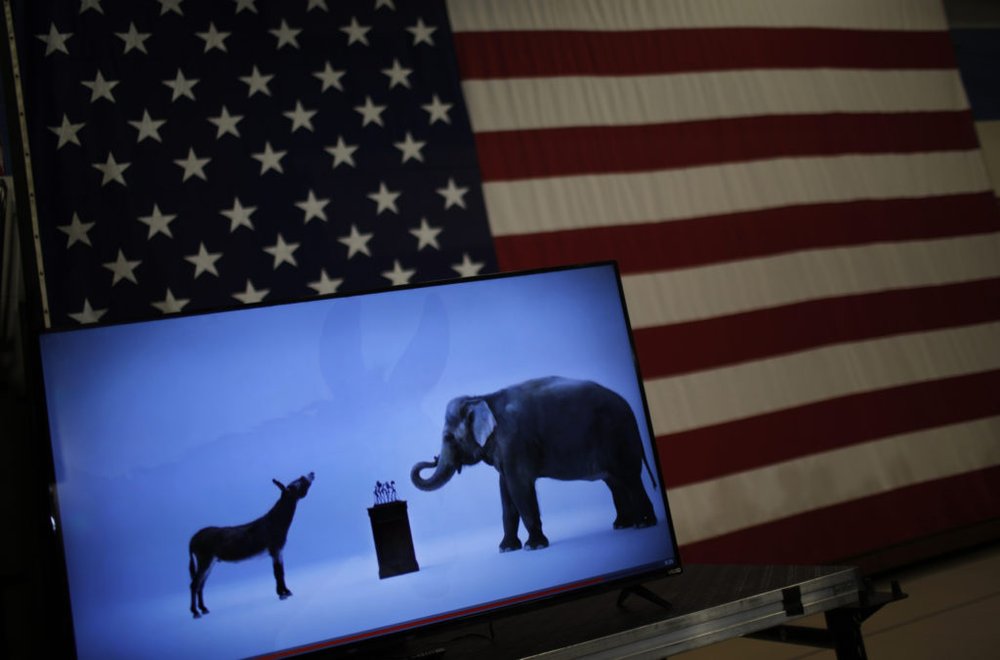
A special election year
The
2008 primary race is special because it is the first time since
1928 that an incumbent president or vice president was not running
for the nomination of their party. It also comes at a time when
the current Republican president and Democratic Congress have
some of the lowest popularity ratings in modern history.
Thursday's Iowa caucuses were marked by an unprecedented
turnout, especially on the Democratic side. According to the
Washington Post, 236,000 people voted in the Democratic caucuses
in Iowa, up from 125,000 in 2004. Obama was able to attract
independents and some Republicans, while the number of Republican
caucus-goers was less than half the Democrats, suggesting
a lack of enthusiasm among core party members.
Moreover, young voters overwhelmingly went for Obama. Sixty
percent of voters under 25 came out for the senator, while
45 percent of voters over 65 supported Clinton, the New York
Times reported. More than half of Democratic voters said they
were first-time caucus-goers and 40 percent of those voters
chose Obama.
On the Republican side, approximately 60 percent of caucus-goers
described themselves as evangelical Christians, and the vast
majority voted for Huckabee.
|