|
|
Life
after 9.11 View from the VP's Office: Dick Cheney, the vice president, calls for caution and patience from Americans. (10/15/01) Military Update: Several days of military strikes weaken Afghanistan's military. (10/12/01) Strikes Against the Taliban: The U.S. strikes military targets in Afghanistan. (10/08/01) A
New Uncertainty: Muslim students in NY worried but hopeful.
(9/26/01) How We See It: Muslim students from Washington State University discuss campus life after September 11. Terrorism Reaction: Students and other readers speak out about the terrorism attacks on New York and the Pentagon. NewsHour Features: Online NewsHour: Limits of Dissent: Should there be limits on dissent during times of war and crisis? (10/16/01) For
Teachers: Special Educational Resources for the Attacks Taking Action: Civic Responsibility case studies of different protest groups allow students to evaluate the effectiveness of consensus-building and nonviolent protest. Outside
Links: |
It's
My Right... War is often about bombs and missiles. War pits people against others they've never met. It's also what nations do to protect their citizens.
Voices of dissent When a country is trying to fight an enemy, it tries to build unity and support for a common cause. This can lead to limits on speech that is critical of U.S. policy. Across America, the issue of free speech versus appropriate speech has been tested repeatedly: In the entertainment industry, the media and on college campuses. Recently, a University of Texas professor wrote an article arguing against the war-- it got him into trouble with the president of the university.
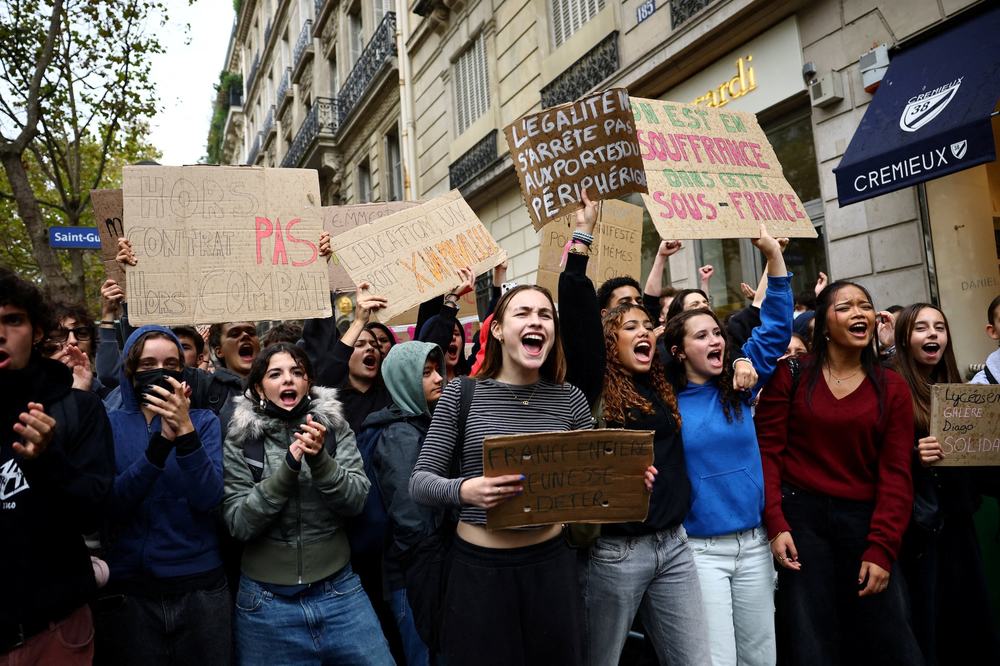
But because free speech is one of the most important American values, there are still many places where people are chanting anti-war slogans and flashing peace signs. In Berkeley, California, people were on the streets in protest, even before the military strikes began. Their demonstrations and rallies calling for a "non-military approach" to capturing terrorist Osama bin Laden was also represented in Capitol Hill.
"I am convinced that military action will not prevent further acts of international terrorism against the United States," said Lee. "However, difficult this vote may be, some of us must urge the use of restraint." Congressman James McDermott from Washington State later echoed Lee's sentiment.
"I'm not so sure that President Bush, members of his administration or the military have thought this action out completely or fully examined America's cause," said McDermott. Taking it to the streets
"I don't think the solution to violence is more violence," 19-year-old Rachel Ettling said to The Washington Post newspaper. "It's a very patriotic thing to be an activist." Cities like Boston and Chicago saw similar peace rallies. In New York City, more than 1,000 antiwar protesters demonstrated less than two miles from Ground Zero, the site of the former World Trade Center buildings. Many of the activists are critical of U.S. foreign policy. However, the antiwar protester is not the only activist on the streets these days. Lots of Americans are out supporting the president's decision to launch military strikes. A matter of opinion "They want peace? They don't want to go to war? I hate that," said 15 year-old Boston resident Patrick Faherty to reporters. "Thousands of people are killed. I'm glad we're at war."
"We just had 5,000 casualties on our soil," said Boston antiwar activist Ofer Levy to reporters. "Slogans like 'Give Peace a Chance' have been replaced with 'No More Victims' at rallies." Around the globe In Berlin, Germany, several thousand students marched against war, but their numbers were much lower than what organizers had projected.
Around 2,000 Muslims and Christians recently marched in Sydney, Australia, to protest the war. Again, their numbers were smaller than what peace organizers had wished. A different kind of war Different than most wars, which are based on "attack and acquire," the U.S. has no plans to take over Afghanistan. The president has said part of this war against terrorism is to protect the United States from future terrorist attacks. On September 11, the president said that "our way of life, our very freedom came under attack in a series of deliberate and deadly terrorist acts."
What do you think? Is demonstrating against the war unpatriotic? How do you balance freedom of speech with support for our armed forces? |
||
PBS Online Privacy Policy | Contact Us | Our Mission | FAQ Copyright © MacNeil-Lehrer Productions All Rights Reserved |