|
|
NewsHour
Extra: Legal punishment or murder: As Timothy McVeigh awaits execution, the U.S. debates the death penalty. (5/16/01) Democracy: Do we take it for granted? (7/04/00) Gay
Boy Scouts: The Supreme Court says the Scouts may exclude gays Grandparents' Rights: The Supreme Court decides-- in some cases-- parents have the final say. (6/06/00)
Multimedia: Complete NewsHour coverage of Law For
Teachers: Constitutional Issues -- Separation of Powers Outside
Links: |
Courting Student Rights
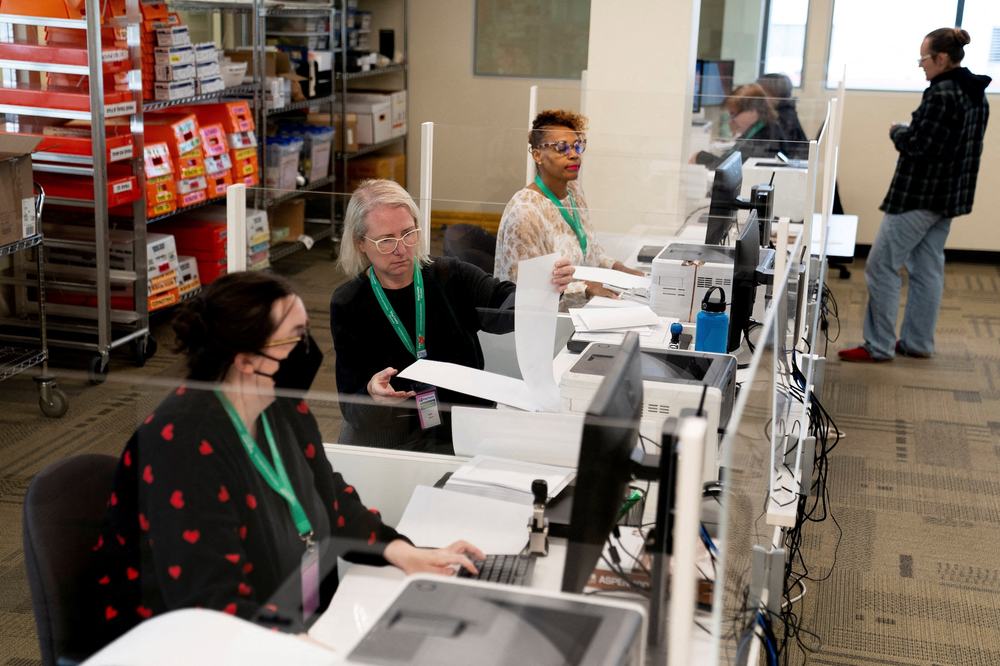
The two cases will have outcomes affecting all students from elementary to high school. Although the cases both deal with privacy rights, they could not be more different. One case aims to keep information about students private for their protection. The other case seeks to invade their privacy in order to protect them. Are
your grades public? Last November, the court heard Owasso vs. Falvo, a case about student privacy and school policy. The case
focuses on a common classroom activity of students grading each other's
papers.
One of the students was humiliated after scoring a failing 47 percent on a quiz, and having the score announced in front of the class. Mrs. Falvo, the humiliated student's mother, believes the practice of peer grading affects her kids' ability to take tests. They sued the school, asking that the public grading end. On the other side, the school says peer grading offers students immediate feedback on daily lessons. It saves teachers time, allowing them to concentrate on more important state exams. The school system pointed out that if there are laws against making grades public, it might not be legal to recognize honor roll students and class valedictorians. Today, the Supreme Court ruled 9-0 that there is nothing illegal about the paper-swapping practice. "Correcting
a classmate's work can be as much a part of the assignment as taking
the test itself," Justice Anthony M. Kennedy wrote for himself
and seven colleagues. Justice Antonin M. Scalia filed a separate opinion.
More on the Owasso vs. Falvo case... Can
your school test you for drugs? Later this year, the court will consider Pottawatomie vs. Earls, another case about student privacy versus school policy. Pottawatomie school district wants to test all students for drugs. Lindsay Earls, a former student choir member, was tested in 1999. Earls and her family sued, saying the drug tests violated her constitutional right against unreasonable searches.
"I felt they were accusing us and convicting us before they had given us a chance," said Lindsay Earls to local newspapers. "It was horrible. Someone would stand outside the bathroom stall and listen." Supporters of Pottawatomie policy argue it's necessary to keep schools drug free. They say the policy helps students understand doing drugs while in school has costs. More on the Pottawatomie vs. Earls case... How does a case get to the Supreme Court?
Although it happens occasionally, it is rare for the Supreme Court to hear a case that has not gone through the lower federal court system. The path the Falvo case took is illustrates of how to get your argument heard in front of the "big nine." In 1999, the Falvo case was heard in a local Tulsa courthouse, where a district judge dismissed it. The judge ruled the quizzes and mini exams the students graded did not constitute an educational record. Unsatisfied with the dismissal, the angry mother appealed her case to the U.S. Circuit court. The U.S. Circuit court is like the middleman in the federal court system. It hears appeals and issues rulings on cases that can not be resolved in the lower district courts. In the Falvo case the Circuit ruled the school violated Falvo's son's right to privacy. That decision stopped the practice of peer grading in Oklahoma and five other states.
The U.S. Court of Appeals is like the vice-president of the federal court system. It hears appeals and issues rulings on cases that the Circuit court could not resolve. Most legal disputes end with their ruling. However, in some cases the parties take the Appeal Court's ruling to the Supreme Court. In the Falvo case, the Court of Appeals overturned the Circuit court ruling. Today both parties are in front of the Supreme Court for the final answer. What do you think...
If the issue is student safety, should schools be allowed to test students for drugs? What do you think?
|
PBS Online Privacy Policy | Contact Us | Our Mission | FAQ Copyright © MacNeil-Lehrer Productions All Rights Reserved |