the Online NewsHour
E-mail This Page   Print This Page  
the Online NewsHour EXTRANews for Students AND Teacher Resources MAIN: ONLINE NEWSHOUR
7 - 12 grade level
SEARCH
ALL OR STUDENT VOICES LESSON PLANS VIDEO GO
Main: NewsHour ExtraU.S.WorldScienceEconomicsHealthArts and MediaStudent VoicesTeacher Center

Watson Wins: Computer Beats Human Trivia Champs

Posted: February 17, 2011
PRINTER FRIENDLY VERSION: PDF
Scientists building computers that can simulate the workings of the human brain scored a major victory when their creation, Watson, beat the greatest "Jeopardy!" winners of all time.
One of the contestants playing against Watson answers his final jeopardy question, with a humorous touch.

Two of the top "Jeopardy!" champions of all time, Ken Jennings, who won 74 consecutive games, and Brad Rutter, who won more than $3 million in prize money, competed against Watson in a three-day challenge testing the contestants' knowledge of history, science, geography, sports and literature.

The final score?

Watson: $77,147
Ken Jennings: $24,000
Brad Rutter: $21,600

A computer that can outplay humans


In 1997, a computer named "Deep Blue" beat chess legend Gary Kasparov at the game.

In 1997 a computer named “Deep Blue” beat world chess champion Garry Kasparov. Skeptics downplayed the win because chess is essentially complex math problems.

So IBM researchers took on the grand challenge of developing a computing system that can master the complex natural human language on "Jeopardy!" which clues include jokes, puns, analogies and slang.

More than 200 IBM researchers throughout the world worked for four years to develop the super computer. Watson is named after Thomas J. Watson, who served as IBM’s CEO for 38 years. On television, it was represented by a "smarter plant" avatar with color-coded levels of confidence.

Programmers taught the computer to "get" human jokes


One of the hardest parts of programming Watson was making the computer able to understand nuances in language like jokes and puns.

The programmers had to write dozens of formulas and algorithms to sort through the nuances of language, looking for patterns and learning from mistakes.

"There's not going to be one algorithm that just understands language," explained the head of the project, David Ferrucci. "It's going to be a lot of different algorithms. They're going to look at and interpret the language from different perspectives. And somehow, we're going to be able to combine them."
 
Once Watson understood the question, it searched through memory banks filled with the entire "World Book Encyclopedia," Wikipedia, the Internet Movie Database, much of the New York Times archive and the Bible.

Can Watson help doctors diagnose disease?


Next, Watson will head to Columbia University to see if its computing power can help the health care industry.

Watson is not perfect and does make mistakes. When a final "Jeopardy!" question asked for the name of a U.S. city, Watson answered Toronto, a city in Canada. But each wrong answer helps programmers refine the formulas that lead Watson to the correct conclusion.

Watson's next challenge takes it to Columbia University Medical Center to explore and develop improvements in the health care industry.

Watson’s technology has the potential to develop formulas that could identify patterns on diagnostic images that radiologist can’t see with the human eye. Researchers also think Watson might be able to help financial advisors, government agencies, transportation workers and retail services.

Artificial intelligence: good or bad?


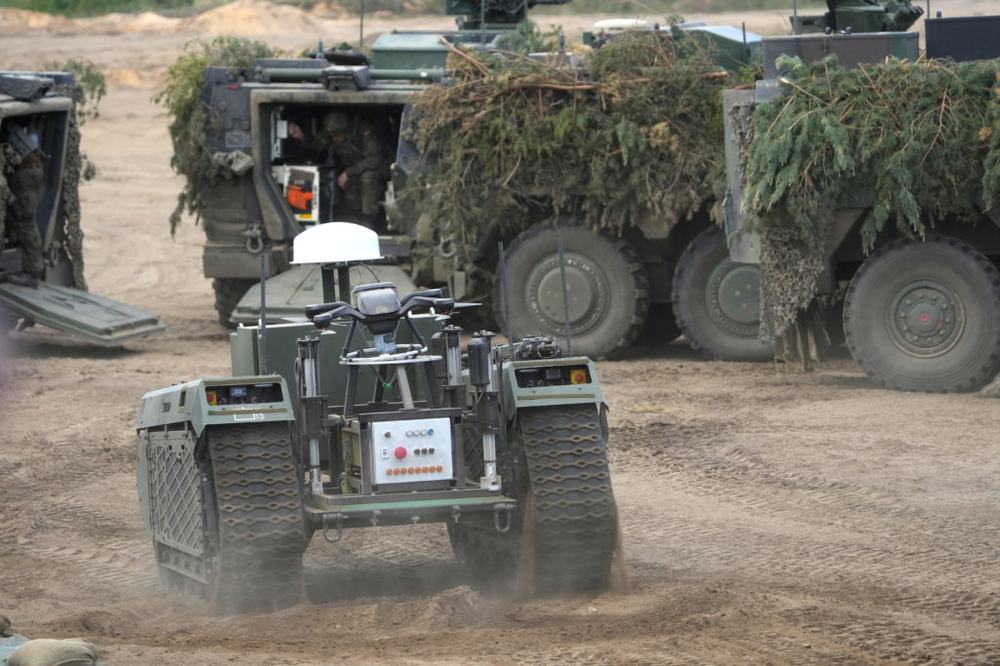
Science fiction movies often exaggerate the dangers that artificial intelligence, like supercomputers and robots, could present for mankind.

Of course, in many science fiction movies smart computers don't always have humankind's best interests in mind; think "The Matrix" or "2001: A Space Odyssey."

"Certainly, artificial intelligence can be destructive. It's already used in our weapons. We have smart weapons that have their own intelligence," says futurist and author Ray Kurzweil.

"Technology can be destructive, particularly in the wrong hands. The positive side is that these tools can help overcome human suffering, help cure disease, alleviate poverty, solve the energy problem, clean up the environment."

--Compiled by Imani M. Cheers for NewsHour Extra
Resources

Daily Video Clip

Student Voice
NewsHour
Students From Around the US Debate Gun Control
I think we've been witnessing violence for years, whether in reality through the media or through video games, and I don't think that's a first-hand effect.
Ellie, Student Reporting Labs
Send us your essay, personal story or poem
SUBMIT

Related Coverage

Extra: News for Students
Meet Watson, a Formidable Jeopardy! Opponent
Will Robots Someday Fight Our Wars?
Scientists Ponder When Robots Should Replace Humans

The PBS NewsHour
Watson Wins: IBM's Machine Rages Against Jeopardy! Champs
A: This Computer Could Defeat You at 'Jeopardy!' Q: What is Watson?
Preview: Watson Creams Miles O'Brien

SUGGESTIONS / COMMENTS
Do you have an opinion about this article? Or do you have a personal experience related to this article that you'd like to share with our readers? Submit your comments!
FRIDAY
What's Next for the U.S. Drone Campaign?
News Wrap: Syria Is Said to Agree to Peace Summit
Oklahomans Help Each Other to Rebuild and Recover
New 'Development' for Delivering Entertainment
Political Wrap With Brooks and Marcus
A Look Inside the Making of U.S. Foreign Policy
An hour-long daily news broadcast.