|
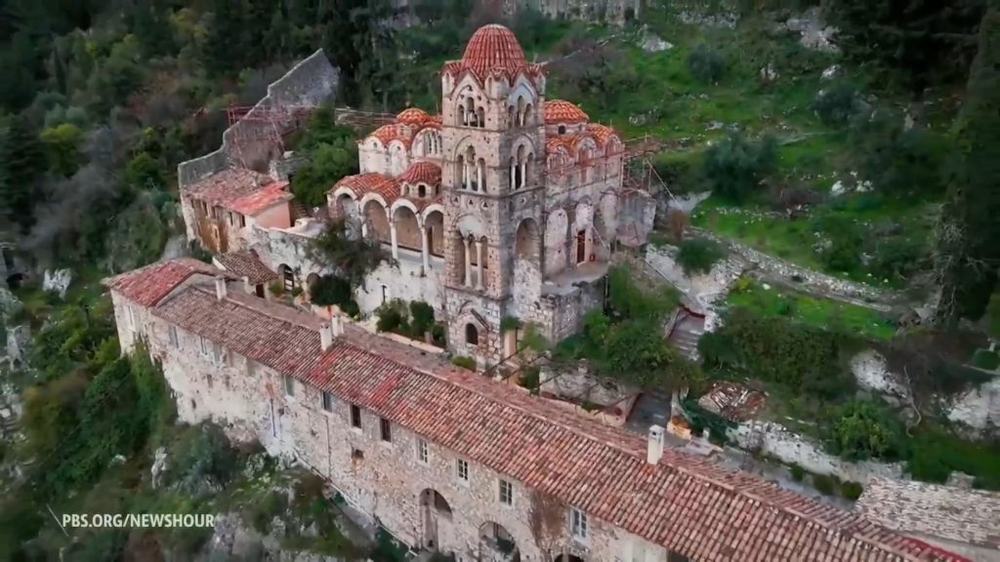
Groups of government employees who are affected by the job cuts include garbage collectors, transit workers and teachers. During last week’s strikes, the streets of Athens were covered in garbage, few students went to school and people had a hard time getting around the city.
For young Greeks, this is a defining moment and not just about jobs and money. They say they're being robbed of their ambitions and their dignity, Martin Geissler of Independent Television News reported on the NewsHour.
“This is really bad. This is really difficult for a young person to not have dreams, you know?” one young woman said.
Greece spent too much for decades
 |
 |
 |
 |
 |
 |
 |
 |
 |
 |

Prime Minister George A. Papandreou shocked investors and politicians across Europe when he announced in December 2009 that his predecessor had disguised the size of the country’s ballooning deficit. |
 |
 |
The problems stem from decades of heavy spending that was not covered by the taxes paid to the government. As a result, Greece borrowed money from banks around the world and now owes billions of dollars that it does not have.
To make matters worse, the government hid the problem with accounting tricks until 2009. When a new prime minister took office, he discovered that Greece owned much more money than it said it did, and European bankers started to panic.
European countries are forcing Greece to cut spending as a condition of giving it more money to pay its debts. Now, in the latest round of protests, most of Athens has stopped functioning and Greeks have gathered in front of the Parliament building, calling for an end to the waves of government cuts known as “austerity measures.”
The Eurozone - linked in currency and economy
 |
 |
 |
 |
 |
 |
 |
 |
 |
 |

The euro is the official currency of the eurozone: 17 of the 27 member states of the European Union. It is also the second most traded currency in the world after the United States dollar. |
 |
 |
Greece is part of the European Union, a group of 27 countries that share an economic marketplace and allow a relatively open flow of people and labor across borders. Some also share a common currency: the Euro.
Not all EU countries use the Euro, but the 17 that do are commonly known as the “Eurozone.” They are Austria, Belgium, Cyprus, Estonia, Finland, France, Germany, Greece, Ireland, Italy, Luxembourg, Malta, the Netherlands, Portugal, Slovakia, Slovenia and Spain.
Being united by a currency means that eurozone economies are also closely linked economically. Every time Greece has gotten close to defaulting on its debts, or failing to pay what it owes its creditors, other EU member states have given it money, or a “bailout,” to avoid a collapse of the entire eurozone economy.
Many people in the largest eurozone countries that have provided most of the bailout money, like Germany and France, are getting fed up with having to pay for Greece’s debt problems. “That entire country has no sense of responsibility, and now we're supposed to fix it," Karen Schumann, a 27-year-old German, told Time magazine after the first bailout from Germany. Eurozone countries are meeting in Brussels to decide whether to enlarge their bailout fund, or the amount of money they can use to help struggling member countries like Greece.
Life in Greece is getting harder
 |
 |
 |
 |
 |
 |
 |
 |
 |
 |

"The Greeks simply need to accept the challenge and reinterpret the crisis as a chance for a new beginning," said Vasiliki Mitrakos, a Greek-American student reporter. |
 |
 |
“Cuts and tax increases are not easy toaccept,especially when a large portion of the population is used to avoiding taxes and finding long-term job security in the public sector,” writes Vasiliki Mitrakos, a Greek-American student reporter who traveled to Athens recently and witnessed the protests.
“Many families or individuals dearly depend on state assistance or government employment.” Alexis Georgiadis, another Greek-American student reporter, writes: “There are more empty, boarded-up shops, more immigrants selling counterfeit bags outside the metro stations, and generally, I felt my Greek family and friends were more melancholic.
However, they all agreed that the bureaucratic issues that Greece has today are the same issues that existed decades ago.”
|