|
Students will need to view the following parts of Not For Ourselves Alone:
Episode 1:
first eleven minutes until you see the title Part 1: Revolution
Episode 2:
last fifteen minutes of film called Winter Wheat
They will also need access to a word processing program.
- Ask students what they think the following quotation means. Not for ourselves alone,
but that we may teach others. (Taken from Episode 2, final
segment of film.) Ask them to give examples to illustrate the meaning of the quote.
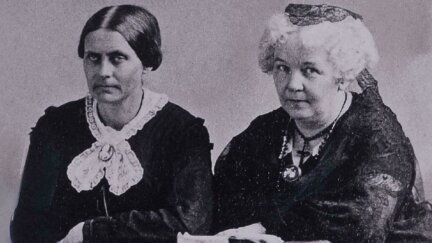
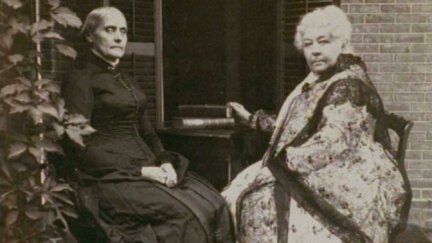
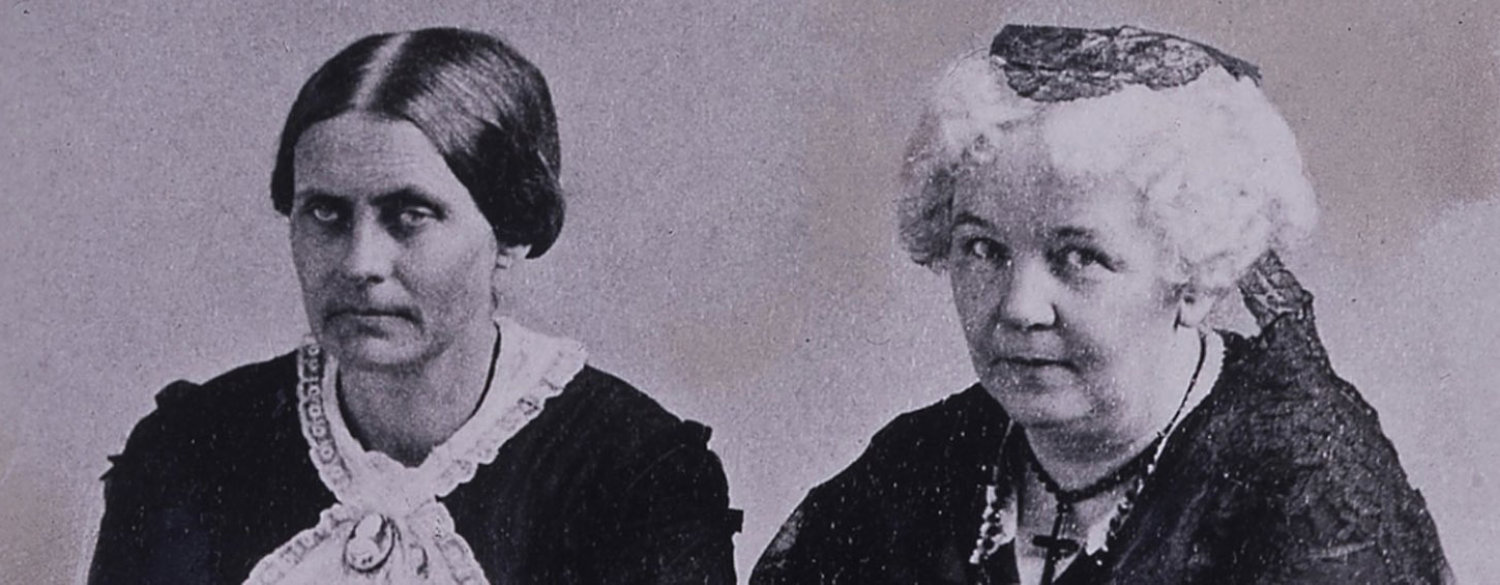
- Introduce Not For Ourselves Alone by writing the names Susan B. Anthony and
Elizabeth Cady Stanton on the board. Assess students prior knowledge of the
topic by asking the group to brainstorm a list of what they know about the two
women. In some cases, the list may be very short.
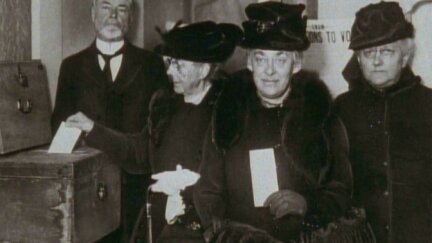
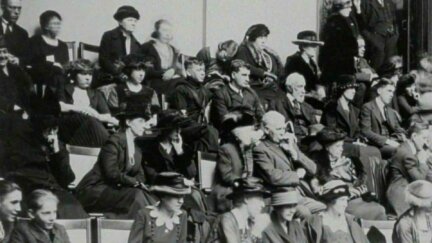
- Give students a brief introduction to Stanton and Anthony by viewing the portions of
the video mentioned in the materials section. After viewing, discuss what students learned about the women and their involvement with suffrage.
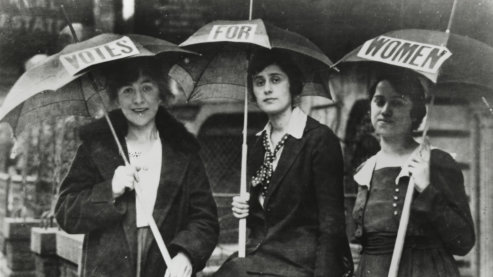
- Review the basic timeline of womens rights by visiting the PBS site One Woman, One Vote.
Other helpful sites include:
A History of the American Suffragist Movement
University of Maryland Womens Studies
- Review the quote from the opening of the lesson and replay that portion of the
video for students if necessary. Discuss how the quote from the film is illustrated in Stanton and Anthonys actions.
- Have students brainstorm how womens rights have changed even since 1920. Make
a list of ideas on the board. Be sure to include educational and career opportunities, role of women in politics, leadership, and the military, and changes
in traditional roles of men and women. At this time it would benefit students to
return to the PBS site and visit the Where Are We Now? section. There they can
see interviews with women who lived through the changes in this century. Have
students focus carefully on the interviews and the questions so they can get ideas
for the types of questions they would like to ask when they conduct their own
interviews. Discuss what makes a good interview question after viewing this
part of the site.
- Once this discussion is complete, have students conduct an interview with a person
born after 1920 but before 1950. It could be a man or woman, although a
womans point of view might be more appropriate based upon the focus of the
film. Before doing the interview, students should create a list of questions that
would be interesting and related to the subject. Their experience with the Where
Are We Now? section will be helpful with this. In addition, the interview could include questions like the following:
-How have educational opportunities for women changed since you
were young?
-How have career opportunities of women changed since you were
young?
-What do you think is the most important change that the womens
rights movement has contributed to since 1920?
-How has the role of women in leadership positions changed since you
were young?
-Who do you think was the most influential woman of your time?
-Do you think the womens rights movement has had any negative
consequences? If so, what?
- Once the interview is completed, the student should write a paper or feature story
that describes how the role of women has changed since the subject of the
interview was young. The paper could be an oral history, or it could be expository,
simply stating the information as it would appear in an informational article
or text. If a feature story is the chosen format, it should include a headline,
byline, and follow the standard style for this type of writing.
While the content of the article is of primary importance, students need to be reminded to use correct spelling, mechanics, grammar and usage. In addition, students should be reminded of how to use quotes in their papers/articles since these may be effective tools to illustrate the subjects point of view.
- Once articles are complete, students could share them by binding them into a book
to be placed in local school and public libraries and local and state historical
societies. Students may find the interviews with women politicians in the Where Are We Now? section of this Web site to be helpful.
- Create a scoring guide that will help to evaluate the interview questions and notes,
the content of the article/story, correct spelling, mechanics, grammar, and usage,
and the reference to the quote from Not For Ourselves Alone.
- Ask students to complete a self-evaluation of their work using a scoring guide and
criteria similar to those mentioned above.
- Ask students to give an oral presentation of what they learned from conducting the
interview. They should not read the article or story to the group, but they should
explain what they learned about Womens Rights and how they have changed
after seeing the video and interviewing their subject. The explanation should be
approximately two minutes long.
- Ask the subject of the interview to read the story and make remarks about its
accuracy and whether or not they believe the student correctly conveyed the
information they shared in the interview. The teacher can then give the student
a completion grade or a separate grade for the writing, but this will allow the
student to get feedback from the subject while allowing the subject to actually
see the work that was produced.
- Expand on the activity by having students obtain or take a photograph of the person they interviewed. The photo could then be mounted with a quote about how the Womens Rights Movement changed expectations during their lifetime. In addition, the student essay could be displayed with the photo. Then the subjects of the interviews could come to see the final projects and participate in a dialogue with students about the changes they have experienced.
- Have students choose the public figure they think has done the most for the rights of women in the 1980s to the present. Students should then write a paper or article about this woman, her contributions to the Womens Rights Movement, and why they believe she is deserving of this distinction. To assist students with the selection of an appropriate subject, a group brainstorming session could be used. Some names that would probably be included on the list are: Madeline Albright, Geraldine Ferraro, Janet Reno, Hillary Clinton, Christa McCauliff, Sandra Day OConnor, etc. Work could be shared with the class or small groups when
completed.
Taken from Mid-continent Research for Education and Learning
- Demonstrates competence in the general skills and strategies of the writing process
- Demonstrates competence in the stylistic and rhetorical aspects of writing
- Uses grammatical and mechanical conventions in written compositions
- Demonstrates competence in speaking and listening as tools for learning
- Understands the struggle for racial and gender equality and for the extension of civil liberties
- Understands the historical perspective
Lisa Prososki is a technology and communications teacher at Northgate Middle School in the North Kansas City School District. She has been teaching for 12 years. Lisa was the North Kansas City School Districts Teacher of the Year in 1995, and was named Technology and Learning magazines Missouri Technology Teacher of the Year in 1996. She has conducted numerous workshops and been a presenter at many local, state, and national conferences. In her spare time she enjoys athletics, scrapbooking, and spending time with her husband and new baby, Jacob.
Women Today: An Editorial
Changes in the Role of Women: An Interview
Womens Rights and Reform in the 19th Century
Conflict, Consensus, and Conclusion
|