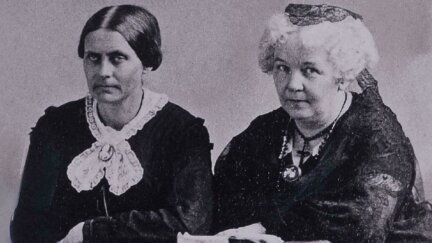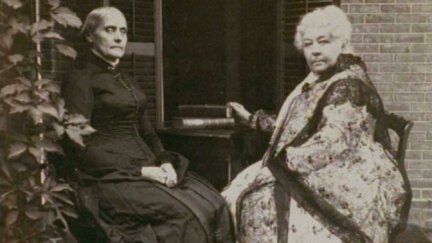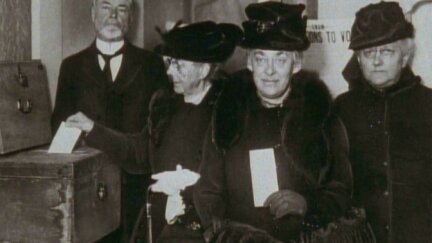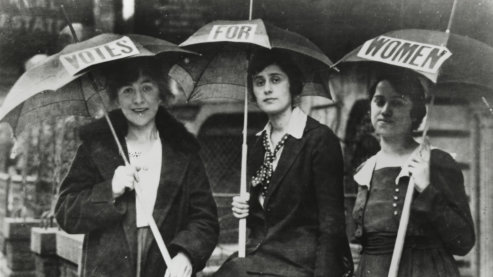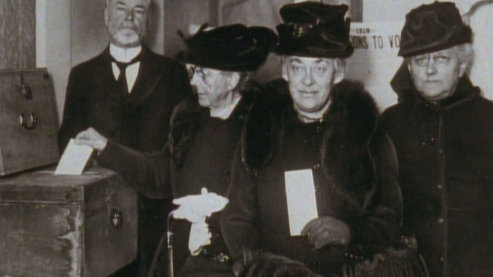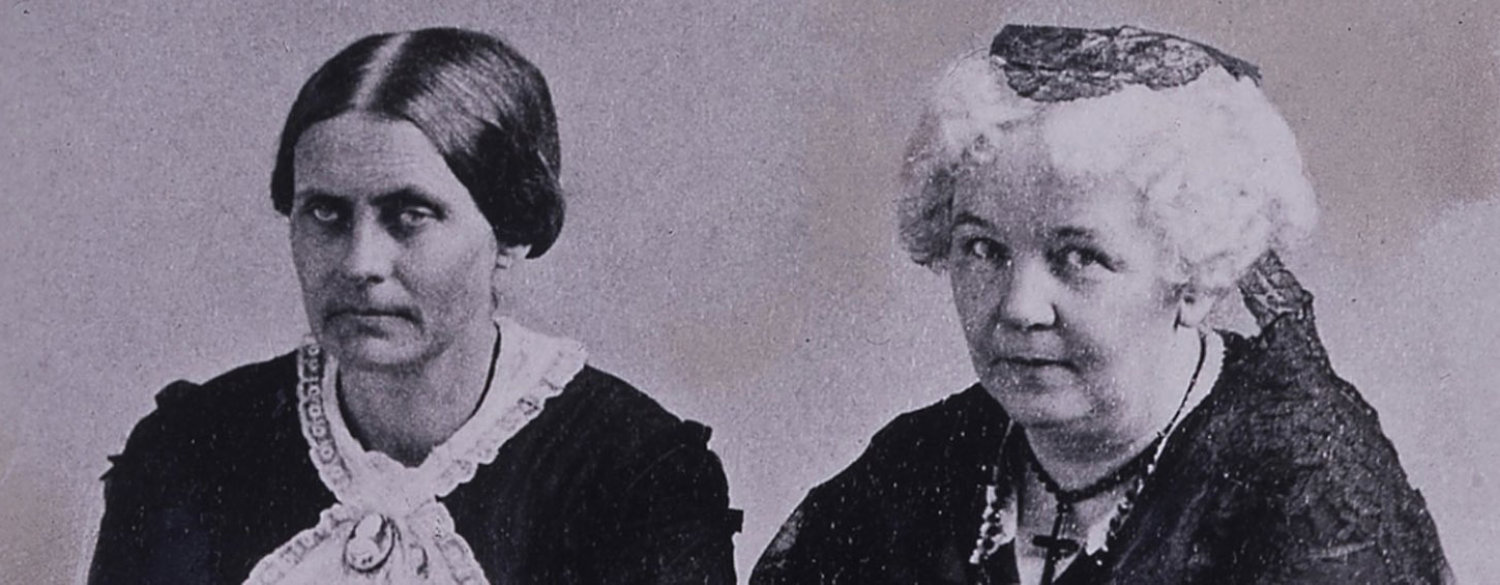

n November of 1872, Susan B. Anthony and 13 other suffragists chose to illegally cast their ballots in a presidential election. The women were arrested and charged with "knowingly voting without having a lawful right to vote." The following linksdirect excerpts from the trial recordprovide an abridged overview of the proceedings that took place in the historic case known as U.S. vs. Anthony.
Preface
At the election of President and Vice President of the United States, and members of Congress, in November, 1872, Susan B. Anthony, and several other women, offered their votes to the inspectors of election, claiming the right to vote, as among the privileges and immunities secured to them as citizens by the fourteenth amendment to the Constitution of the United States. The inspectors, Jones, Hall, and Marsh, by a majority, decided in favor of receiving the offered votes, against the dissent of Hall, and they were received and deposited in the ballot box. For this act, the women, fourteen in number, were arrested and held to bail, and indictments were found against them severally, under the 19th Section of the Act of Congress of May 30th, 1870, (16 St. at L. 144.) charging them with the offense of "knowingly voting without having a lawful right to vote." The three inspectors were also arrested, but only two of them were held to bail, Hall having been discharged by the Commissioner on whose warrant they were arrested. All three, however were jointly indicted under the same statutefor having "knowingly and willfully received the votes of persons not entitled to vote."
Of the women voters, the case of Miss Anthony alone was brought to trial, a nolle prosequi having been entered upon the other indictments. Upon the trial of Miss Anthony before the U.S. Circuit Court for the Northern District of New York, at Canandaigua, in June, 1873, it was proved that before offering her vote she was advised by her counsel that she had a right to vote; and that she entertained no doubt, at the time of voting, that she was entitled to vote. It was claimed in her behalf:
I. That she was legally entitled to vote.
II. That if she was not so entitled, but voted in good faith in the belief that it was her right, she was guilty of no crime.
III. That she did vote in such good faith, and with such belief.
The court held that the defendant had no right to votethat good faith constituted no defencethat there was nothing in the case for the jury to decide, and directed them to find a verdict of guilty; refusing to submit, at the request of the defendants counsel, any question to the jury, or to allow the clerk to ask the jurors, severally, whether they assented to the verdict which the court had directed to be entered. The verdict of guilty was entered by the clerk, as directed by the court, without any express assent or dissent on the part of the jury. A fine of $100, and costs, was imposed upon the defendant.
Miss Anthony insists that in these proceedings, the fundamental principle of criminal law, that no person can be a criminal unless the mind be so-that an honest mistake is not a crime, has been disregarded; that she has been denied her constitutional right of trial by jury, the jury having had no voice in her conviction; that she has been denied her right to have the response of every juror to the question, whether he did or did not assent to the verdict which the court directed the clerk to enter.
The trial of the three inspectors followed that of Miss Anthony, and all were convicted, the court holding, as in the case of Miss Anthony, that good faith on their part in receiving the votes was not a protection; which they think a somewhat severe rule of law, inasmuch as the statute provides the same penalty, and in the same sentence, "for knowingly and wilfully receiving the vote of any person not entitled to vote, or refusing to receive the vote of any person entitled to vote." The inspectors claim, that according to this exposition of the law, they were placed in a position which required them, without any opportunity to investigate or take advice in regard to the right of any voter whose right was questioned, to decide the question correctly, at the peril of a term in the states prison if they made a mistake: and, though this may be a correct exposition of the law in their case, they would be sorry to see it applied to the decisions of any court, not excepting the tribunal by which they were convicted.
The defendant, Hall, is at a loss to know how he could have avoided the penalty, inasmuch as he did all that he could in the way of rejecting the votes, without throttling his co-inspectors,and forcing them to desist from the wrong of receiving them. He is of opinion that by the ruling of the Court, he would have been equally guilty, if he had tried his strength in that direction, and had failed of success.
To preserve a full record of so important a judicial determination, and to enable the friends of the convicted parties to understand precisely the degree of criminality which attaches to them in consequences of these convictions, the following pamphlet has been prepared-giving a more full and accurate statement of the proceedings than can elsewhere be found.
Indictment against Susan B. Anthony. District Court of the United States of America, in and for the Noterther District of New York.
At a stated session of the District Court of the United States of
America, held in and for Northern District of New York, at the City
Hall, in the city of Albany, in the said Northern District of New York,
on the third Tuesday of January, in the year of our Lord one thousand
eight hundred and seventy-three, before the Honorable Nathan K. Hall,
Judge of the said Court, assigned to keep the peace of the said United
States of America, in and for the said District, and also to hear and
determine divers Felonies, Misdemeanors
Proceedings
Hon. WARD HUNT, Presiding.
APPEARANCES For the United States: Hon. Richard Crowley U. S. District Attorney.
For the Defendant: Hon. Henry R. Selden. John Van Voorhis, Esq.
Tried at Canandaigua, Tuesday and Wednesday, June 17th and 18th, 1973, before Hon. Ward Hunt, and a jury.
Jury impanneled at 2:30 p.m.
Argument of Mr. Crowley for the Prosecution
Mr. Crowley opened the case as follows: May if please the Court and Gentlemen of the Jury: On the 5th of November, 1872, there was held in this State, as well as in other States of the Union, a general election for different officers, and among those, for candidates to represent several districts of this State in the Congress of the United States. The defendant, Miss Susan B. Anthony, at the time resided in the city of Rochester, in the country of Monroe, Northern District of New York, and upon the 5th day of November, 1872, she voted for a representative in the Congress of the United States, to represent the 20th Congressional District of the State, and also for a representative at large for the State of New York, to represent the State in the Congress of the United States. At that time she was a woman. I suppose there will be no question about that. The question in this case, if there be a question of fact about it at all, will, in my judgment, be rather a question of law than one of fact. I suppose that there will be no question of fact, substantially, in the case when all of the evidence is out, and it will be for you to decide under the charge of his honor, the Judge, whether or not the defendant committed the offense of voting for a representative in Congress upon that occasion. We think, on the part of the Government, that there is no question about it either one way of the other, neither a question of fact, nor a question of law, and that whatever Miss Anthonys intentions may have been-whether they were good or otherwise-she did not have a right to vote upon that question, and if she did vote without having a lawful right to vote, then there is no question but what she is guilty of violating a law of the United States in that behalf enacted by the Congress of the United States.
We dont claim in the case, gentlemen, that Miss Anthony is of that class of people who go about "repeating." We dont claim that she went from place to place for the purpose of offering her vote. But we do claim that upon the 5th of November, 1872, she voted, and whether she believed that she had a right to vote or not, it being a question of law, that she is within the Statute.
Congress in 1870 passed the following statute: (Reads 19th Section of the Act of 1870, page 144, 16th statutes at large.)
It is not necessary for me, gentlemen, at this stage of the case, to state all the facts which will be proven on the part of the Government. I shall leave that to be shown by the evidence and by the witnesses, and if any question of law shall arise his Honor will undoubtedly give you instruction as he shall deem proper.
Conceded, that on the 5th day of November, 1872, Miss Susan B. Anthony was a woman.
Beverly W. Jones , a witness, called in behalf of the United States, having been duly sworn, testified as follows:
Examined by Mr. Crowley:
Q. Mr. Jones, where do you reside?
A. 8th ward, Rochester.
Q. Where were you living on the 5th of November, 1872?
A. Same place.
Q. Do you know the defendant, Miss Susan B. Anthony?
A. Yes, sir.
Q. In what capacity were you acting upon that day, if any, in relation to election?
A. Inspector of election.
Q. Into how many election districts is the 8th ward divided, if it contains more than one?
A. Two, sir.
Q. In what election district were you inspector of elections?
A. The first district.
Q. Who were inspectors with you?
A. Edwin T. Marsh and William B. Hall
Q. Had the Board of Inspectors been regularly organized?
A. Yes, sir
Q. Upon the 5th day of November, did the defendant, Susan B. Anthony, vote in the first election district of the 8th ward of the city of Rochester?
A. Yes, sir.
Q. Did you see her vote?
A. Yes, sir.
Q. Will you state to the jury what tickets she voted, whether State, Assembly, Congress and Electoral?
Objected to as calling a conclusion.
Q. State what tickets she voted, if you know, Mr. Jones?
A. If I recollect right she voted the Electoral ticket, Congressional ticket, State ticket, and Assembly ticket.
Q. Was there an election for Member of Congress for that district and for Representative at Large in Congress, for the State of New York, held on the 5th of November, in the city of Rochester?
A. I think there was; yes, sir.
Q. In what Congressional District was the city of Rochester at the time?
A. The 29th.
Q. Did you receive the tickets from Miss Anthony?
A. Yes, sir.
Q. What did you do with them when you received them?
A. Put them in the separate boxes where they belonged.
Q. State to the jury whether you had separate boxes for the several tickets voted in that election district?
A. Yes, sir; we had.
Q. Was Miss Anthony challenged upon that occasion?
A. Yes, sirno; not on that day she wasnt.
Q. She was not challenged on the day she voted?
A. No, sir.
Cross-Examination by Judge Selden:
Q. Prior to the election, was there a registry of voters in that district made?
A. Yes, sir.
Q. Was you one of the officers engaged in making that registry?
A. Yes, sir.
Q. When the registry was being made did Miss Anthony appear before the Board of Registry and claim to be registered as a voter?
A. She did.
Q. Was there any objection made, or any doubt raised as to her right to vote?
A. There was.
Q. On what ground?
A. On the ground that the Constitution of the State of New York did not allow women to vote.
Q. What was the defect in her right to vote as a citizen?
A. She was not a male citizen.
Q. That she was a woman?
A. Yes, sir.
Q. Did the Board consider that and decide that she was entitled to register?
Objected to. Objection overruled.
Q. Did the Board consider the question of her right to registry, and decide that she was entitled to registry as a voter?
A. Yes, sir.
Q. And she was registered accordingly?
A. Yes, sir.
Q. When she offered her vote, was the same objection brought up in the Board of Inspectors, or question made of her right to vote as a woman?
A. She was challenged previous to election day.
Q. It was canvassed previous to election day between them?
A. Yes, sir; she was challenged on the second day of registering names.
Q. At the time of the registry, when her name was registered, was the Supervisor of Election present at the Board?
Q. He was.
A. Was he consulted upon the question of whether she was entitled to registry, or did he express an opinion on the subject to the inspectors.?
Mr. Crowley : I submit that it is of no consequence whether he did or not.
Judge Selden : He was the Government Supervisor under this set of Congress.
Mr. Crowley : The Board of Inspectors, under the State law, constitute the Board of Registry, and they are the only persons to pass upon that question.
The Court : You may take it.
A. Yes, sir; there was a United States Supervisor of Elections, two of them.
By Judge Selden :
Q. Did they advise the registry, or did they not?
A. One of them did.
Q. And on that advice the registry was made with the judgment of the inspectors.
A. It had a great deal of weight with the inspectors, I have no doubt.
Re-direct Examination by Mr. Crowley:
Q. Was Miss Anthony challenged before the Board of Registry?
A. Not at the time she offered her name.
Q. Was she challenged at any time?
A. Yes, sir; the second day of the meeting of the Board.
Q. Was the preliminary and the general oath administered?
A. Yes, sir.
Q. Wont you state what Miss Anthony said, if she said anything, when she came there and offered her name for registration?
A. She stated that she did not claim any rights under the constitution of the State of New York; she claimed her right under the constitution of the United States.
Q. Did she name any particular amendment?
A. Yes, sir; she cited the 14th amendment.
Q. Under that she claimed her right to vote?
A. Yes, sir.
Q. Did the other Federal Supervisor who was present, state it as his opinion that she was entitled to vote under that amendment, or did he protest, claiming that she did not have the right to vote?
A. One of them said that there was no way for the inspectors to get around placing the name upon the register; the other one, when she came in, left the room.
Q. Did this one who said that there was no way to get around placing the name upon the register, state that she had her right to register but did not have the right to vote?
A. I didnt hear him make any such statement.
Q. You didnt hear any such statement as that?
A. No, sir.
Q. Was there a poll list kept of the voters of the first selection district of the 18th ward on the day of election?
A. Yes, sir.
Q. (Handling two books.) State whether that is the poll list of voters kept upon the day of election in the first election district of the 8th ward, of the city of Rochester?
A. This is the poll list, and also the register.
Q. Turn to the name of Susan B. Anthony, if it is upon that poll list?
A. I have it.
Q. What number is it?
A. Number 22.
Q. From that poll list what tickets does it purport to show that she voted upon that occasion?
A. Electoral, State, Congress and Assembly.
United States rests.
Judge Selden opened the case in behalf of the defendant, as follows:
If the Court please, Gentlemen of the Jury:
This is a case of no ordinary magnitude, although many might regard it as one of very little importance. The question whether my client here had done anything to justify her being consigned to a felons prison or not, is one that interests her very essentially, and that interests the people also essentially. I claim and shall endeavor to establish before you that when she offered to have her name registered as a voter, and when she offered her vote for Member of Congress, she was as much entitled to vote as any man that voted at that election, according to the Constitution and laws of the Government under which she lives. If I maintain that proportion, as a matter of course she has committed no offence, and is entitled to be discharged at your hands.
But, beyond that, whether she was a legal vote or not, whether she was entitled to vote or not, if she sincerely believed that she had a right to vote, and offered her ballot in good faith, under that belief, whether right or wrong, by the laws of this country she is guilty of no crime. I apprehend that that proposition, when it is discussed, will be maintained with a clearness and force that shall leave no doubt upon the mind of the Court or upon your minds as the gentlemen of the jury. If I maintain that proposition here, then the further question and the only question which, in my judgment, can come before you to be passed upon by you as a question of fact is whether or not she did vote in good faith, believing that she had a right to vote.
The public prosecutor assumes that, however honestly she may have offered her vote, however sincerely she may have believed that she had a right to vote, if she was mistaken in that judgment, her offering her vote and its being received makes a criminal offence- a proposition to me most abhorrent, as I believe it will be equally abhorrent to your judgment.
Before the registration, and before this election, Miss Anthony called upon me for advice upon the question whether, under the 14th Amendment of the Constitution of the United States, she had a right vote. I had not examined the question. I told her I would examine it and give her my opinion upon the question of her legal right. She went away and came again after I had made the examination. I advised her that she was as lawful a voter as I am, or as any other man is, and advised her to go and offer her vote. I may have been mistaken in that, and if I was mistaken, I believe she acted in good faith. I believe she acted according to her right as the law and Constitution gave it to her. But whether she did or not, she acted in the most perfect good faith, and if she made a mistake, or if I made one, that is not a reason for committing her to a felons cell.
For the second time in my life, in my professional practice, I am under the necessity of offering myself as a witness for my client.
Henry R. Selden , a witness sworn in behalf of the defendant, testified as follows: Before the last election, Miss Anthony called upon me for advice, upon the question whether she was or was not a legal voter. I examined the question, and gave her my opinion, unhesitatingly, that the laws and Constitution of the United States, authorized her to vote, as well as they authorize any man to vote; and I advised her to have her name placed upon the registry and to vote at the election, if the inspectors should receive her vote. I gave the advice in good faith, believing it to be accurate, and I believe it to be accurate still.
[This witness was not cross-examined]
Judge Selden : I propose to call Miss Anthony as to the fact of her voting-on the question of the intention or belief under which she voted.
Mr. Crowley: She is not competent as a witness in her own behalf.
[The Court so held.]
Defendant rests.
John E, Pound, a witness sworn in behalf of the United States, testified as follows:
Examined by Mr. Crowley.
Q. During the months of November and December, 1872, and January, 1873, were you Assistant United States Dist. Attorney for the Northern district of New York?
A. Yes, sir.
Q. Do you know the defendant, Susan B. Anthony?
A. Yes, sir.
Q. Did you attend an examination before Wm. C. Storrs, a United States Commissioner, in the city of Rochester, when her case was examined?
A. I did
Q. Was she called as a witness in her own behalf upon that examination?
A. She was.
Q. Was she sworn?
A. She was.
Q. Did she give evidence?
A. She did.
Q. Did you keep minutes of evidence on that occasion?
A. I did.
Q. (Handling the witness a paper.) Please look at the paper now shown you and see if it contains the minutes you kept upon that occasion?
A. It does.
Q. Turn to the evidence of Susan B. Anthony?
A. I have it.
Q. Did she, upon that occasion, state that she consulted or talked with Judge Henry R. Selden, of Rochester, in relation to her right to vote?
Judge Selden: I object to that upon the ground that it is incompetent, that if they refuse to allow her to be sworn here, they should be excluded from producing any evidence that she gave elsewhere, especially when they want to give the version which the United States officer took of her evidence.
The Court: Go on.
By Mr Crowley:
Q. State whether she stated on that examination, under oath, that she had talked or consulted with Judge Henry R. Selden in relation to her right to vote?
A. She did.
Q. State whether she was asked, upon that examination, if the advice given her by Judge Henry R. Selden would or did make any difference in her action in voting, or in substance that?
A. She stated on the cross-examination, "I should have made the same endeavor to vote that I did had I not consulted Judge Selden. I didnt consult any one before I registered. I was not influenced by his advice in the matter at all; have been resolved to vote, the first time I was at home 30 days, for a number of years."
Cross-examination by Mr. Van Voorhees:
Q. Mr. Pound, was she asked there if she had any doubt about her right to vote, and did she answer "Not a particle?"
A. She stated. "Had no doubt as to my right to vote," on the direct examination.
Q. There was a stenographic reporter there, was there not?
A. A reporter was there taking notes.
Q. Was not this question put to her "Did you have any doubt yourself of your right to vote?" and did she not answer "Not a particle?"
The Court: Well, she says so, that she had no doubt of her right to vote.
Judge Selden: I beg leave to state, in regard to my own testimony, Miss Anthony informs me that I was mistaken in the fact that my advice was before her registry. It was my recollection that it was on her way to the registry, but she states to me now that she was registered and came immediately to my office. In that respect I was under a mistake.
Evidence closed.
Argument of Mr. Selden for the Defendant
The defendant is indicted under the 19th section of the Act of Congress
of May 31, 1870 (16 St. at L., 144,), for "voting without having a
lawful right to vote."
The words of the Senate, so far as they are material in this case, are
as follows: "If at any election for representative or delegate in the
Congress of the United States, any person shall knowingly * * * vote
without having a lawful right to vote * * every such person shall be
deemed guilty of a crime, * * and on conviction thereof shall be
punished by a fine not exceeding $500, or by imprisonment for a term not
exceeding three years, or by both, in the discretion of the court, and
shall pay the costs of prosecution."
The only alleged ground of illegality of the defendants vote is that
she is a woman. If the same act had been done by her brother under the
same circumstances, the act would have been not only innocent, but
honorable and laudable; but having been done by a woman it is said to be
a crime. The crime therefore consists not in the act done, but in the
simple fact that the person doing it was a woman and not a man, I
believe this is the first instance in which a woman has been arraigned
in a criminal court, merely on account of her sex.
If the advocates of female suffrage had been allowed to choose the point
of attack to be made upon their position, they could not have chosen it
more favorably for themselves; and I am disposed to thank those who have
been instrumental in this proceeding, for presenting it in the form of a
criminal prosecution.
Women have the same interest that men have in the establishment and
maintenance of good government;they are to the same extent as men bound
to obey the laws; they suffer to the same extent by bad laws, and profit
to the same extent by good laws; and upon principles of equal justice,
as it would seem, should be allowed equally with men, to express their
preference in the choice of law-makers and rulers. But however that may
be, no greater absurdity, to use no harsher, term, could be presented,
than that of rewarding men and punishing women, for the same act,
without giving to women any voice in the question which should be
rewarded, and which punished.
I am aware, however, that we are here to be governed by the Constitution
and laws as they are, and that if the defendant has been guilty of
violating the law, she must submit to the penalty, however unjust or
absurd the law may be. But courts are not required to so interpret laws
or constitutions as to produce either absurdity or injustice, so long as
they are open to a more reasonable interpretation. This must be my
excuse for what I design to say in regard to the propriety of female
suffrage, because with that propriety established there is very little
difficulty in finding sufficient warrant in the constitution for its
exercise.
1. .......... Was the defendant legally entitled to vote at the election
in question. 2. .......... If she was not entitled to vote, but believed
that she was, and voted in good faith in that belief, did such voting
constitute a crime under the statute before referred to? 3. ..........
Did the defendant vote in good faith in that belief?
If the first question be decided in accordance with my views, the other
questions become immaterial; if the second be decided adversely to my
views, the first and third become immaterial. The two first are
questions of law to be decided by the court, the other is a question for
the jury.
[The Judge here suggested that the argument should be confined to the
legal questions, and the argument on the other question suspended, until
his opinion on those questions should be made known. This suggestion was
assented to, and the counsel proceeded.]
My first position is that the defendant had the same right to vote as
any other citizen who voted at that election.
Before proceeding to the discussion of the purely legal question, I
desire, as already intimated, to pay some attention to the propriety and
justice of the rule which I claim to have been established by the
Constitution.
Miss Anthony, and those united with her in demanding the right of
suffrage, claim, and with a strong appearance of justice, that upon the
principles upon which our government is founded, and which lie at the
basis of all just government, every citizen has a right to take part,
upon equal terms with every other citizen, in the formation and
administration of government. This claim on the part of the female sex
presents a question the magnitude of which is not well appreciated by
the writers and speakers who treat it with ridicule. Those engaged in
the movement are able, sincere and earnest women, and they will not be
silenced by such ridicule, nor even by the villainous caricatures of
Nast. On the contrary, they justly place all those things to the account
of the wrongs which they think their sex has suffered. They believe,
with an intensity of feeling which men who have not associated with them
have not yet learned, that their sex has not had, and has not now, its
just and true position in the organization of government and society.
They may be wrong in their position, but will be content until their
arguments are fairly, truthfully and candidly answered.
In the most celebrated document which has been put forth on this side of
the Atlantic, our ancestors declared that "governments derive their just
powers from the consent of the governed."
Blackstone says, "The lawfulness of punishing such criminals (i.e.,
persons offending merely against the laws of society) is founded upon
this principle: that the law by which they suffer was made by their own
consent; it ita part of the original contract into which they entered
when first they engaged in society; it was calculated for and has long
contributed to their own security."
Quotations, to an unlimited extent, containing similar doctrines from
eminent writers, both English and American, on government, from the time
of John Locke to the present day, might be made. Without adopting this
doctrine which bases the rightfulness of government upon the consent of
the governed, I claim that there is implied in it the narrower and
unassailable principle that all citizens of a State, who are bound by
its laws, are entitled to an equal voice in the making and execution of
such laws. The doctrine is well stated by Godwin in his treatise on
Political Justice. He says: "The first and most important principle that
can be imagined relative to the form and structure of government, seems
to be this: that as government is a transaction in the name and for the
benefit of the whole, every member of the community ought to have some
share in its administration."
Again, "Government is a contrivance instituted for the security of
individuals; and it seems both reasonable that each man should have a
share in providing for his own security, and probable, that partiality
and cabal should by this means be most effectually excluded."
And again, "To give each man a voice in the public concerns comes
nearest to that admirable idea of which we should never lose sight, the
uncontrolled exercise of private judgment. Each man would thus be
inspired with a consciousness of his own importance, and the slavish
feelings that shrink up the soul in the presence of an imagined superior
would be unknown."
The mastery which this doctrine, whether right or wrong, has acquired
over the public mind, has produced as its natural fruit, the extension
of the right of suffrage to all the adult male population in nearly all
the states of the Union; a result which was well epitomized by President
Lincoln, in the expression, "government by the people for the people."
This extension of the suffrage is regarded by many as a source of danger
to the stability of free government. I believe it furnishes the greatest
security for free government, as it deprives the mass of the people of
all motive for revolution; and that government so based is most safe,
not because the whole people are less liable to make mistakes in
government so selet few, but because they have no interest which can
lead them to such mistakes, or to prevent their correction when made. On
the contrary, the world has never seen an aristocracy, whether composed
of few or many, powerful enough to control a government, who did not
honestly believe that their interest was identical with the public
interest, and who did not act persistenly in accordance with such
belief; and, unfortunately, an aristocracy of sex has not proved an
exception to the rule. The only method yet discovered of overcoming this
tendency to the selfish use of power, whether consciously or
unconsciously, by those possessing it, is the distribution of the power
among all who are its subjects. Short of this the name free government
is a misnomer.
This principle, after long strife, not yet entirely ended has been,
practically at least, very generally recognized on this side of the
Atlantic, as far as relates to men; but when the attempt is made to
extend it to women, political philosophers and practical politicians,
those "inside of polities," two classes not often found acting in
concert, join in denouncing it. It remains to be determined whether the
reasons which have produced the extension of the franchise to all adult
men, do not equally demand its extension to all adult women. If it be
necessary for men that each should have a share in the administration of
government for his security, and to exclude partiality, as alleged by
God-win, it would seem to be equally, if not more, necessary for women,
on account of their inferior physical power: and if, as is persistently
alleged by those who sneer at their claims, they are also inferior in
mental power, that fact only gives additional weight to the argument in
their behalf, as one of the primary objects of government, as
acknowledged on all hands, is the protection of the weak against the
power of the strong.
I can discover no ground consistent with the principal on which the
franchise has been given to all men, upon which it can be denied to
women. The principal argument against such extension, so far as argument
upon that side of the question has fallen under my observation, is based
upon the position that women are represnted in the government by men,
and that their rights and interests are better protected through that
indirect representation than they would be by giving them a direct voice
in the government.
The teachings of history in regard to the condition of women under the
care of these self-constituted protectors, to which I can only briefly
allude, show the value of this argument as applied to past ages; and in
demonstration of its value as applied to more recent times, even at the
risk of being tedious. I will give some examples from my own
professional experience. I do this because nothing adds more to the
efficacy of truth than the translation of the abstract into the
concrete. Withholding names, I will state the facts with fullness and
accuracy.
An educated and refined woman, who had been many years before deserted
by her drunken husband, was living in a small village of Western New
York, securing, by great economy and intense labor in fine needle work,
the means of living, and of supporting her two daughters at an academy,
the object of her life being to give them such an education as would
enable them to become teachers, and thus secure to them some degree of
independence when she could no longer provide for them. The daughters
were good scholars, and favorites in the school, so long as the mother
was able to maintain them there. A young man, the nephew and clerk of a
wealthy but miserly merchant, became acquainted with the daughters, and
was specially attentive to the older one. The uncle disapproved of the
conduct of his nephew, and failing to control it by honorable means,
resorted to the circulation of the vilest slanders against mother and
daughters. He was a man of wealth and influence. They were almost
unknown. The mother had but recently come to the village, her object
having been to secure to her daughters the educational advantages which
the academy afforded. Poverty, as well as perhaps an excusable if not
laudable pride, compelled her to live in obscurity, and consequently the
assault upon their characters fell upon her and her daughters with
crushing force. Her employment mainly ceased, her daughters were of
necessity withdrawn from school, and all were deprived of the means,
from their own exertions, of sustaining life. Had they been in fact the
harlots which the miserly scoundrel represented them to be, they would
not have been so utterly powerless to resist his assault. The mother in
her despair naturally sought legal redress. But how was it to be
obtained? By the law the wifes rights were merged in those of the
husband. She had in law no individual existence, and consequently no
action could be brought by her to redress the grievous wrong; indeed
according to the law she had suffered no wrong, but the husband had
suffered all, and was entitled to all the redress. Where he was the lady
did not know; she had not heard from him for many years. Her counsel,
however, ventured to bring an action in her behalf, joining the
husbands name with hers, as the law required. When the cause came to
trial the defendant made no attempt to sustain the charges which he had
made, well knowing that they were as groundless as they were cruel; but
he introduced and proved a release of the cause of action, signed by the
husband, reciting a consideration of fifty dollars paid to him. The
defendants counsel had some difficulty in proving the execution of the
release, and was compelled to introduce as a witness, the constable who
had been employed to find the vagabond husband and obtain his signature.
His testimony disclosed the facts that he found the husband in the
forest in one of our north-eastern counties, engaged in making shingles,
(presumably stealing timber from the public lands and converting it into
the means of indulging his habits of drunkenness), and only five dollars
of the fifty mentioned in the release had in fact been paid. The Court
held, was compelled to hold, that the party injured in view of the law,
had received full compensation for the wrong-and the mother and
daughters with no means of redress were left to starve. This was the act
of the representative of the wife and daughters to whom we are referred,
as a better protector of their rights than they themselves could be.
It may properly be added, that if the action had proceeded to judgment
without interference from the husband, and such amount of damages had
been recovered as a jury might have thought it proper to award, the
money would have belonged to the husband, and the wife could not
lawfully have touched a cent of it. Her attorney might, and doubtless
would have paid it to her, but he could only have done so at the peril
of being compelled to pay it again to the drunken husband if he had
demanded it.
In another case, two ladies, mother and daughter, some time prior to
1860 came from an eastern county of New York to Rochester, where a
habeas corpus was obtained for a child of the daughter, less than two
years of age. It appeared on the return of the writ, that the mother of
the child had been previously abandoned by her husband, who had gone to
a western state to reside, and his wife had returned with the child to
her mothers house, and had resided there after her desertion. The
husband had recently returned from the west, had succeeded in getting
the child into his custody, and was stopping over night with it in
Rochester on the way to his western home. No misconduct on the part of
the wife was pretended, and none on the part of the husband, excepting
that he had gone to the west leaving his wife and child behind, no cause
appearing, and had returned, and somewhat clandestinely obtained
posession of the child. The Judge, following Blackstones views of
husbands rights, remanded the infant to the custody of the father. He
thought the law required it, and perhaps it did; but if mothers had had
a voice, either in making or in administering the law, I think the
result would have been different. The distress of the mother on being
thus separated from her child can be better imagined than described. The
separation proved a final one, as in less than a year neither father nor
mother had any child on earth to love or care for. Whether the loss to
the little one of a mothers love and watchfulness had any effect upon
the result, cannot, of course, be known.
The state of the law a short time since, in other respects, in regard to
the rights of married women, shows what kind of security had been
provided for them by their assumed representatives. Prior to 1848 all
the personal property of every woman on marriage became the absolute
property of the husband-the use of all her real estate became his during
coverture, and on the birth of a living child, it became his during his
life. He could squander it in dissipation or bestow it upon harlots, and
the wife could not touch or interfere with it. Prior to 1860, the
husband could by will take the custody of his infant children away from
the surviving mother, and give it to whom he pleased-and he could in
like manner dispose of the control of the childrens property, after his
death, during their minority, without the mothers consent.
In most of these respects the state of the law has undergone great
changes within the last 25 years. The property, real and personal, which
a woman possesses before marriage, and such as may be given to her
during coverture, remains her own, and is free from the control of her
husband.
If a married woman is slandered she can prosecute in her own name the
slanderer, and recover to her own use damages for the injury.
The mother now has an equal claim with the father to the custody of
their minor children, and in case of controversy on the subject, courts
may award the custody to either in their discretion.
The husband cannot now by will effectually appoint a guardian for his
infant children without the consent of the mother, if living.
These are certainly ameliorations of the law; but how have they been
produced? Mainly as the result of exertions of a few heroic women, one
of the foremost of whom is her who stands arraigned as a criminal before
this Court to-day. For a thousand years the absurdities and cruelties to
which I have alluded have been embedded in the common law, and in the
statute books, and men have not touched them, and would not until the
end of time, had they not been goaded to it by the persistent efforts of
the noble women to whom I have alluded.
Much has been done, but much more remains to be done by women. If they
had possessed the elective franchise, the reforms which have cost them a
quarter of a century of labor would have been accomplished in a year.
They are still subject to taxation upon their property, without any
voice as to the levying or destination of the tax; and are still subject
to laws made by men, which subject them to fine and imprisonment for the
same acts which men do with honor and reward-and when brought to trial
no woman is allowed a place on the bench or in the jury box, or a voice
in her behalf at the bar. They are bound to suffer the penalty of such
laws, made and administered solely by men, and to be silent under the
infliction. Give them the ballot, and, although I do not suppose that
any great revolution will be produced, or that all political evils will
be removed, (I am not a believer in political panaceas,) but if I
mistake not, valuable reforms will be introduced which are not now
thought of. Schools, almshouses, hospitals, drinking saloons, and those
worse dens which are destroying the morals and the constitutions of so
many of the young of both sexes, will feel their influence to an extent
now little dreamed of. At all events women will not be taxed without an
opportunity to be heard, and will not be subject to fine and
imprisonment by laws made exclusively by men for doing what it is lawful
and honorable for men to do.
It may be said in answer to the argument in favor of female suffrage
derived from the cases to which I have referred, that men, not
individually, but collectively, are the natural and appropriate
representatives of women, and that, notwithstanding cases of individual
wrong, the rights of women are, on the whole, best protected by being
left to their care. It must be observed, however, that the cases which I
have stated, and which are only types of thousands like them, in their
cruelty and injustice, are the result of ages of legislation by these
assumed protectors of women. The wrongs were less in the men than in the
laws which sustained them, and which contained nothing for the
protection of the women.
But passing this view, let us look at the matter historically and on a
broader field.
If Chinese women were allowed an equal share with men in shaping the
laws of that great empire, would they subject their female children to
torture with bandaged feet, through the whole period of childhood and
growth, in order that they might be cripples for the residue of their
lives?
If Hindoo women could have shaped the laws of India, would widows for
ages have been burned on the funeral pyres of their deceased husbands?
If Jewish women had had a voice in framing Jewish laws, would be
husband, at his own pleasure, have been allowed to "write his wife a
bill of divorcement and give it in her hand, and send her out of his
house"?
Would women in Turkey or Persia have made it a heinous, if not capital,
offence for a wife to be seen abroad with her face not covered by an
impenetrable veil?
Would women in England, however learned, have been for ages subjected to
execution for offences for which men, who could read, were only
subjected to burning in the hand and a few months imprisonment?
The principle which governs in these cases, or which has done so
hitherto, has been at all times and everywhere the same. Those who
succeed in obtaining power, no matter by what means, will, with rare
exceptions, use it for their exclusive benefit. Often, perhaps
generally, this is done in the honest belief that such use is for the
best good of all who are affected by it. A wrong, however, to those upon
whom it is inflicted, is none the less a wrong by reason of the good
motives of the party by whom it is inflicted.
The condition of subjection in which women have been held is the result
of this principle; the result of superior strength, not of superior
right, on the part of men. Superior strength, combined with ignorance
and selfishness, but not with malice. It is a relic of the barbarism in
the shadow of which nations have grown up. Precisely as nations have
receded from barbarism the severity of that subjection has been relaxed.
So long as merely physical power governed in the affairs of the world,
the wrongs done to women were without the possibility of redress or
relief; but since nations have come to be governed by laws, there is
room to hope, though the process may still be a slow one, that injustice
in all its forms, or at least political injustice, may be extinguished.
No injustice can be greater than to deny to any class of citizens not
guilty of crime, all share in the political power of a state, that is,
all share in the choice of rulers, and in the making and administration
of the laws. Persons to which such share is denied, are essentially
slaves, because they hold their rights, if they can be said to have any,
subject to the will of those who hold the political power. For this
reason it has been found necessary to give the ballot to the emancipated
slaves. Until this was one their emancipation was far from complete.
Without a share in the political powers of the state, no class of
citizens has any security for its rights, and thee history of nations to
which I briefly alluded, shows that women constitute no exception to the
university of this rule.