Visit Your Local PBS Station PBS Home PBS Home Programs A-Z TV Schedules Watch Video Support PBS Shop PBS Search PBS
 
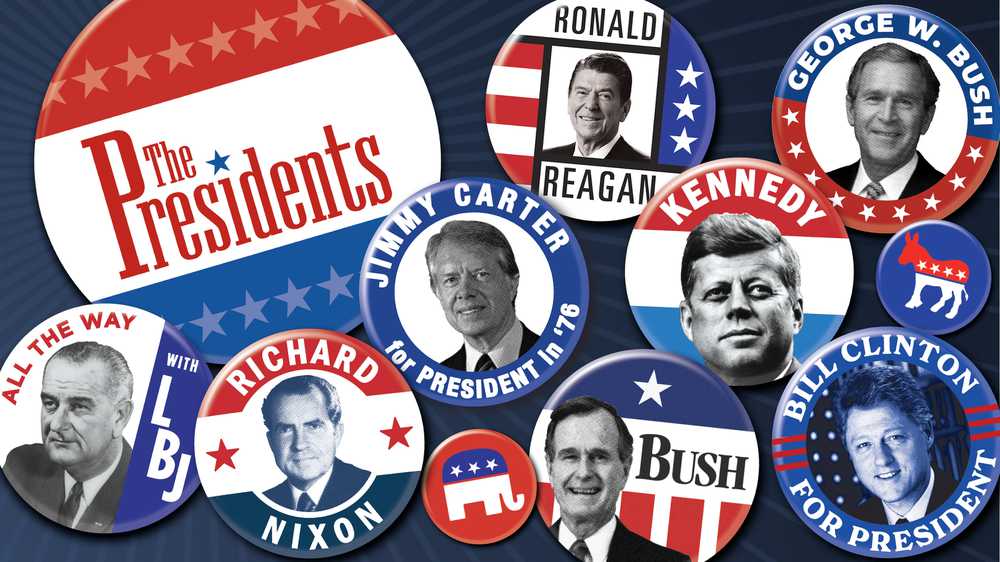
The Presidents Connect today's election issues with the past


Chapter:

A Surprising Presidential Bid (7:56)
Ronald Reagan campaigns for but loses the Republican nomination for president in 1976.
FDR
Truman
LBJ
Nixon
Carter

Now
Playing

Reagan
G H W Bush

Related Clips


TRUMAN, Chapter 24

The Conventions (6:41)
Despite Democrats' misgivings, President Truman is nominated at a dispirited Democratic Convention.
Watch Now

TRUMAN, Chapter 15

Hiroshima and Nagasaki (7:32)
The U.S. drops atomic bombs on two Japanese cities. The Japanese surrender and World War II ends.
Watch Now

CARTER, Chapter 5

Politics and Integrity (8:19)
Carter challenges election fraud and wins a seat in the state senate. He becomes known for his integrity. In 1966 he narrowly loses the governor's race to a segregationist.
Watch Now

CARTER, Chapter 7

"Jimmy Who?" (11:11)
Post-Watergate, Carter runs a grassroots presidential campaign with themes of honesty and trust. Though unknown, he emerges as the frontrunner.
Watch Now

GHW_BUSH, Chapter 8

A Race Horse Under Wraps (11:18)
Bush serves as ambassador to China, then CIA director. In the 1980 election, he becomes Ronald Reagan's running mate.
Watch Now

Chapter 1

Introduction (5:50)
Part one of a biography of Ronald Reagan, the 40th president.
Watch Now

Chapter 2

The Lifeguard (11:21)
Ronald Reagan grows up in a small town and works as a lifeguard on the Rock River.
Watch Now

Chapter 3

Actor (8:39)
Starting out in radio and sportscasting, Reagan moves to California to pursue an acting career.
Watch Now

Chapter 4

Communists in Hollywood (9:43)
Reagan, an active anti-Communist, ends his first marriage. He meets and marries actress Nancy Davis.
Watch Now

Chapter 5

Political Apprenticeship (9:26)
Reagan hones his speaking skills as a television host and spokesman for General Electric. He becomes known for his conservative views.
Watch Now

Chapter 6

The First Campaign (6:03)
Incumbent California governor Pat Brown underestimates his opponent Ronald Reagan's appeal. Reagan cultivates a heroic cowboy image.
Watch Now

Chapter 7

Governor and National Figure (12:37)
Reagan gains political confidence in two terms as governor of California.
Watch Now

Chapter 8

A Surprising Presidential Bid (7:56)
Ronald Reagan campaigns for but loses the Republican nomination for president in 1976.
Watch Now

Chapter 9

Landslide Victory (7:34)
Ronald Reagan defeats incumbent Jimmy Carter and is elected president in 1980.
Watch Now

Chapter 10

A Plan for Economic Recovery (10:13)
Reagan works to pass his economic package.
Watch Now

Chapter 11

Assassination Attempt (10:54)
Reagan is seriously wounded in an assassination attempt. Congress enacts his conservative economic agenda.
Watch Now

Chapter 12

Reaganomics (11:17)
Dramatic rises in unemployment, inflation, and homelessness signal the failure of Reagan's economic program.
Watch Now

Chapter 13

CreditsProduction credits for part one of the television program.
Watch Now

Chapter 14

Introduction (2:26)
Part two of a biography of Ronald Reagan, the 40th president.
Watch Now

Chapter 15

Battle on Two Fronts (11:53)
As the recession deepens, Reagan dramatically increases military spending in his crusade against Communism.
Watch Now

Chapter 16

The Nuclear Freeze Movement (7:07)
Demonstrators, including Reagan's daughter, protest his plan to increase nuclear weapons.
Watch Now

Chapter 17

The Strategic Defense Initiative (8:03)
Reagan promotes his plan for a missile defense system.
Watch Now

Chapter 18

Peace Through Strength (6:26)
Reagan broadly states his anti-Soviet "crusade for freedom," but works quietly with the Soviets on human rights issues.
Watch Now

Chapter 19

Missile Deployment in Europe (12:02)
In a controversial speech, Reagan calls the Soviet Union an "evil empire." Some fear the arms race will end in nuclear Armageddon.
Watch Now

Chapter 20

Morning in America (9:11)
America's economy has improved and national confidence is renewed. Reagan wins a second term in a landslide.
Watch Now

Chapter 21

Transitions (10:40)
Reagan loses his oldest advisers. Mikhail Gorbachev becomes the new Soviet leader, and Reagan embarks on a fateful secret course with Iran.
Watch Now

Chapter 22

Personal Diplomacy (10:55)
Reagan and Gorbachev summit in Geneva. Reagan refuses to make concessions on SDI.
Watch Now

Chapter 23

Reagan's Changing Role (5:37)
Despite successes both symbolic and real, Reagan becomes less engaged as president.
Watch Now

Chapter 24

Summit at Reykjavik (10:44)
Reagan and Gorbachev reach for the abolition of nuclear weapons. Though their talks fail, they are a breakthrough.
Watch Now

Chapter 25

The Iran-Contra Crisis (14:11)
The government's secret arms-for-hostages dealings with Iran are uncovered. Reagan learns that his staff has diverted profits to support the anti-Communist Contras in Nicaragua.
Watch Now

Chapter 26

Highs and Lows (11:50)
Americans forgive Reagan for Iran-Contra. The stock market crashes, the gap between rich and poor grows and the AIDS epidemic hits. The U.S. and U.S.S.R. sign a historic weapons treaty.
Watch Now

Chapter 27

The End of the Cold War (10:32)
After his lifelong crusade, Reagan witnesses Communism's demise in Eastern Europe, Afghanistan, Nicaragua and the Soviet Union.
Watch Now

Chapter 28

Into the Sunset (6:28)
Ronald Reagan retires to his California ranch. He will be diagnosed with Alzheimer's disease.
Watch Now

Chapter 29

CreditsProduction credits for part two of the television program.
Watch Now

  • REAGAN: Chapter 1
  • REAGAN: Chapter 2
  • REAGAN: Chapter 3
  • REAGAN: Chapter 4
  • REAGAN: Chapter 5
  • REAGAN: Chapter 6
  • REAGAN: Chapter 7
  • REAGAN: Chapter 8
  • REAGAN: Chapter 9
  • REAGAN: Chapter 10
  • REAGAN: Chapter 11
  • REAGAN: Chapter 12
  • REAGAN: Chapter 13
  • REAGAN: Chapter 14
  • REAGAN: Chapter 15
  • REAGAN: Chapter 16
  • REAGAN: Chapter 17
  • REAGAN: Chapter 18
  • REAGAN: Chapter 19
  • REAGAN: Chapter 20
  • REAGAN: Chapter 21
  • REAGAN: Chapter 22
  • REAGAN: Chapter 23
  • REAGAN: Chapter 24
  • REAGAN: Chapter 25
  • REAGAN: Chapter 26
  • REAGAN: Chapter 27
  • REAGAN: Chapter 28
  • REAGAN: Chapter 29
Choose a format

Choose a Video Format

Quicktime | Windows Media

Download a free player
QuickTime | Windows Media

Related Links


REAGAN
Learn more about Ronald Reagan.

Daughter from Danang
In 1975, thousands of Vietnamese children were evacuated to the U.S.

The Presidents: Gerald R. Ford
Reagan took on President Ford in 1976 -- and almost beat him.

Purchase Videos & DVDs

• See Comments

Loading comments...

You must log in to submit a comment. If you don't have an account at American Experience, you will need to register to comment. It's fast and easy to do!

Post a Comment (Limit 5000 Characters)

• View Transcripts •


Transcript: Chapter 08

Narrator: In his bid for the 1976 Republican nomination, Reagan faced enormous odds. He was taking on President Gerald Ford, and his own Republican party. He lost to Ford in New Hampshire, and kept on losing.

Martin Anderson: I think that that is a point in time, at least in my ... at least in my mind, when you really saw the essence of Reagan's character in its full flower. At that time if I recall correctly, the campaign was basically considered dead in the water. He had just lost five straight presidential primaries to President Ford. Maybe most importantly we were about two million dollars in debt.

Reporter: Does it change significantly any of the political plans of yours?

Reagan: No, not a bit. I'm going to run as hard as I can and figure I'm behind.

Anderson: And the question was should we quit. And I think the general attitude was, it's not should we? It's do we have any choice? And we had this discussion, and the consensus was, certainly you have to quit. And Reagan was just sitting there listening to this. "And I'm telling you right now," and he was looking at everybody in the room, "that I am going to run in every single primary from here to the convention even if I lose every single one."

Narrator: Reagan searched for an issue to ignite his campaign.

Reagan: Ladies and gentlemen, I'm deeply concerned about our defense posture. Despite the assurances of Dr. Kissinger and Mr. Ford, the United States is no longer the first military power on earth. The Soviet army is now twice the size of ours. Russia's annual investment in weapons, in strategic, strategic, and conventional, now runs some 50 percent ahead of ours. Under Kissinger and Ford, this nation's become number two in military power in a world where it's dangerous, if not fatal, to be second best.

Narrator: Televised repeatedly on the eve of the North Carolina primary, Reagan's warning of a new Communist menace brought him his first victory.

As the primaries moved to the more conservative South and West, the campaign gained momentum.

Reagan: We are ahead of our projections at this time, where we thought we would be. And many people say well you know is that just whistling past the graveyard or something. No, we're ahead to the extent that recently for the first time I said I believe that there was a very great possibility if not probability that I could go to the convention with enough delegates in advance to win on the first ballot.

Michael Deaver: After winning some of those primaries, none of us ever thought that it was out of our reach, something would happen that would turn that convention. And I think Reagan believed that.

Delegate: Madame chairman, the Commonwealth of Pennsylvania, home of the Phillies and the Pirates, casts ten votes for Governor Reagan and 93 votes for Gerald Ford.

Delegate: Twenty votes for Gerald R. Ford.

Ron Reagan: Ford had given his acceptance speech, um, and he then turned to the sky box where we were, where my father was, and ... and sort of beckoned my father to... to come down. I think he was conscious of the fact that nearly 50 percent of the people in the hall, maybe even more, really would have preferred Ronald Reagan to be the candidate.

Nancy Reagan: The response of those delegates was something unbelievable, just unbelievable. And there we were in this box way back in the back and we stood and he kept doing this to them, to tell them to sit down, they never would sit down. They wouldn't stop yelling and yelling for him and speech, speech. I just hoped that that Ronnie had something that he wanted to say because he said to me, as we were running, we didn't expect to be up in the stage and as we were running to get there, he said, I haven't the foggiest idea of what I'm going to say.

Reagan: If I could just take a moment. I had an assignment the other day. Someone asked me to write a letter for a time capsule that is going to be opened in Los Angeles 100 years from now. We live in a world in which the great powers have poised and aimed at each other horrible missiles of destruction, nuclear weapons that can in a matter of minutes arrive at each other's country and destroy virtually the civilized world we live in.

And suddenly it dawned on me those who would read this letter 100 years from now will know whether those missiles were fired. They will know whether we met our challenge. Whether they have the freedoms that we have known up until now will depend on what we do here ... Mr. President

Morris: The power of that speech was extraordinary. And you can just feel throughout the auditorium the palpable sense amongst the delegates that we've nominated the wrong guy.

Narrator: The next day Reagan bid farewell to his campaign staff.

Reagan: Sure, there's a disappointment in what happened, but the cause, the cause goes on. [Applause] Don't get cynical. Don't get cynical because look at yourselves and what you were willing to do, and recognize that there are millions and millions of Americans out there that want what you want, that want it to be that way, that want it to be a shining city on a hill.

Martin Anderson: On the plane going back, I went over, I had a convention ticket, and I asked him if he'd sign it as a souvenir. And what he wrote was, "We fought, we dreamed, and the dream is still with us." And looking back on it now, he never gave up, just kept right on going. It was, it was, you know, this incredible crushing defeat. And it didn't crush him.

He just came back up shook his head and said, OK, what's next. And that began the campaign for the year 1980.

back to top


Major funding provided by the National
Endowment for the Humanities and the Corporation for Public Broadcasting

NEH Corporation for Public Broadcasting


Any views, findings, conclusions, or recommendations expressed in this Web site do not necessarily represent those of the National Endowment for the Humanities.