Visit Your Local PBS Station PBS Home PBS Home Programs A-Z TV Schedules Support PBS Shop PBS Search PBS
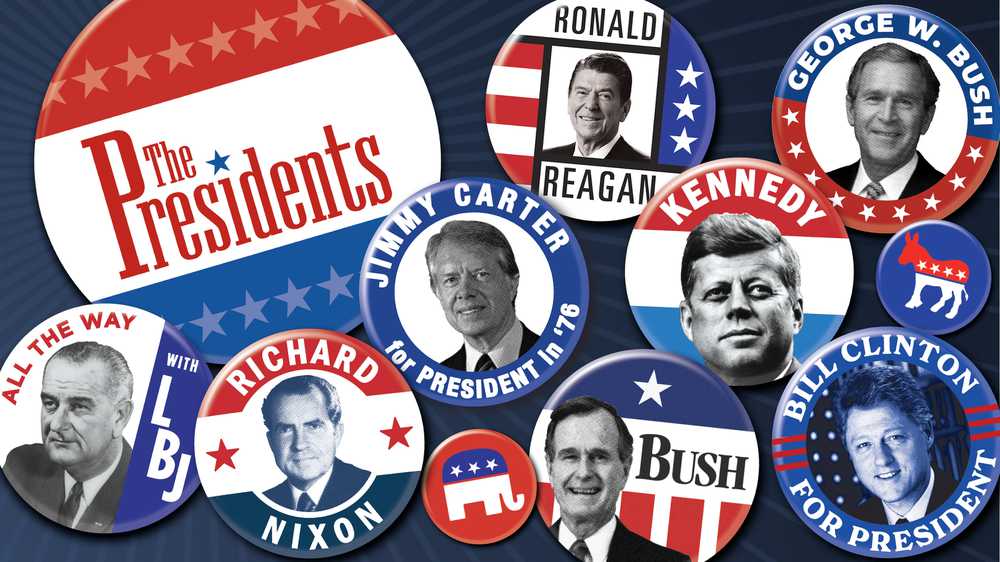
The Presidents Connect today's election issues with the past


Chapter:

The Nuclear Freeze Movement (7:07)
Demonstrators, including Reagan's daughter, protest his plan to increase nuclear weapons.
FDR
Truman
LBJ
Nixon
Carter

Now
Playing

Reagan
G H W Bush

Related Clips


REAGAN, Chapter 24

Summit at Reykjavik (10:44)
Reagan and Gorbachev reach for the abolition of nuclear weapons. Though their talks fail, they are a breakthrough.
Watch Now

TRUMAN, Chapter 28

Crossing the 38th Parallel (9:35)
MacArthur convinces Truman to fight the Chinese in Korea. Truman denies MacArthur's demand to use atomic weapons.
Watch Now

NIXON, Chapter 13

Living in a Bunker (9:19)
After National Guardsmen kill four students at Kent State University, tensions flare over the war. Nixon begins secretly taping White House conversations.
Watch Now

LBJ, Chapter 21

Questioning the War (9:05)
As Americans watch the Vietnam War in their living rooms, support for it wavers.
Watch Now

Chapter 1

Introduction (5:50)
Part one of a biography of Ronald Reagan, the 40th president.
Watch Now

Chapter 2

The Lifeguard (11:21)
Ronald Reagan grows up in a small town and works as a lifeguard on the Rock River.
Watch Now

Chapter 3

Actor (8:39)
Starting out in radio and sportscasting, Reagan moves to California to pursue an acting career.
Watch Now

Chapter 4

Communists in Hollywood (9:43)
Reagan, an active anti-Communist, ends his first marriage. He meets and marries actress Nancy Davis.
Watch Now

Chapter 5

Political Apprenticeship (9:26)
Reagan hones his speaking skills as a television host and spokesman for General Electric. He becomes known for his conservative views.
Watch Now

Chapter 6

The First Campaign (6:03)
Incumbent California governor Pat Brown underestimates his opponent Ronald Reagan's appeal. Reagan cultivates a heroic cowboy image.
Watch Now

Chapter 7

Governor and National Figure (12:37)
Reagan gains political confidence in two terms as governor of California.
Watch Now

Chapter 8

A Surprising Presidential Bid (7:56)
Ronald Reagan campaigns for but loses the Republican nomination for president in 1976.
Watch Now

Chapter 9

Landslide Victory (7:34)
Ronald Reagan defeats incumbent Jimmy Carter and is elected president in 1980.
Watch Now

Chapter 10

A Plan for Economic Recovery (10:13)
Reagan works to pass his economic package.
Watch Now

Chapter 11

Assassination Attempt (10:54)
Reagan is seriously wounded in an assassination attempt. Congress enacts his conservative economic agenda.
Watch Now

Chapter 12

Reaganomics (11:17)
Dramatic rises in unemployment, inflation, and homelessness signal the failure of Reagan's economic program.
Watch Now

Chapter 13

CreditsProduction credits for part one of the television program.
Watch Now

Chapter 14

Introduction (2:26)
Part two of a biography of Ronald Reagan, the 40th president.
Watch Now

Chapter 15

Battle on Two Fronts (11:53)
As the recession deepens, Reagan dramatically increases military spending in his crusade against Communism.
Watch Now

Chapter 16

The Nuclear Freeze Movement (7:07)
Demonstrators, including Reagan's daughter, protest his plan to increase nuclear weapons.
Watch Now

Chapter 17

The Strategic Defense Initiative (8:03)
Reagan promotes his plan for a missile defense system.
Watch Now

Chapter 18

Peace Through Strength (6:26)
Reagan broadly states his anti-Soviet "crusade for freedom," but works quietly with the Soviets on human rights issues.
Watch Now

Chapter 19

Missile Deployment in Europe (12:02)
In a controversial speech, Reagan calls the Soviet Union an "evil empire." Some fear the arms race will end in nuclear Armageddon.
Watch Now

Chapter 20

Morning in America (9:11)
America's economy has improved and national confidence is renewed. Reagan wins a second term in a landslide.
Watch Now

Chapter 21

Transitions (10:40)
Reagan loses his oldest advisers. Mikhail Gorbachev becomes the new Soviet leader, and Reagan embarks on a fateful secret course with Iran.
Watch Now

Chapter 22

Personal Diplomacy (10:55)
Reagan and Gorbachev summit in Geneva. Reagan refuses to make concessions on SDI.
Watch Now

Chapter 23

Reagan's Changing Role (5:37)
Despite successes both symbolic and real, Reagan becomes less engaged as president.
Watch Now

Chapter 24

Summit at Reykjavik (10:44)
Reagan and Gorbachev reach for the abolition of nuclear weapons. Though their talks fail, they are a breakthrough.
Watch Now

Chapter 25

The Iran-Contra Crisis (14:11)
The government's secret arms-for-hostages dealings with Iran are uncovered. Reagan learns that his staff has diverted profits to support the anti-Communist Contras in Nicaragua.
Watch Now

Chapter 26

Highs and Lows (11:50)
Americans forgive Reagan for Iran-Contra. The stock market crashes, the gap between rich and poor grows and the AIDS epidemic hits. The U.S. and U.S.S.R. sign a historic weapons treaty.
Watch Now

Chapter 27

The End of the Cold War (10:32)
After his lifelong crusade, Reagan witnesses Communism's demise in Eastern Europe, Afghanistan, Nicaragua and the Soviet Union.
Watch Now

Chapter 28

Into the Sunset (6:28)
Ronald Reagan retires to his California ranch. He will be diagnosed with Alzheimer's disease.
Watch Now

Chapter 29

CreditsProduction credits for part two of the television program.
Watch Now

  • REAGAN: Chapter 1
  • REAGAN: Chapter 2
  • REAGAN: Chapter 3
  • REAGAN: Chapter 4
  • REAGAN: Chapter 5
  • REAGAN: Chapter 6
  • REAGAN: Chapter 7
  • REAGAN: Chapter 8
  • REAGAN: Chapter 9
  • REAGAN: Chapter 10
  • REAGAN: Chapter 11
  • REAGAN: Chapter 12
  • REAGAN: Chapter 13
  • REAGAN: Chapter 14
  • REAGAN: Chapter 15
  • REAGAN: Chapter 16
  • REAGAN: Chapter 17
  • REAGAN: Chapter 18
  • REAGAN: Chapter 19
  • REAGAN: Chapter 20
  • REAGAN: Chapter 21
  • REAGAN: Chapter 22
  • REAGAN: Chapter 23
  • REAGAN: Chapter 24
  • REAGAN: Chapter 25
  • REAGAN: Chapter 26
  • REAGAN: Chapter 27
  • REAGAN: Chapter 28
  • REAGAN: Chapter 29
Choose a format

Choose a Video Format

Quicktime | Windows Media

Download a free player
QuickTime | Windows Media

Related Links


REAGAN
Learn more about Ronald Reagan.

Race for the Superbomb
The superpowers build the world's most powerful weapon.

Construction Footage
Screen a 1983 film on the building of the World Trade Center.

Purchase Videos & DVDs

• See Comments

Loading comments...

You must log in to submit a comment. If you don't have an account at American Experience, you will need to register to comment. It's fast and easy to do!

Post a Comment (Limit 5000 Characters)

• View Transcripts •


Transcript: Chapter 16

Narrator: By 1982 many Americans thought Reagan's weapons buildup was madness. It energized a movement to freeze production of nuclear weapons. Reagan's crusade was against Communism. The freeze movement's was against the bomb. Use of the bomb, scientist Carl Sagan warned, would doom the earth to a "nuclear winter." A fate more likely, Reagan's opponents felt, with yet more bombs -- in the hands of the man who pacified Berkeley with bayonets.

Robert Dallek, Historian: They saw him as something of a cowboy. They identified him with Barry Goldwater, who in the 1964 campaign says, we should think about lobbing one into the men's room of the Kremlin, you see.

People had bumper stickers in 1964 the Goldwater bumper sticker was "In Your Heart You Know He's Right." And the opponents said, "In Your Heart You Know He's Nuts," seeing him as, as a dangerous character who might provoke a nuclear war. And Reagan was seen by many people as the heir of that rhetoric and he frightens people.

Robert McNamara, Former Secretary of Defense: The stocks of both Warsaw Pact and NATO have been increasing dramatically. The deployments have been increasing. More and more one hears of the necessity of developing plans for fighting and winning nuclear wars. Inconceivable to me. Madness.

William Colby, Former CIA Director: It is precisely a freeze which would stop the further build up of weapons aimed at our country. I think the freeze is both in the mutual interest of our two countries and is certainly verifiable.

Senator Edward Kennedy: I reject the absurd theory that we can have fewer nuclear bombs tomorrow only if we build more nuclear bombs today.

Rally Host John Shea: We are the people. We want no more nuclear weapons.

Narrator: By the spring, the freeze had grown into an enormous grassroots movement. A freeze resolution was introduced in Congress. On June 12, nearly one million Americans rallied in Central Park to send a message to Ronald Reagan.

Dr. Helen Caldicott, Physicians for Social Responsibility: His motto is "Arm to Disarm." Those bombs will produce a nuclear war called On the Beach where every person on the earth dies of radioactive fallout within a few weeks. That's what these new bombs mean and that's what the president is doing. I thought he could possibly press the button. Yeah. I was terrified. And I didn't understand why people had this adulation for him.

Mike Farrell: Say a warm hello to Patti Davis.

Narrator: Reagan's daughter Patti Davis made her movement debut in the Hollywood Bowl -- Survival Sunday, 198l.

Patti Davis: We have a choice.

Patti Davis: My motives were the same as everybody else's. But I wasn't like everybody else. My father was sitting in the White House. So, you know, I was out there with the intention of speaking in a sense, for world peace, but the best thing I could have done for world peace that day, I think, was to stay home because really all I was communicating was that I was at war with my father.

Reporter: Have you ever tried to influence your father on this issue or would you ever try?

Patti Davis: We discuss it. We discuss it.

Narrator: Patti Davis met Dr. Caldicott at a star-studded fundraiser for the freeze movement at Hugh Heffner's Playboy mansion in Hollywood. She invited Dr. Caldicott to the White House to try to convert her father.

Dr. Caldicott : To break the ice, I said to him, "You probably don't know who I am, do you?" And he said, "Yes, I do. You're an Australian, you read On the Beach when you were a young girl, and you're scared of nuclear war." And I said, "Yes, that's right." He said, "Well I too am scared of nuclear war, but our ways to prevent it differ. I believe in building more bombs."

After we'd been talking for about an hour, he reached into his inside pocket and pulled a piece of paper out. And he'd written in this backhand writing of his "People who work for the nuclear weapons freeze are either KGB dupes or Soviet agents." And I said, "But that's from last month's Reader's Digest." And he said, "No," he said, "it's from my intelligence files."

Patti Davis: There was so much around, around that visit and in the background of that visit that made it impossible for it to be an open dialogue.

Dr. Caldicott: Patti didn't really participate, she was deeply involved watching, except at one point where I had a document I wanted to show him, and I was bending down to my briefcase to pick it up, and she said, I heard her say, "Daddy I know that what the doctor is saying is correct because I've got a 1982 Pentagon document to prove it." And he looked at her and he said, "That's a forgery." I mean, he didn't even ask her where it is. You know, what document it was. Anything. He just said, "That's a forgery." I was stunned.

Narrator: Dr. Caldicott recalled the meeting as "the most disconcerting" of her life. "I left the White House hardly able to walk from shock and staggered back to ... my hotel. ..." "I shared her fear about what the remaining years of my father's administration would bring," Patti wrote. "I sat at the dinner table that night drinking too much wine. ... I felt like I'd let down an entire movement." Dr. Caldicott is "a nice, caring person," Reagan wrote in his diary. "But she is all steamed up ... I ... couldn't get through her fixation. For that matter I couldn't get through to Patti. I'm afraid our daughter has been taken over by that whole gang."

William Sloane Coffin: Good-bye nuclear weapons. Forever good-bye.

back to top

 
About the SeriesPodcastsFor TeachersCreditsFeedback
Support PBS Programming
 

Produced by

WGBH

Major funding provided by the Alfred P. Sloan Foundation, the National
Endowment for the Humanities, and the Corporation for Public Broadcasting
Alfred P. Sloan Foundation National Endowment for the Humanities Corporation for Public Broadcasting

Major corporate funding provided by
Liberty Mutual

Additional Funding
provided by
Viewers Like You


Any views, findings, conclusions, or recommendations expressed in this Web site do not necessarily represent those of the National Endowment for the Humanities.

Send link to a friend

Shop PBS

Podcasts

Send us your feedback