How the U.S. Gov’t Turned Silicon Valley Into a Surveillance Partner
May 19, 2014
Share
Ten years later, Nick Merrill still can’t discuss the details of the data request that came hand delivered to him from the FBI. If he could, Merrill says, people would be shocked by the implications for their online privacy.
The request came by way of a National Security Letter, or NSL. The letters are not well known, but since 9/11 they’ve helped to dramatically expand the government’s ability to collect information about Americans directly from phone companies and Internet providers. Any FBI office can issue an NSL, without a court’s review and with a gag order.
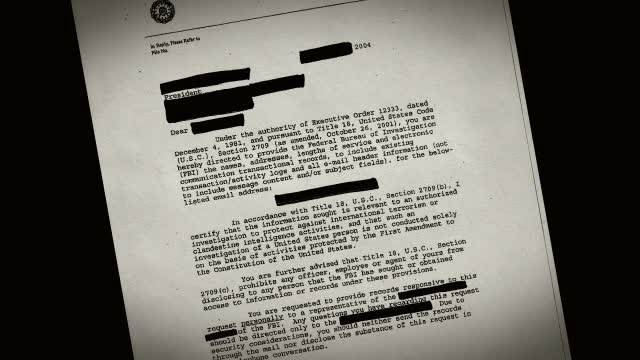
The NSL that Merrill received at his small web-hosting firm, Calyx, was one of 56,507 sent in 2004, according to figures from the Justice Department. The letter, embedded below, instructed Merrill that he was to “personally” deliver the records requested of him. It asked for a client’s name, addresses, “electronic communication transactional records” and “all e-mail header information.” Due to security concerns, the order read, “you should neither send the records through the mail nor disclose the substance of this request in any telephone conversation.”
“I was terrified to talk to anyone about it,” Merrill said in the above excerpt from Part Two of the FRONTLINE investigation, United States of Secrets. “I didn’t call any of my colleagues. I didn’t speak to anyone about it.”
Merrill was not even sure he could discuss the letter with his attorney, but unconvinced the order was legal, he chose to challenge it on constitutional grounds.
The decision set Merrill apart. Until 2013, no major Internet or phone company is known to have questioned the constitutionality of a National Security Letter. And while revelations by former NSA contractor Edward Snowden have shown that tech companies have often aided government surveillance unwittingly, the industry’s broad compliance with NSLs underscores its frequent role as a partner.
“To litigate is expensive,” Barton Gellman, who broke the Snowden story for The Washington Post, told FRONTLINE. “When you’re getting tens of thousands of these letters a year — to litigate any substantial number of them is ruinous — besides which, the big companies that are receiving these letters have regulatory business before the U.S. government and they don’t want to annoy the authorities.”
Nick Merrill’s National Security Letter:

Former Digital Editor
Related Documentaries
Latest Documentaries






Related Stories
Related Stories
Explore
Policies
Teacher Center

Jon and Jo Ann Hagler on behalf of the Jon L. Hagler Foundation
Corey David Sauer
Koo and Patricia Yuen
FRONTLINE is a registered trademark of WGBH Educational Foundation. Web Site Copyright ©1995-2025 WGBH Educational Foundation. PBS is a 501(c)(3) not-for-profit organization.
Funding for FRONTLINE is provided through the support of PBS viewers and by the Corporation for Public Broadcasting, with major support from Ford Foundation, and The Fialkow Family Foundation. Additional funding is provided the Abrams Foundation, Park Foundation, John D. and Catherine T. MacArthur Foundation, Heising-Simons Foundation, and the FRONTLINE Trust, with major support from Jon and Jo Ann Hagler on behalf of the Jon L. Hagler Foundation, and Corey David Sauer, and additional support from Koo and Patricia Yuen. FRONTLINE is a registered trademark of WGBH Educational Foundation. Web Site Copyright ©1995-2025 WGBH Educational Foundation. PBS is a 501(c)(3) not-for-profit organization.