Police Once Dropped a Bomb on a House in a Black Neighborhood in Philadelphia
The streaming premiere of ‘The Bombing of West Philly,’ a 1987 documentary from FRONTLINE’s archives, brings the deadly yet little-known events on Osage Avenue on May 13, 1985, into focus.
May 6, 2026
Share
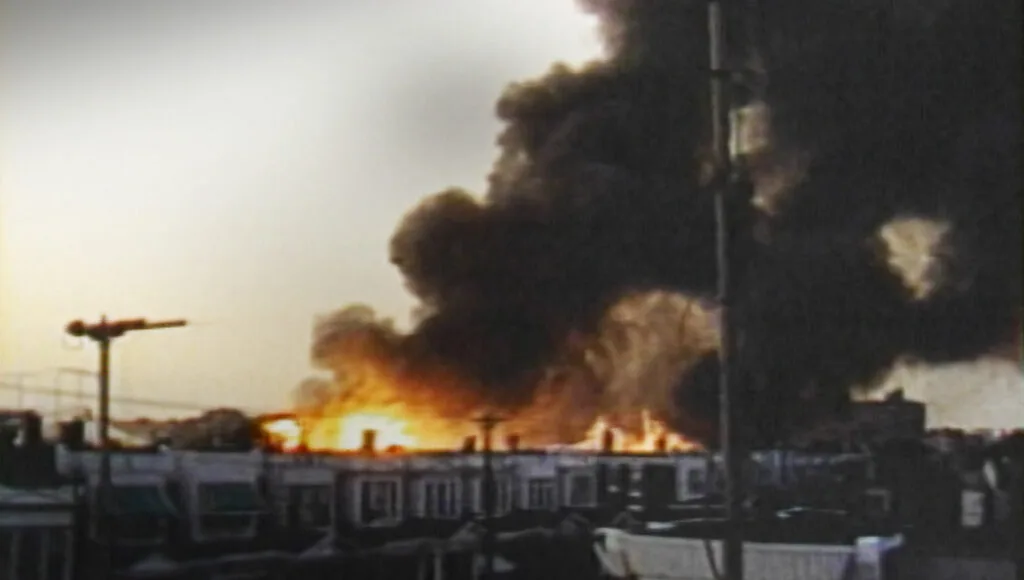
On May 13, 1985, a years-long feud between the Black revolutionary group MOVE and Philadelphia officials reached a bloody culmination that saw police dropping a military-grade bomb in a Black residential neighborhood and allowing the resulting fire to rage.
Eleven people were killed at MOVE’s headquarters, five of them children, and 61 neighboring homes were destroyed.
How it happened, and who was responsible, is the focus of The Bombing of West Philly, a 1987 documentary that is now available to watch online for the first time as part of an ongoing effort to make FRONTLINE’s multi-decade film archive widely available for streaming.
“We have to remember that this nation fought wars to prevent bombs from being dropped on its people in this country,” Novella Williams, a community activist, said in the documentary. “And we sit by and allow a little city government to borrow a helicopter and concoct a bomb with high military explosives, C-4, and drop it on our people? What kind of people are we?”
From correspondent Leon Dash and producer Martin Smith, the documentary is a powerful and nuanced exploration of that question, tracing back to the 1970s. That’s when MOVE arose against the backdrop of stark police brutality against Black Philadelphians. The film chronicles what led up to an initial standoff between the city and MOVE in 1978: After the group became more militant, police attempted to blockade MOVE and shut off utilities at its home base. An eventual confrontation left one police officer dead.
Years later, the film recounts, members of the group moved to a rowhouse in a middle-class Black neighborhood in West Philadelphia — and set in action a strategy to try to free members who had been imprisoned after the deadly 1978 standoff. MOVE employed tactics that alarmed the neighborhood’s residents, including blaring profane messages from a bullhorn, constructing a fortified bunker on their roof, and allegedly threatening and physically attacking neighbors. Neighbors also complained about children eating out of their garbage cans.
“What led to the neighbors’ complaints was the position that we took, that we had innocent people in prison, and we want them out. And, our demonstrations to get our people out of prison,” MOVE member Ramona Africa said in the film. “We told people that we were pushed to take the position that we’re taking, that if they wanted to do something to eliminate the situation, to relieve it in some way, that they should be down in City Hall complaining.”
“They said, ‘We’re going to put pressure on you until you put pressure on City Hall and make them let our people go,” one neighbor, Gerald Renfrow, said in the documentary.
"We have to remember that this nation fought wars to prevent bombs from being dropped on its people in this country. And we sit by and allow a little city government to borrow a helicopter and concoct a bomb with high military explosives, C-4, and drop it on our people? What kind of people are we?”
For months, the neighborhood’s complaints went unaddressed by city officials — including Wilson Goode, Philadelphia’s first Black mayor. Then, in the spring of 1985, neighbors called on Pennsylvania’s governor for help, and Goode was forced to take action. He turned the matter over to the police.
“The final point I gave to the police commissioner was, ‘Take your time, prepare a good plan, we can then proceed with a tremendous amount of order,’” Goode said in testimony that’s excerpted in the documentary.
In stunning detail, the documentary unspools what happened next. On May 12, police evacuated the neighborhood, telling residents they could return in 24 hours. By 5:35 a.m. the following morning, police surrounded the MOVE compound at 6221 Osage Avenue and gave four members named in arrest warrants 15 minutes to surrender. The police believed there were at least six adults and as many as 12 children in the house.
When MOVE refused to surrender, the police opened up with tear gas, smoke and water cannons. They also fired at least 10,000 rounds of live ammunition into the house and used explosives. After a morning of gunfire and explosions, a ten-hour standoff followed.
Then, at 5:27 p.m., with no warning to MOVE, police used a helicopter to drop a bomb containing powerful military explosives on 6221 Osage Ave.
In footage that appears in the documentary, a police officer can be heard saying, “They won’t call the police commissioner a motherf****r any more,” as the house burns.
Ramona Africa was the only adult MOVE member in the house to survive. Six others were killed, along with five children. The youngest, Tomaso Africa, was just nine years old.
The bombing and the resulting fire destroyed not just the MOVE compound, but also the homes of frustrated neighbors who had complained about MOVE’s tactics to city officials and begged for their help.
“I’m very, very bitter. And I make no bones about it, and I don’t care where chips fall because I know one thing, if it would ever happen in a white neighborhood, they would’ve snuffed it out, no question,” said Gerald Renfrow, one of more than 250 people left homeless.
“Is this the penalty for being Black in this country?” Renfrow asked.
The Philadelphia City Council issued a formal apology for the MOVE bombing in 2020, acknowledging “the fundamental injustice, cruelty, brutality, and inhumanity” of the event. No city officials were ever criminally charged.
Watch the Documentary
The Bombing of West Philly
Reporting the truth takes determination.
While journalism is under fire around the world, your gift ensures that our investigations stay fearless and free.
Senior Digital Writer, FRONTLINE
Related Documentaries
Latest Documentaries
Related Stories
The Bombing of West Philly
Related Stories
The Bombing of West Philly
Explore
Policies
Teacher Center

Jon and Jo Ann Hagler on behalf of the Jon L. Hagler Foundation
Corey David Sauer
Koo and Patricia Yuen
FRONTLINE is a registered trademark of WGBH Educational Foundation. Web Site Copyright ©1995-2025 WGBH Educational Foundation. PBS is a 501(c)(3) not-for-profit organization.
Funding for FRONTLINE is provided through the support of PBS viewers and by the Corporation for Public Broadcasting, with major support from Ford Foundation, and The Fialkow Family Foundation, as part of the Plum Bush Foundation. Additional funding is provided the Abrams Foundation, Park Foundation, John D. and Catherine T. MacArthur Foundation, Heising-Simons Foundation, and the FRONTLINE Trust, with major support from Jon and Jo Ann Hagler on behalf of the Jon L. Hagler Foundation, and Corey David Sauer, and additional support from Koo and Patricia Yuen. FRONTLINE is a registered trademark of WGBH Educational Foundation. Web Site Copyright ©1995-2025 WGBH Educational Foundation. PBS is a 501(c)(3) not-for-profit organization.