|
Has the universe always existed? How did it become a place that could harbor
life? What was the birth of our planet like? Are we alone, or are there alien worlds waiting to be discovered?
NOVA presents some startling new answers in "Origins," a groundbreaking
four-part NOVA miniseries hosted by dynamic astrophysicist Neil deGrasse Tyson, Director of the Hayden
Planetarium at the American Museum of Natural History. Tyson leads viewers on a cosmic journey to the beginning of time and
into the distant reaches of the universe, searching for life's first stirrings
and its traces on other worlds.
The series' first hour, "Origins: Earth is Born," gives viewers a spectacular
glimpse of the tumultuous first billion years of Planet Earth—a time of
continuous catastrophe. Vivid animation lets viewers witness the traumatic
birth of the moon from a titanic collision between Earth and an object believed
to have been the size of Mars. Bombarded by meteors and comets, rocked by
massive volcanic eruptions, and scoured by hot acid rain, the early Earth seems
a highly improbable place for life to have taken root. Despite such violent
beginnings, scientists have found new clues that life-giving water and oxygen
appeared on our planet much earlier than previously thought.
Hour Two, "Origins: How Life Began," zeroes in on the mystery of exactly how it
happened. Join the hunt for hardy microbes that flourish in the most unlikely
places: inside rocks in a mine shaft two miles down, inside a cave dripping
with acid as strong as a car battery's, and in noxious gas bubbles erupting
from the Pacific ocean floor. The survival of these tough microorganisms
suggests they may be related to the planet's first primitive life forms. Tyson
deepens the search by investigating tantalizing and controversial chemical
"signatures" of life inside three-billion-year-old rocks and meteorites found
around the world.
In Hour Three, "Origins: Where are the Aliens?," Tyson explores such
provocative questions as: would "ETs" resemble us or the creatures of science
fiction? Are there "aliens" already amongst us on Planet Earth—brainy
creatures whose intelligence is very different from our own? And are planets on
which life can flourish rare or common in our universe?
Hour Four starts with a bang—the big bang in which everything began.
"Origins: Back to the Beginning" explores how the colossal, mind-boggling
forces of the early universe made it possible for habitable worlds to emerge.
The clues begin with a race among scientists to capture lingering echoes of the
big bang's ferocious energy in a microwave "whisper" from deep space. The race
pits underdog astronomer Tony Readhead and his improvised detector
in the high Andes against NASA scientists and their state-of-the-art satellite
probe. Tyson shares his excitement with viewers as computer animation of the
big bang's echo emerges on the screen. It's as close as we can get to a
"photograph" of the primordial universe. Here we glimpse the seeds from which
all the galaxies, stars, and planets eventually grew.
In the search for answers to the many provocative questions the program raises,
Tyson catches up with one of astronomy's most exciting recent findings:
the discovery of the first planets outside our own solar system.
Detecting more than 100 of these planets over the last few years, astronomers
have developed an ingenious technique worthy of Sherlock Holmes for deducing
whether or not they might be suitable for life.
As for the ultimate question—whether we can contact an alien
civilization—Tyson tells us to stay tuned, reminding us that the quest
for origins has involved us in one incredible surprise after another.
|
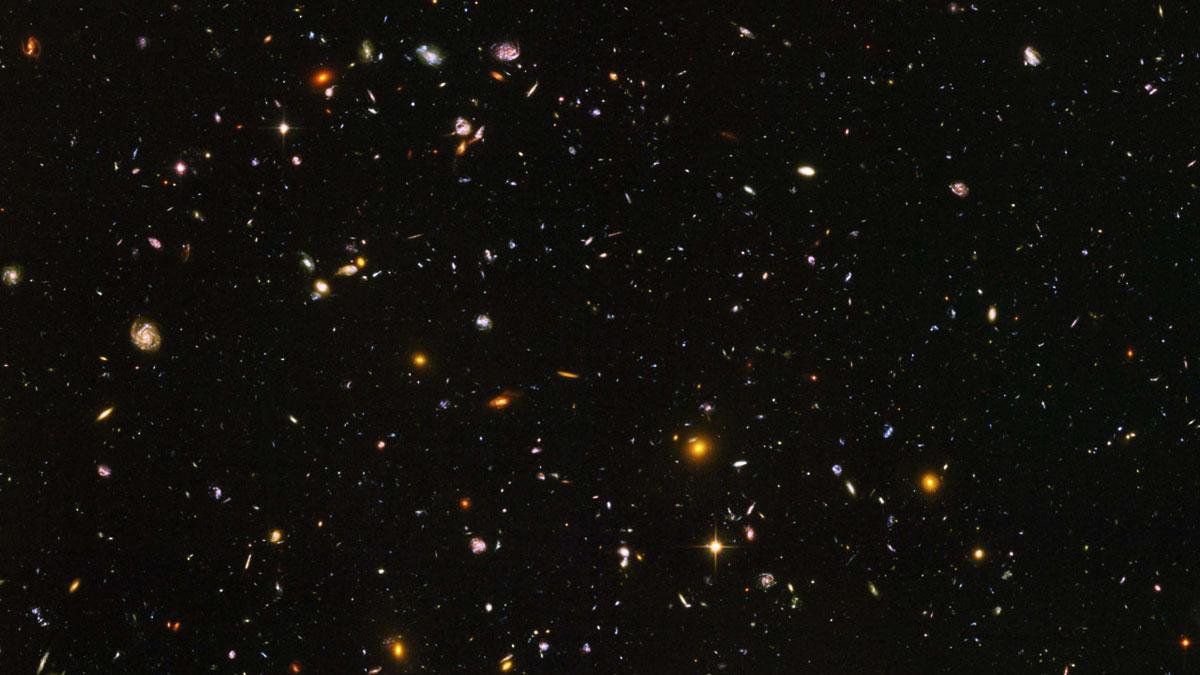
Scientists featured in the "Origins" miniseries ponder four cosmic beginnings: of planet Earth, of life, of intelligent life, and of the universe itself.
|
|
Back to the Origins homepage for more articles, interviews,
interactives, and slide shows.
|
|
|