
|
|
|
|
|
|
This hour-long program is divided into six chapters. Choose
any chapter below and select QuickTime, RealVideo, or Windows
Media Player to begin viewing. If you experience difficulty
viewing, it may be due to high demand. We regret this and
suggest you try back at another time.
Technical Help
| Feedback |
Program Credits
|
Program Transcript
|

|
|
|
|

watch chapter 1 in
Quicktime
RealVideo
Windows Media:
hi
|
low
|
|
Discovering the Big Bang
This chapter:
-
points out that early cosmologists believed the cosmos
always existed—an idea known as steady state theory.
explains the nature of light. -
notes that space bodies emit microwave and radio wave
radiation, and the sky is studied using these forms of
radiation.
-
reports how scientists discovered the cosmic background
radiation.
states how the Big Bang was discovered.
running time 8:55
|
|
|
|

|
|
|
|
watch chapter 2 in
Quicktime
RealVideo
Windows Media:
hi
|
low
|
|
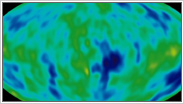
A 30-Year Search
This chapter:
-
reports on Dr. Arno Penzias' Nobel Prize award for his
discovery of the Big Bang.
-
questions how the universe became filled with galaxies.
-
presents the results of the Cosmic Background Explorer
(COBE) satellite that was launched into near Earth orbit
to study microwave radiation patterns.
running time 7:52
|
|
|
|

|
|
|
|
watch chapter 3 in
Quicktime
RealVideo
Windows Media:
hi
|
low
|
|
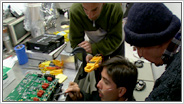
Race for a Sharper Image
This chapter:
-
explains how the cosmic microwave background can reveal
information about the properties of the universe including
its age, composition, number of atoms, and expansion rate.
-
follows the scientific teams working on the Cosmic
Background Imager (CBI) and the Wilkinson Microwave
Anisotropy Probe (WMAP) as they compete to provide a
higher-resolution picture of the cosmic microwave
background.
running time 8:21
|
|
|
|

|
|
|
|
watch chapter 4 in
Quicktime
RealVideo
Windows Media:
hi
|
low
|
|
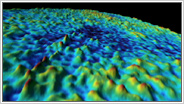
The Picture Emerges
This chapter:
-
describes WMAP's difficult three-month journey to its
destination.
-
reports on findings from the CBI and WMAP probes.
-
explains that the images can be interpreted to reach back
to almost the Big Bang, when the universe was the size of
a pea.
-
explains how stars form and explode, thereby providing
enough energy for the remaining iron to undergo reactions
to create all known remaining elements.
running time 9:09
|
|
|
|

|
|
|
|

watch chapter 5 in
Quicktime
RealVideo
Windows Media:
hi
|
low
|
|
Forging the Elements
This chapter:
-
notes that stars forge all elements in the universe.
explains how elements are formed in a star. explains how humans are made of stardust.
running time 8:37
|
|
|
|

|
|
|
|
watch chapter 6 in
Quicktime
RealVideo
Windows Media:
hi
|
low
|
|
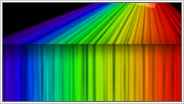
A Universe Hospitable to Life
This chapter:
-
asks whether life and the conditions for life are
widespread throughout the universe.
-
shows the Deep Extragalactic Imaging Multi-Object
Spectrograph being used to study light from distant
galaxies.
-
explains that elements such as oxygen and others are
measured to determine a galaxy's readiness for life and
that our Sun's levels of elements are used as a benchmark
to consider whether a distant galaxy could have planets
and life.
-
reports that at least a thousand galaxies have been
detected that have elements that, over a great deal of
time, could lead to life.
running time 6:45
|
|
|
|





