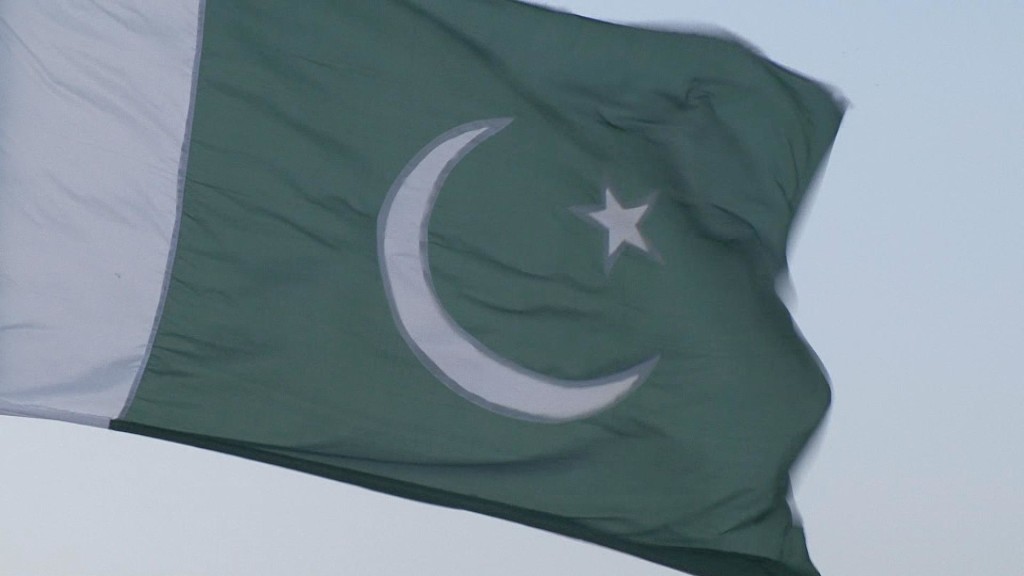
NYT Covers “Little-Known Ethnic Rebellion” as Pakistan’s Feud with Paper Continues
August 25, 2011
Share
For the past 18 months, dozens of tortured, bullet-riddled bodies have mysteriously turned up in Pakistan’s southwestern province of Balochistan. They were journalists, lawyers, students, teachers and farm workers somehow caught up in the Baloch insurgency, an ethnic nationalist rebellion the Pakistani Army has for decades gone to great lengths to suppress and that rights groups have long raised concerns about.
Though militancy in Pakistan is frequently front-page news, this deadly separatist conflict in the country’s biggest but least developed province receives rare coverage from mainstream media in Pakistan, let alone internationally — in part because the Pakistani state makes it extraordinarily difficult to report from there. But on Wednesday, The New York Times published a story on the ongoing conflict by veteran reporter Carlotta Gall featuring a rare interview with its exiled leader Brahumdagh Bugti.
Bugti is considered a terrorist by the Pakistani state. According to State Department embassy cables released by WikiLeaks last year, Pakistan and Afghanistan had been involved in a bitter dispute over Afghanistan’s refusal to hand him over. At the time of the cables’ release, Bugti had apparently left Afghanistan, but his location was unknown.
Gall found the exiled leader in Geneva, where he moved with his family in October 2010. In the interview, Bugti urged the U.S. to cut off military aid to Pakistan, which he said was being diverted to suppress the Baloch people, and sent a searing message to the Pakistani state,
“The people are more angry and they will go to the side of those using violence, because if you close all the peaceful ways of struggle, and you kidnap the peaceful, political activists, and torture them to death and throw their bodies on roadsides, then definitely they will go and join the armed resistance groups.”
The piece delves into the abuses human rights group say they have documented — including enforced disappearances and extrajudicial killings by Pakistani security forces, as well the targeting of teachers by armed Baloch militant groups. In July, Human Rights Watch (HRW) issued a 132-page report documenting abuse by Pakistani security forces, including 45 cases of enforced disappearances and torture in 2009 and 2010.
The state has consistently denied these claims, and on Tuesday, Major General Obaidullah Khattak, the chief of the Frontier Corps in the province, the paramilitary force accused in the report, rejected the HRW report, calling it an attempt to encourage terrorists.
In late July, the Times also reported that Pakistani journalists and scholars in the U.S. had said Pakistani officials warned them “against speaking out on politically delicate subjects like the indigenous insurgency in Balochistan or accusations of human rights abuses by Pakistani soldiers.”
Gall’s article comes as the paper and Pakistan seem to be in the most heated of exchanges. Though the Pakistani state has frequently contested critical reports, the Army took particular offense at an article published by Jane Perlez in June asserting that Army chief Gen. Ashfaq Parvez Kayani was “clinging to his job.”
Anger only intensified after the paper reported that two anonymous senior U.S. administration officials said they had evidence the Pakistani spy agency, the ISI, had directed the attack that killed journalist Syed Saleem Shahzad in late May in an effort to silence him.
Military spokesperson Maj. Gen. Athar Abbas responded, calling the Times‘ reports “baseless and mischievous,” and struck back by referencing a sore point in the paper’s history. A military press release stated,
“In recent weeks the New York Times has continued to publish wild claims presented as news stories on the basis on information supposedly provided by unnamed US officials. [Gen. Abbas] said in most cases such news reports have quoted anonymous US sources, bringing the veracity of their reporting into question. Recalling NYT’s apology of March 2004 about some of its coverage of the Iraq war, General Abbas said at that time the newspaper had this to say: ‘In some cases, information that was controversial then, and seems questionable now, was insufficiently qualified or allowed to stand unchallenged. Looking back, we wish we had been more aggressive in reexamining the claims as new evidence emerged-or failed to emerge’. The Military Spokesman further said: “if the newspaper continues with its vilifying campaign without any concrete evidence, I am afraid at some point it may end up expressing its deep regret the way it did in the case of its Iraq coverage.”
In its frequent editorials on Pakistan, the paper has not been shy about criticizing the country, even calling for the U.S. to work to “hasten the departure” of ISI chief Lt. Gen. Ahmed Shuja Pasha.
Support provided by:
Learn More
Latest Documentaries



Explore
Policies
Teacher Center

Jon and Jo Ann Hagler on behalf of the Jon L. Hagler Foundation
Corey David Sauer
Koo and Patricia Yuen
FRONTLINE is a registered trademark of WGBH Educational Foundation. Web Site Copyright ©1995-2025 WGBH Educational Foundation. PBS is a 501(c)(3) not-for-profit organization.
Funding for FRONTLINE is provided through the support of PBS viewers and by the Corporation for Public Broadcasting, with major support from Ford Foundation, and Fialkow Family Foundation. Additional funding is provided the Abrams Foundation, John D. and Catherine T. MacArthur Foundation, Park Foundation, Heising-Simons Foundation, and the FRONTLINE Trust, with major support from Jon and Jo Ann Hagler on behalf of the Jon L. Hagler Foundation, and Corey David Sauer, and additional support from Koo and Patricia Yuen. FRONTLINE is a registered trademark of WGBH Educational Foundation. Web Site Copyright ©1995-2026 WGBH Educational Foundation. PBS is a 501(c)(3) not-for-profit organization.