Money, Power and Wall Street
April 24, 2012
59m
In a special investigation, FRONTLINE goes inside the struggles to rescue and repair a shattered economy
Money, Power and Wall Street
Part One
April 24, 2012
59m
NOW PLAYING
Part Two
April 24, 2012
54m
Part Three
May 1, 2012
57m
Part Four
May 1, 2012
56m
Share
In the special four-hour investigation, Money, Power and Wall Street, FRONTLINE tells the inside story of the struggles to rescue and repair a shattered economy, exploring key decisions, missed opportunities, and the unprecedented and uneasy partnership between government leaders and titans of finance that affects the fortunes of millions of people around the world.
Transcript
Credits
Journalistic Standards
Support provided by:
Learn More
Most Watched





The FRONTLINE Newsletter

Related Stories
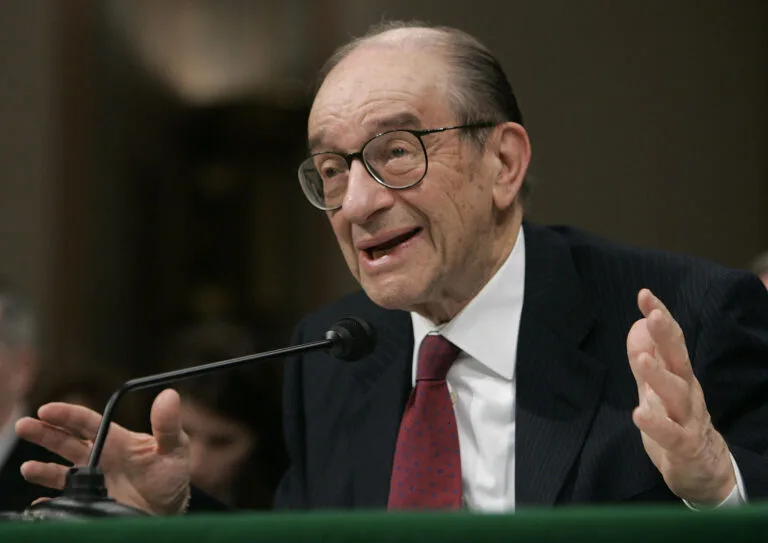
Unpacking the Alan Greenspan Era — and the Crisis That Followed

Abacus: Small Enough to Jail
S.&P. to Pay $1.38 Billion for Once Rave Ratings of Toxic Mortgages
Pioneer Behind Credit Derivatives is Leaving JPMorgan
The Financial Crisis Five Years Later — How It Changed Us
JPMorgan To Lose $842 Million In Toxic Ala. Sewer Deal
Financial Regulators Turn Their Focus To Non-Banks
U.S. Sues Bank of America for $1 Billion Over Mortgage Sales
New Mortgage Task Force Charges JPMorgan With “Systemic Fraud”
Deadlines Loom To Bring Financial Crisis Cases
Neil Barofsky on the “Broken Promises” of the Bank Bailouts
The State of Reform: Dodd-Frank at Two Years Old
Do Credit Ratings Still Matter?
Trouble At UBS For Obama’s Favorite Banker?
Home Foreclosure Rates on the Rise Again
Sheila Bair: From Regulator To Watchdog
Small Banks Under Pressure From New Capital Requirements
How Much Did the Financial Crisis Cost?
Shadow Banking Down From Crisis, But for How Long?
Watch Now: Six Billion Dollar Bet
Is the U.S. Economy Prepared for the Fallout From Greece?
JPMorgan Loss Poses Early Test For Dodd-Frank Pay Rules
What Can We Learn from JPMorgan’s $2 Billion Loss?
What’s the Status of the Dodd-Frank Financial Overhaul?

The Financial Crisis Is Like… Sangria?
Live Chat 1 p.m. ET: Can Wall Street Change?
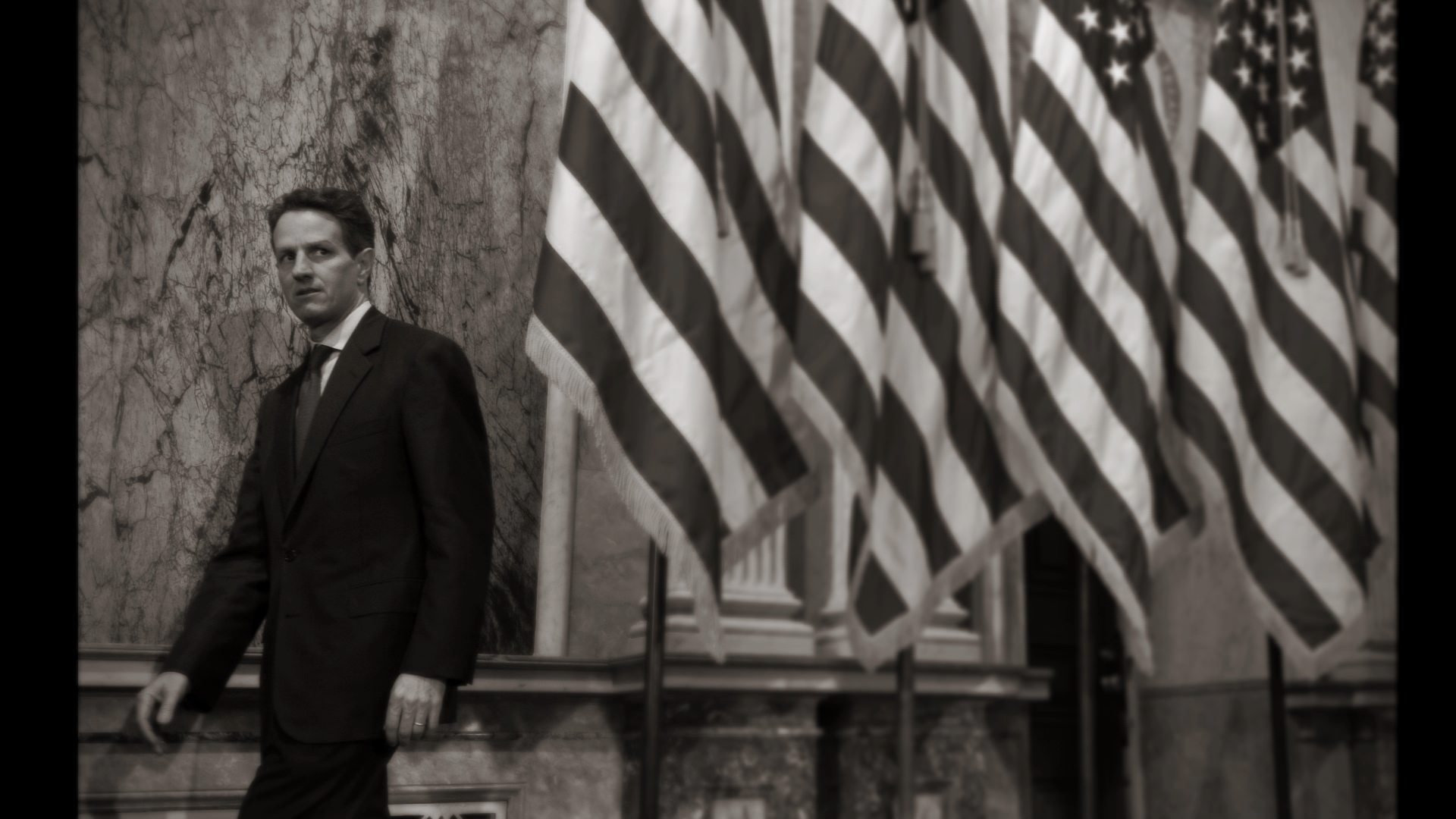
The Buzz Around That Tim Geithner Scene…
Did the Fed’s Emergency Lending Prop Up “Too Big to Fail”?
Live Chat 1 p.m ET: The Battles Behind Closed Doors
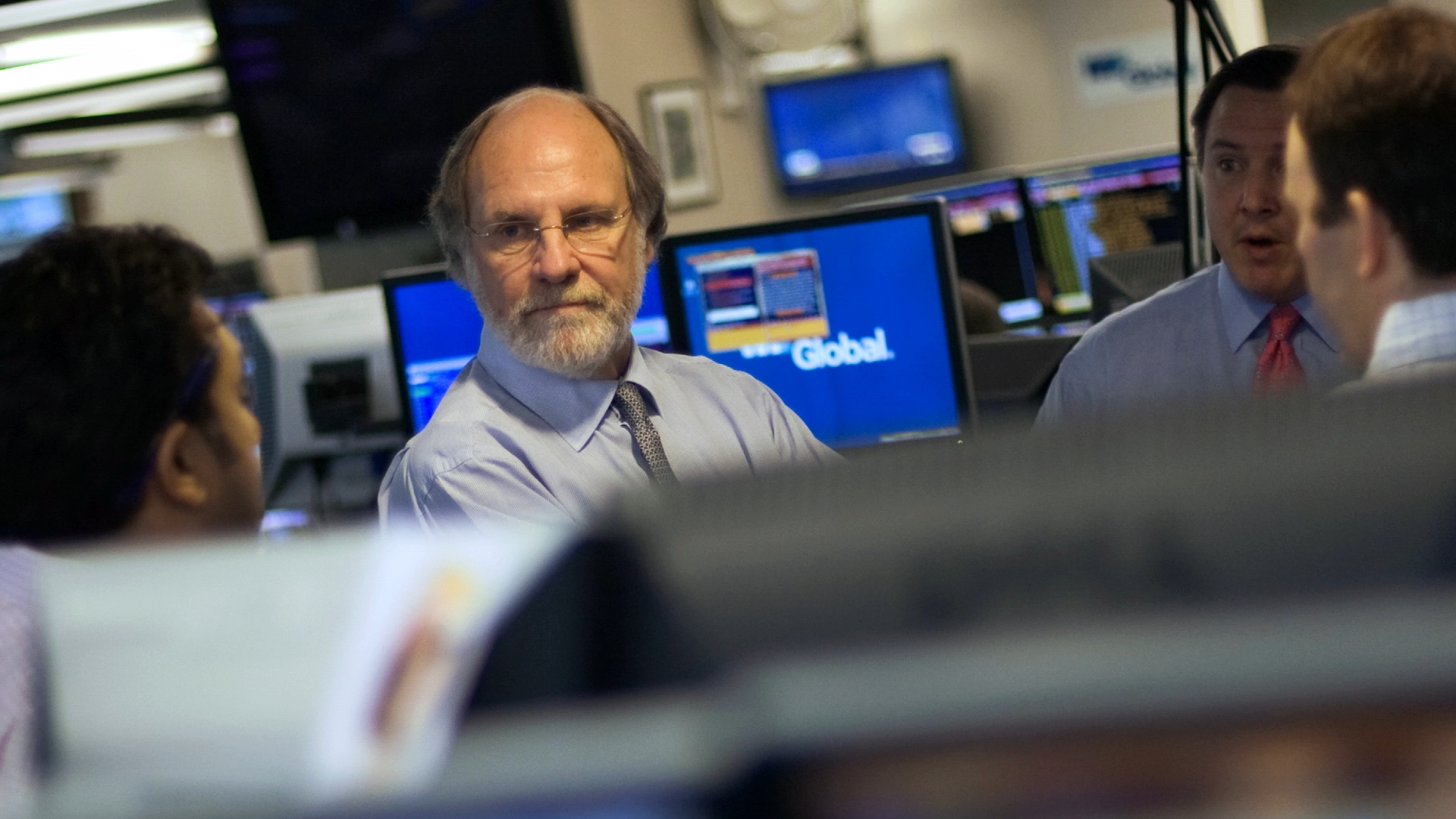
Lessons Not Learned at MF Global
What Has Occupy Wall Street Been Up To?
From Bear to Lehman: Documents Reveal an Alternate History
Live Chat 2:30 p.m. ET: How Do You Stop A Financial Meltdown? (Hour 2)
The Buzz Around “Money, Power and Wall Street”
Live Chat 1 p.m. ET: Down the Financial Rabbit Hole (Hour 1)
Next Week: How the Financial Crisis Never Ended
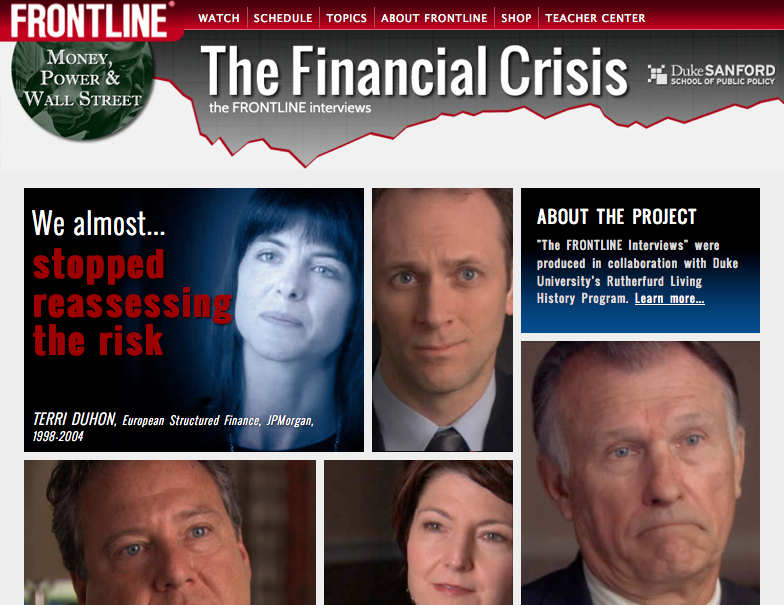
Introducing “The FRONTLINE Interviews”
Bloomberg: “Money, Power & Wall Street” “Takes No Prisoners”
Dig Deeper: What You Need to Know About the Financial Crisis
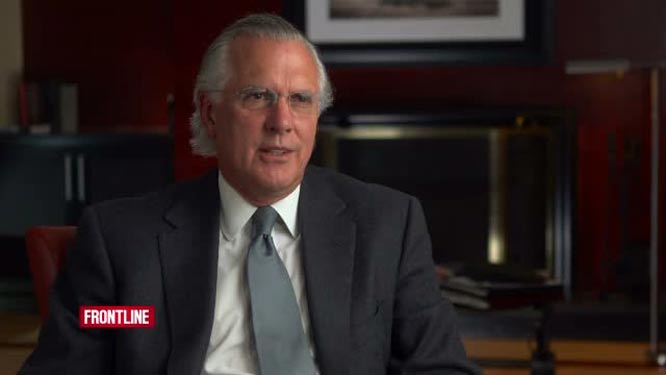
Top Fed Official: “The Moment Is Now” to Break Up Big Banks
Related Stories
Unpacking the Alan Greenspan Era — and the Crisis That Followed
Abacus: Small Enough to Jail
S.&P. to Pay $1.38 Billion for Once Rave Ratings of Toxic Mortgages
Pioneer Behind Credit Derivatives is Leaving JPMorgan
The Financial Crisis Five Years Later — How It Changed Us
JPMorgan To Lose $842 Million In Toxic Ala. Sewer Deal
Financial Regulators Turn Their Focus To Non-Banks
U.S. Sues Bank of America for $1 Billion Over Mortgage Sales
New Mortgage Task Force Charges JPMorgan With “Systemic Fraud”
Deadlines Loom To Bring Financial Crisis Cases
Neil Barofsky on the “Broken Promises” of the Bank Bailouts
The State of Reform: Dodd-Frank at Two Years Old
Do Credit Ratings Still Matter?
Trouble At UBS For Obama’s Favorite Banker?
Home Foreclosure Rates on the Rise Again
Sheila Bair: From Regulator To Watchdog
Small Banks Under Pressure From New Capital Requirements
How Much Did the Financial Crisis Cost?
Shadow Banking Down From Crisis, But for How Long?
Watch Now: Six Billion Dollar Bet
Is the U.S. Economy Prepared for the Fallout From Greece?
JPMorgan Loss Poses Early Test For Dodd-Frank Pay Rules
What Can We Learn from JPMorgan’s $2 Billion Loss?
What’s the Status of the Dodd-Frank Financial Overhaul?
The Financial Crisis Is Like… Sangria?
Live Chat 1 p.m. ET: Can Wall Street Change?
The Buzz Around That Tim Geithner Scene…
Did the Fed’s Emergency Lending Prop Up “Too Big to Fail”?
Live Chat 1 p.m ET: The Battles Behind Closed Doors
Lessons Not Learned at MF Global
What Has Occupy Wall Street Been Up To?
From Bear to Lehman: Documents Reveal an Alternate History
Live Chat 2:30 p.m. ET: How Do You Stop A Financial Meltdown? (Hour 2)
The Buzz Around “Money, Power and Wall Street”
Live Chat 1 p.m. ET: Down the Financial Rabbit Hole (Hour 1)
Next Week: How the Financial Crisis Never Ended
Introducing “The FRONTLINE Interviews”
Bloomberg: “Money, Power & Wall Street” “Takes No Prisoners”
Dig Deeper: What You Need to Know About the Financial Crisis
Top Fed Official: “The Moment Is Now” to Break Up Big Banks
Part One
PRODUCED BY Martin Smith Marcela Gaviria
PRODUCER Thomas Jennings
CO-PRODUCERS Linda Hirsch Ben Gold
WRITTEN BY Martin Smith and Marcela Gaviria
NARRATOR: Every day, tens of thousands of workers make their way to Wall Street. They work for banks, brokerages, hedge funds, insurance companies and mortgage lenders. It is the largest single sector of the American economy, an industry that is almost double the size of America’s manufacturing sector, a business with enormous power and global reach.
It is the industry that led America and the world into its worst economic crisis since the Great Depression.
The banks say they exist to create wealth, holding in trust our collective worth, promising to invest the trillions of dollars that stream in from businesses, pension funds and savings accounts that belong to all of us.
One morning in the fall of 2011, bankers arriving in Lower Manhattan were caught by surprise.
OCCUPY WALL STREET DEMONSTRATORS: This is what democracy looks like! We got sold out, banks got bailed out!
POLICE OFFICER: On the sidewalk! You must go on the sidewalk!
NARRATOR: The recession had destroyed $11 trillion of Americans’ net worth. A recovery seemed far off. Occupy Wall Street wanted bankers held responsible.
DAVID WESSEL, The Wall Street Journal: Most Americans think, and with good reason, that Wall Street got bailed out and Main Street didn’t. We have very high unemployment. We lost 8.5 million jobs in the recession. People’s houses aren’t worth what they paid for them. A lot of them don’t have jobs. Their kids are graduating from college and are moving back in.
DEMONSTRATORS: This is what democracy looks like!
NARRATOR: Some protesters were calling for bankers to be prosecuted.
DENNIS KELLEHER, Financial Reform Advocate: It is pretty clear, actually, that there was massive illegality going on. And if somebody with subpoena power was intent on prosecuting that, I don’t think there’s really much doubt that they would be quite successful in criminal prosecutions.
DEMONSTRATORS: We are the 99 percent! We are the 99 percent!
[Twitter #frontline]
NARRATOR: In a matter of weeks, Occupy demonstrations spread to scores of cities across America and the world, calling for radical changes in the banking system. Bankers responded by saying that the answer is to move on and get back to business.
STEVE BARTLETT, Financial Services Roundtable: Some of our companies made a series of bad mistakes, and— and— and— and we all paid for them, including— and— and— and it lead to the economic crisis.
MARTIN SMITH, Correspondent: But what makes people upset is that — I mean, what— you know, a lot of the people that are on the streets demonstrating, Occupy Wall Street — is that the economy hasn’t recovered but banks have.
STEVE BARTLETT: If you want a strong economy, you have to have financial services companies that are safe and sound and able to lend and able to finance their— their customers. Now, if you want to have a recession, then go ahead and— and— and hammer the banks, and you know, make sure that they’re— that they fail because then you’ll have another recession.
REPORTER: [to bankers] Do you understand why they’re angry? Do you have any comment? Mr. Blankfein, can we ask you a question, sir? Can you give the American people an accounting of how you spent their money? And do you understand why it is they’re are angry at bankers? Do you have any regrets about the way you spent the taxpayers’ money?
NARRATOR: Since the meltdown of 2008, there have been dozens of hearings.
LLOYD BLANKFEIN, Goldman Sachs CEO & Chairman: —and we regret that people have lost money. And whatever we did, whatever the standards of the time were, it didn’t work out well.
BROOKSLEY BORN, Financial Crisis Inquiry Commission: I would like to ask your opinion of the role that over-the-counter derivatives played—
NARRATOR: Many questions have been asked—
BROOKSLEY BORN: —in contributing to the financial crisis.
NARRATOR: —but there have been few satisfying answers.
DENNIS KELLEHER: What goes on at Wall Street and exactly what caused the crisis and how did we get where we are— it’s difficult to understand even for professionals.
BYRON GEORGIOU, Financial Crisis Inquiry Commission: I’m not sure I understand that point. Maybe you could elaborate.
JOHN MACK, Morgan Stanley CEO and Chairman: Well, I think that it’s— in many ways, is very simple. I think our regulators and the industry have to focus on complexity.
DENNIS KELLEHER: But at the end of the day, people usually have a pretty good ability to tell when something’s wrong.
JAMIE DIMON, JP Morgan Chairman, Pres. & CEO: Somehow, we just missed, you know, that home prices don’t go up forever.
Sen. JOHN McCAIN (R-AZ), Permanent Subcommittee on Investigations: What is a synthetic CDO?
LLOYD BLANKFEIN: A CDO is a pool of assets—
FRANK PARTNOY, Morgan Stanley, 1994-95: I think finance may have gotten too complicated for anyone to understand—
LLOYD BLANKFEIN: —that are pooled together and then can be sliced. In a synthetic, you pool reference securities that are indexed to specific more pools of mortgage.
FRANK PARTNOY: —and that the managers of these large financial institutions in some ways have been given an impossible task, that they won’t be able to comprehend what it is their institutions are doing. And that is really, really scary.
Rep. MICHAEL CAPUANO (D-MA), Financial Services Committee: You created the mess we’re in, and now you’re saying, “Sorry. Trust us.” You created CDOs. You created credit default swaps that never existed a few years ago. Who was the brilliant person who came and said, “Let’s do credit default swaps?” Find him! Fire him!
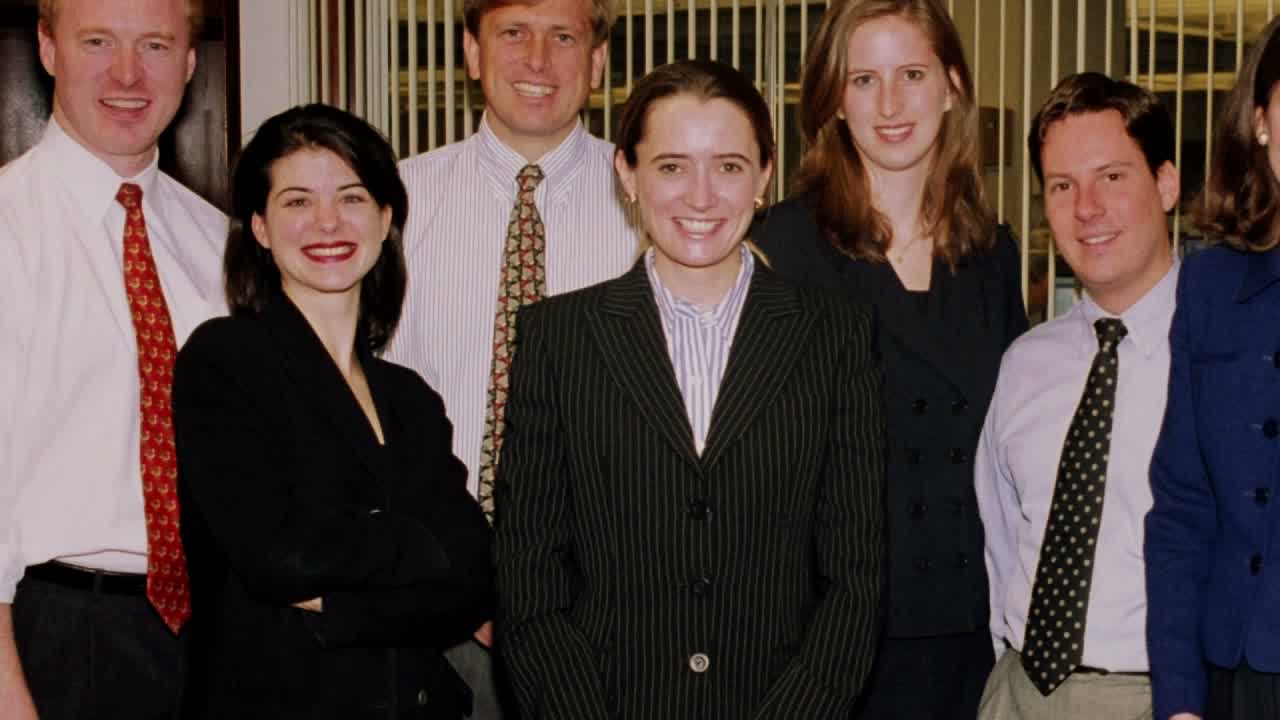
NARRATOR: It’s hard to pinpoint the origins of America’s financial crisis, but one weekend at this resort in Boca Raton, Florida, is a good place to start. Assembled here in June 1994 were a group of young bankers from JP Morgan. At the time, it all seemed innocent enough.
BLYTHE MASTERS, JP Morgan, 1991-Present: Boca Raton was a gathering of people that were part of the Global Derivative Group at JP Morgan, in part as a celebration, in part as an opportunity to relax, but perhaps much more importantly, as an opportunity to get creative, innovative people together in a room to discuss a whole variety of different topics.
GILLIAN TETT, Author, Fool’s Gold: And since they were young, mostly in their 20s, and since there was plenty of money floating around and they were full of high spirits, they did what any young bunch of kids would do and they got drunk. They had parties. They threw each other in pools. You know, this is the normal stuff that happens at conferences.
BILL WINTERS, JP Morgan, 1983-09: Yes, I went into the pool fully clothed, as did— as did my boss. Some people drank, some people didn’t. And I’m happy to say that, like, most people stayed reasonably sober.
NARRATOR: They played hard. But they also worked hard. They were striving to address an age-old problem in banking, how to reduce risk.
BILL WINTERS: The defining problem was that banks were unable to adequately deal with their own credit risks.
MARK BRICKELL, JP Morgan, 1976-01: We’re thinking about how to manage risk. We were thoughtful and deliberate and careful. We had a responsibility not just to make a profit for the shareholders, but to look after the financial system as a whole.
NARRATOR: Over two days of meetings, they looked at whether they could find a way to make their loans less risky. The first journalist to tell the full story was Gillian Tett.
GILLIAN TETT: They began to look for ways to enable financial institutions to pass risk between them. One way to do that was to sell loans. Another way, though, was to separate out the risk of a loan going bad from the loan itself. And out of that came this drive to develop credit default swaps.
NARRATOR: Credit default swaps, a kind of derivative that insures a loan against default.
This was a very new concept. Traditionally, derivatives were a way to bet on the future value of something. For hundreds of years, farmers have traded derivatives to protect themselves against fluctuating crop prices. It is this type of derivative that has been traded on the Commodities Exchange in Chicago, along with the futures of fuels, currencies and precious metals.
In Boca Raton, the JP Morgan team realized that they could use credit derivatives to trade their loan risks.
GILLIAN TETT: Bankers borrowed one set of ideas that had been developed in the commodities market and applied it to loans for the first time. This idea was essentially created under the banner of making the financial system safer.
NARRATOR: The first big credit default swap was engineered by Blythe Masters and involved Exxon.
BLYTHE MASTERS: Exxon was the client at the bank, and we had credit exposure associated with that relationship.
NEWSCASTER: The Exxon Valdez spewed almost 11 million gallons of oil into Prince William Sound.
NARRATOR: In the wake of the Exxon Valdez oil spill and a rash of lawsuits, Exxon took out a multi-billion dollar letter of credit with JP Morgan.
BLYTHE MASTERS: A letter of credit creates credit risk. If Exxon were to fail on their obligations, then JP Morgan would have to step in and make good on those obligations on their behalf. There was a large amount of exposure, and there was a significant amount of risk associated with that.
NARRATOR: And that risk is a big drain on a bank.
SATYAJIT DAS, Fmr. Derivatives Trader: Every time a bank makes a loan, under banking regulations, they’re required to set aside certain reserves of capital for the loan. So JP Morgan, when they made the loan to Exxon, would have had to set aside some capital.
DENNIS KELLEHER: JP Morgan has to hold a certain capital relative to the size of that loan in the event the loan is not paid off at 100 percent as you expect. Well, of course, if you don’t have to do that and you’re a bank, you— you’d prefer not to do that.
MARTIN SMITH: Because then you can finance more freely? You can take on more debt?
DENNIS KELLEHER: Right.
NARRATOR: So Masters started looking at who could take on their loan risk and free up JP Morgan’s capital. She found a taker in London, the European Bank for Reconstruction and Development, the EBRD.
BLYTHE MASTERS: EBRD would receive compensation from JP Morgan for taking on or assuming credit risk, and felt that that was a good risk/reward proposition. And so risk was essentially dispersed. And why did JP Morgan do that? Because we wanted to free up our capacity to do more business.
NARRATOR: This was a major financial innovation. Credit derivatives made it possible for a bank to skirt capital requirements.
SATYAJIT DAS: And that’s what actually happened, is the amount of capital that banks had to hold got less. And so banks became able to create more and more credit. They could make more loans.
MARK BRICKELL: The innovative element of swaps is that they allow companies, financial institutions, governments, to shed the risks that they don’t want to take and take on other risks that they would prefer to be exposed to.
NARRATOR: The Exxon deal was just the beginning, demonstrating that risk could be off-loaded and capital freed up. JP Morgan had struck gold. In 1998, they decided to ramp up their credit derivatives operation. That year, another young banker joined the team, Terri Duhon.
TERRI DUHON, JP Morgan, 1994-02: Part of my job was to come in as a trader and to build a credit derivative trading book, including all the risk management around the more exotic products. That was what I was brought in to do.
NARRATOR: Previously JP Morgan had written credit swaps on single companies like Exxon. Duhon was asked to write swaps on bundles of debt.
TERRI DUHON: The idea was, “Let’s put together a portfolio of credit risk, a portfolio of names.”
NARRATOR: Her first trade was a credit default swap on 306 corporate names on JP Morgan’s books.
TERRI DUHON: And that list of 306 entities, they were very highly rated. They had very low credit risk.
MARTIN SMITH: And the credit default swap was ensuring JP Morgan against default by those 306 entities—
TERRI DUHON: That’s correct.
MARTIN SMITH: —many of them Fortune 500 companies or other—
TERRI DUHON: It would have been— it would have been your— some of your most well known household names. And so we were giving investors an opportunity to, in effect, invest in our loan portfolio.
BILL WINTERS: JP Morgan did a lot of work, did a lot of due diligence to assemble this portfolio of loans. And you can get it in one easy bite-sized piece.
NARRATOR: And the bank facilitated this by slicing up the portfolio into different risk levels, or tranches. Investors could choose how much risk they were willing to take.
BILL WINTERS: Different investors wanted different levels of risk. There were some investors that wanted to earn a big return on really risky stuff, and there were some investors that wanted to earn a little return on stuff that wasn’t risky at all.
NARRATOR: From there, the bank looked to expand their business even further.
BLYTHE MASTERS: So along comes this idea. What if we could create a market where people were able to buy and sell freely, independently of the companies themselves, the risk associated with lending to those companies?
NARRATOR: And so they began selling derivatives that were simply bets on any and all portfolios, whether the bank owned them or not. These products came to be known as synthetic collateralized debt obligations, synthetic CDOs.
TERRI DUHON: There were investors who were able to invest in some entities that they had not had access to before.
MARTIN SMITH: By buying a credit default swap.
TERRI DUHON: By investing in a credit default swap because it was a name that they hadn’t previously had access to. So there was a lot of— a lot of very positive reinforcement of the market. And it just grew. It grew very naturally. Once the seed was planted, there wasn’t any stopping it.
NARRATOR: It was the beginning of an unfettered brave new world of banking.
MARTIN SMITH: This was pretty new stuff.
TERRI DUHON: This was— [laughs] This was incredibly new stuff. It was amazing. It was clearly a product that was in need. We had identified a need.
NARRATOR: Most of the members of the global derivatives group at JP Morgan were in their 20s, including Masters and Duhon. But with the creation of the credit default swap market, they had made banking history.
BLYTHE MASTERS: What in the long run this all meant was that credit, which is a vital part of the lifeblood of any economy, the global economy, became a more readily available asset. And the thinking was that that would be an unambiguously positive thing. Credit helps drive growth, helps companies deploy capital, helps employment, et cetera. It wasn’t any longer just an idea in a room in Florida, it was the creation of an entire marketplace.
[www.pbs.org: More from Duhon and Masters]
NARRATOR: Risk could now be easily traded. It fueled a worldwide credit boom. Soon other banks got excited about the money to be made writing credit derivatives.
Paul LeBlanc was a derivative salesman at Morgan Stanley who remembers the pressure to get more deals done.
PAUL LeBLANC, Morgan Stanley, 1983-04: The volume of transactions was just exploding. I mean, I used to know all the statistics because they used to talk about it every meeting, how this is a growing market and you have to get your customers involved. They can make money. We can make money. It was a massively important sector for us to focus on, derivatives.
NARRATOR: And importantly, it was a private market, unregulated, and out of view.
NEWSCASTER: —the Dow up just about two and three quarters of—
CHRISTOPHER WHALEN, Investment Banker: See, unlike an exchange-traded market where all the banks can see all the positions, there’s no public market for these derivatives. You can’t look in the newspaper and get a price for them. These are all private off-exchange markets. And nobody else in the market knows what’s going on.
NARRATOR: And because this market was opaque, the spreads — the difference between what banks could charge for derivatives and what it cost to provide them — could be huge.
MARTIN SMITH: How much were these things making for the bankers that were selling them?
CHRIS WHALEN: The spreads on derivatives are several times larger than on comparable cash securities, just as a general rule. And that’s why the banks trade them.
MARTIN SMITH: Cash securities being those that are—
CHRIS WHALEN: Equities, bonds—
MARTIN SMITH: Well, paint some picture of that and the kind of money that people were making.
CHRIS WHALEN: The best reference that you could give is that if you look at, say, the spread that a bank might earn doing an IPO for FaceBook, they’re going to maybe make 1 percent to bring out that IPO, a very hot IPO. If you were doing the same size deal in a derivative security, you might make 10 times the fee.
SATYAJIT DAS: And the basic business that they created was immensely profitable. But there’s a problem with all of this. Most people in finance assume risk can be eliminated, but all you can do is to move it around from one party to another party.
NARRATOR: There was growing concern in Washington.
Sen. BYRON DORGAN (D-ND), 1981-11: [1999] We are moving towards greater risk. We must do something to address the regulation of hedge funds and especially derivatives in this country, $33 trillion, a substantial amount of it held by the 25 largest banks in this country, a substantial amount being traded in proprietary accounts of those banks. That kind of risk overhanging the financial institutions of this country one day, with a thud, will wake everyone up.
NARRATOR: Proposals circulated to rein in the banks and to regulate derivatives.
Rep. SPENCER BACHUS (R-AL), Financial Services Committee: What are you trying to protect?
BROOKSLEY BORN, Commodity Futures Trading Commission Chair, 1996-99: We’re trying to protect the money of the American public, which is at risk in these markets.
NARRATOR: The head of the Commodity Futures Trading Commission, Brooksley Born, led the charge.
BROOKSLEY BORN: Certainly, we are the regulator which has been given the authority to oversee the major derivatives markets—
DENNIS KELLEHER, Chief Counsel, Sen. Dorgan, 2006-10: Brooksley Born was absolutely right because what she said is if you don’t have transparency and regulation of derivatives, the risk is going to build up and they’re going to lead to a financial crisis that’s going to cause massive taxpayer bailouts.
NARRATOR: The banks lobbied hard for no derivative regulation.
FRANK PARTNOY, Author, Infectious Greed: The banks didn’t want anyone to know how much risk they were taking on. They didn’t want to have to quantify it on their balance sheet. They wanted to be able to push it off and hide it. And that was why they lobbied so hard to make sure that swaps and derivatives would be treated differently from other kinds of financial products.
NARRATOR: Others wanted them to be regulated like insurance.
DENNIS KELLEHER: One of the most heavily regulated products in the country are insurance products, for all the obvious reasons. If you’re going to— if you’re going to write insurance, you have to have enough money to pay off that insurance.
MARTIN SMITH: But if you write a credit default swap, you don’t have to have that same amount of money on hand.
DENNIS KELLEHER: Or anything else, including, importantly, no disclosure.
MARTIN SMITH: So you’re saying it’s a kind of under-the-table insurance agreement that avoids regulation.
DENNIS KELLEHER: It’s an insurance product designed not to be regulated as an insurance product and designed to avoid regulation at all. And one thing we do know is that when a product of any type is designed with minimal regulation, capital and activity moves into that area and it expands dramatically.
ALAN GREENSPAN, Federal Reserve Chairman, 1987-2006: Regulation of derivatives transactions that are privately negotiated by professionals is unnecessary.
NARRATOR: The chairman of the Fed, Alan Greenspan, sided with the banks.
SIMON JOHNSON, Economist, MIT: Alan Greenspan was coming from a very libertarian tradition. Keep your hands off everything. The markets will sort themselves out. And if there’s a problem, then we’ll clean up afterwards. And now that— that really was the way the Federal Reserve operated under— under his leadership for almost 20 years.
NARRATOR: On Capitol Hill, supporters of bank deregulation made urgent, stark pleas.
Sen. CHARLES SCHUMER (D), New York: [1999] The future of America’s dominance as the financial center of the world is at stake.
NARRATOR: Before them was legislation to lift restrictions on how banks could do business.
Sen. CHARLES SCHUMER: If we didn’t pass this bill, we could find London or Frankfurt or Shanghai becoming the financial capital of the world.
Sen. PHIL GRAMM (R), Texas: This bill is going to make America more competitive on the world market, and that’s important.
NARRATOR: And legislation to prevent oversight of credit derivatives.
Sen. PHIL GRAMM: —high-paying jobs not just on Wall Street in New York City, but it affects every business in America and it benefits every consumer in America. And we do it by repealing Glass-Steagall.
NARRATOR: The campaign to roll back Glass-Steagall, a Depression-era set of reforms was led by the country’s biggest bank, CitiCorp.
SIMON JOHNSON: They felt it was in their way and persuaded lawmakers, both Democratic and Republican, that Glass-Steagall should be repealed. It also symbolized when everything really started to go wrong.
[www.pbs.org: CitiGroup & repeal of Glass-Steagall]
Pres. BILL CLINTON: It’s the most important example of our efforts here in Washington to maximize the possibilities of the new information age global economy.
NARRATOR: In the end, banks would get larger and derivatives would remain in the shadows.
DENNIS KELLEHER: The derivatives market went into darkness, almost no transparency and no regulation. And what you see is this explosion in the growth of derivatives in the United States and throughout the world.
NARRATOR: The banks had won the day. Credit default swaps would now be introduced to new markets.
BLYTHE MASTERS: The next application of this same technology was to portfolios of consumer credit risk, and in particular. mortgage-related credit risk.
NARRATOR: And the higher the risk, the better.
FRANK PARTNOY: What everyone is trying to create is something that has a high rating and a high yield. That’s the holy grail, that’s the goal, is to mix together assets in some way so that you come out with a AAA, and a big return.
NARRATOR: And so Wall Street discovered the rewards of funding the American dream. Just as they had bundled corporate loans, bankers now bundled mortgages.
PAUL LeBLANC: You would buy these big pools of mortgages, and these credit default swaps enabled you to bundle all this stuff together, bring it in-house, in order to get it ready to put through the sausage-making machine and create these securities.
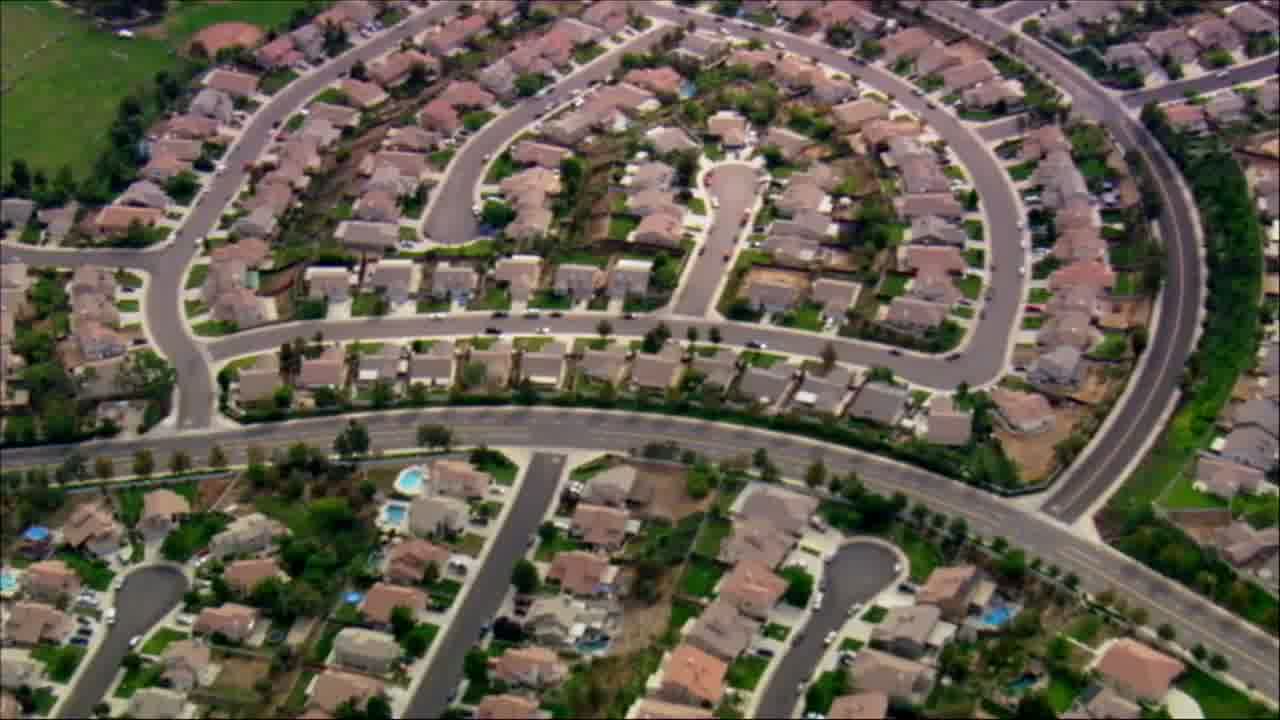
NARRATOR: Bankers spread their investing dollars across the country, but especially in states seeing historic levels of population growth, places like Florida, Nevada, California, and here, in Georgia.
ROY BARNES, (D) Governor of Georgia, 1999-03: Well, Atlanta was one of the hottest markets in the country, the Atlanta region.
NARRATOR: Roy Barnes is the former governor of Georgia.
ROY BARNES: Georgia was the fourth fastest growing state at the turn of this last century, and the fastest growing state east of the Mississippi. So it was a hot market to start with.
WOMAN: I put my house on the market on a Tuesday, and it was gone Thursday.
[www.pbs.org: More on the housing bubble]
NARRATOR: Elected in 1998, Barnes is renowned for having taken on Wall Street over subprime lending, a market the Street had traditionally avoided.
VINCENT FORT, State Senator, Georgia: Subprime lending has been around for a long time and is supposed to be lending done to people whose credit is inferior.
ROY BARNES: And in the ‘80s, there was no place for subprime. Nobody wanted it. The banks wouldn’t buy it because there was a higher risk.
[television commercial]
— City Mortgage. May I help you?
— I’ve been having trouble with my credit.
— That’s no problem. We’ll give you the best rate possible.
ANNOUNCER: 688-CITY.
FRANK ALEXANDER, Emory Univ. Law School: The subprime market was originally a niche market. Originally, it was not the major banks, it was the mortgage brokers who were specialists in this market.
NEWSCASTER: Subprime loans in Atlanta jumped by more than 500 percent during a five-year period.
ROY BARNES: What really changed the appetite for subprime mortgages was you could securitize them. And you could sell it on Wall Street. They do it in tranches, and then they wrap it up so they could be packaged together and have an overall higher yield.
NEWSCASTER: Nearly half of all new single-family home construction is in the South, now more than 50,000 a month.
ROY BARNES: And of course, Moody’s says AAA. So it was just a feeding frenzy. I mean, it was just an absolute feeding frenzy for subprime mortgages.
NEWSCASTER: With the economy strong, home buyers are willing and able to spend double what they did just two decades ago.
ROY BARNES: And you could just about drive by a bank, and they’d throw a loan paper in your car as you passed by. It became very loose. Became very loose.
NARRATOR: But what big banks on Wall Street did not or would not see was what was happening on the ground around the U.S., a wave of lending abuses.
NEWSCASTER: It’s a phrase you’re likely to hear in the future—
NEWSCASTER: —predatory lending—
1st WOMAN: We trusted mortgage companies—
2nd WOMAN: We say that we were swindled.
3rd WOMAN: The situation have caused me to go into the state of bankruptcy.
4th WOMAN: This is what you call robbing somebody without a gun!
FRANK ALEXANDER: The Wild West experience in home mortgages was well under way.
NEWSCASTER: Forty one year old Hessiemay Hector, mother of three, agreed to a second mortgage at 27.5 percent.
FRANK ALEXANDER: We were creating mortgages that we had never seen before. And they were being created faster and faster.
MAN: The interest rate on these loans was as high as 42 percent.
FRANK ALEXANDER: We saw borrowers given loans that were greater than the value of their home. Home buyers were getting loans that had no income. The borrower, particularly the elderly or the low income, had no clue as to what they signed. There was a tremendous growth of mortgages that we knew made no sense financially.
VINCENT FORT: When you have a high interest rate, then you have high points. Then you have pre-payment penalties, when you have balloon payments, when you have adjustable-rate mortgages and when you layer those bad practices on top of a high interest rate, it becomes predatory.
NEWSCASTER: Black home owners in Atlanta have become such frequent targets of unscrupulous lenders that councillors regularly hold community meetings to issue warnings.
WOMAN: —monthly payments that you can’t afford.
VINCENT FORT: And why did they sell them to people that they were not good for? They did it because they could.
WOMAN AT COMMUNITY MEETING: We’ve got to fight, fight, fight, fight!
NARRATOR: Housing advocates around the country took on predatory lenders. But one of the fiercest fights was here in Georgia, over what was called the Georgia Fair Lending Act.
VINCENT FORT: But we don’t need rhetoric, we need—
NARRATOR: The bill was sponsored by State Senator Vincent Fort—
VINCENT FORT: —we need action now!
Gov. ROY BARNES: People are tricked into owing more money than they could ever dream—
NARRATOR: —and backed by Governor Roy Barnes.
Gov. ROY BARNES: —talked into believing there’s a way out.
NEWSCASTER : Governor Barnes and others are making a last ditch effort—
NARRATOR: The bill targeted high-cost loans and predatory lenders with a series of rules and prohibitions.
NEWSCASTER: It’s up right now on the House floor, a governor’s bill to crack down on—
NARRATOR: The mortgage lenders and the banks struck back.
MORTGAGE LENDER: None of these people have a clue of what’s going on! Nobody here understands the business, and they didn’t let us speak!
ROY BARNES: You would have thought I had recommended that we repeal the plan of Salvation. Why were they so opposed to it? Money. Money.
MORTGAGE LENDER: This bill will cripple the mortgage business! It’s going to cripple real estate sales! It’s going to absolutely devastate the home market in Georgia, I can guarantee you!
FRANK ALEXANDER (Prof. of Law, Emory University): There were threats that the residents in Georgia wouldn’t be able to get mortgages anymore because investors would not buy the mortgages in Georgia. And if that were true, no bank would create a mortgage in Georgia.
NARRATOR: Despite the efforts of the mortgage lobby, Barnes and Fort got the bill passed in April 2002.
NEWSCASTER: Georgia now has the toughest predatory lending law in the nation—
NARRATOR: The mortgage lobby feared that similar legislation could pass in other markets, like California. They opposed Barnes’s reelection, they funded his challenger, and lobbied to rescind the law.
FRANK ALEXANDER: Right after the Governor Barnes’s defeat in November, one of the top legislative priorities for the new governor and the new legislature was to gut the Georgia Fair Lending Act. I think it was about two weeks into the new legislative session, and it was gutted.
NARRATOR: But for a seven-month period, predatory lending in Georgia declined. It may have been the last chance to slow the housing boom.
ROY BARNES: I would like to sit up here and tell you that I was like Nostradamus, that I saw that the world was going to come to an end because of all this. But I could never have foreseen the difficulty that existed, never have— could I have foreseen that.
FRANK ALEXANDER: I think we still would have seen an unrealistic bubble, but it wouldn’t have gone up as fast and it wouldn’t have collapsed as fast. We would not have been in as deep a hole today as we are if we hadn’t had these funny mortgage products.
NEWSCASTER: No let-up in the housing boom, which is good for the economy. Homes were selling last month at a record clip, the main reason, low mortgage rates—
NARRATOR: The big banks continued to package and sell more mortgage portfolios. And more and more of these CDOs contained high-risk subprime debt. To keep the rating agencies on board, more credit default swaps were sold.
CHRIS WHALEN, Tangent Capital Partners: Let’s say I have a pool of mortgages. I have a thousand mortgages from California, and I want to package these up. But I decide, “Well, some of these mortgages may be subprime, and I want to buy a little bit of credit default insurance.”
MARTIN SMITH, Correspondent: And by doing that, you improve the profile-
CHRIS WHALEN: In theory, yes.
MARTIN SMITH: —of your CDO-
CHRIS WHALEN: That’s right.
MARTIN SMITH: —so that you can sell it better.
CHRIS WHALEN: And I can go get a rating for it, too. I could go to Moody’s and say, “Look, I have laid off 2 percent of the risk on this portfolio. Shouldn’t I get a better rating than if I just sold the pool as it was?”
MARTIN SMITH: So you take a lot of crap-
CHRIS WHALEN: That’s right.
MARTIN SMITH: —a lot of mortgages that are-
CHRIS WHALEN: Hideous crap. [laughs]
MARTIN SMITH: —people are not going to pay— right. OK. But you insure it, and the credit agency says, “Hey, that’s a good idea.”
CHRIS WHALEN: Yes. Yes.
GILLIAN TETT, Financial Times: And it seems that in the housing market, many investors actually began to take more risks precisely because they thought that they had bought protection with credit default swaps.
[www.pbs.org: Watch on line]
NEWSCASTER: New home sales jumped 13 percent over a year ago, while existing home sales rose 4.5 percent, setting a new record—
NARRATOR: The team at JP Morgan was also dabbling in mortgage debt, but they weren’t sure it made good sense.
TERRI DUHON, JP Morgan, 1994-02: We traded mortgages. We had some mortgages on our books. We certainly understood the mortgage-backed security market. But we had a lot of trouble getting comfortable with that risk.
The big hang-up for us was data. We had years and years of historical data about how corporates performed during business cycles. But we didn’t have that much data about how retail mortgages performed during different business cycles.
BILL WINTERS, Co-CEO, JP Morgan Investment Bank, 2004-09: We knew how much money people said they were making. We saw that UBS and Merrill Lynch had securitized products earnings that were growing faster than ours. And we asked ourselves the question, “What are we doing wrong? What are we missing? Have we not figured out how to lay off some of this risk?”
And honestly, we couldn’t figure it out. What we never imagined was that those other firms weren’t doing anything at all. They were just taking the risk and sitting with it.
NEWSCASTER: Sales of new single family homes shot up—
GILLIAN TETT: The first wave of JP Morgan bankers who had developed these original ideas in the 1990s, when they saw what was starting to happen — essentially, other banks were taking these ideas and applying them in ways that they had never expected — some of them began to get very worried.
TERRI DUHON: We were just about to say done on a transaction. We had a global phone call, and we were discussing the risk that we were about to do, and we had discussed it over and over and over. And finally, someone on that phone call said, “I’m nervous.”
NEWSCASTER: Twice as many home buyers are getting adjustable mortgages—
NEWSCASTER: —a huge increase in new home sales—
TERRI DUHON: We almost had stopped thinking and stopped reassessing the risk as we went along. And suddenly, we found ourselves with a product that was vastly different from where we started. And every little tweak along the way, we had all said, “Oh, that’s OK. That’s OK. That’s OK,” until suddenly, we all looked up and said, “Hang on, it’s not OK.”
NEWSCASTER: The world is still living with a lot of big unresolved problems—
NARRATOR: Other banks were not so cautious.
NEWSCASTER: —storm clouds on the horizon—
NARRATOR: They aggressively sold subprime CDOs to customers all over the world. London became a second beachhead for their trading and sales operations.
NEWSCASTER: The stock market’s on the rise and economic statistics—
CHRIS WHALEN: The City of London actually did yeomen’s service in creating some of the nastier structures. They did this offshore. These were not SEC-registered deals. These were all private placements. So they were going through the legal loopholes.
NARRATOR: A group of state-run banks in Germany known as Landesbanks were among the biggest customers. Desiree Fixler, who worked at JP Morgan, says she was amazed by these banks’ appetite for subprime mortgages.
DESIREE FIXLER, JP Morgan, 2001-04: You knew that a core group of banks in Germany would buy anything. We strongly believed they were very naive. We were amazed that they would buy this. It was— I mean, every single person, every sales person, was envious of that particular sales person that was able to cover the Landesbanks and IKB because you were in one of the hottest seats globally. You were going to generate tremendous profit margin. They were big buyers.
JOSEF ACKERMANN, CEO, Deutsche Bank: IKB was very convinced that they were one of the strongest banks in that area. They were running around, telling people how good they are in investing.
NARRATOR: Multinational Deutsche Bank did several deals with IKB.
MARTIN SMITH: Did you think, at the time, that your products were helping IKB, that these were good things for them to buy?
JOSEF ACKERMANN: Yeah, absolutely. Otherwise, we wouldn’t have manufactured these products and sold it to them.
MARTIN SMITH: So you were bullish on subprime mortgages in the U.S.
JOSEF ACKERMAN: We were bullish on the mortgage market in general, and subprime, which was an element of it, we were not overly aggressive, but we were a part of that market. Absolutely.
NEWSCASTER: Americans are buying real estate in record numbers. That demand has given—
NARRATOR: By the end 2005, the total outstanding value of credit default swaps around the world was measured in trillions of dollars and was doubling every year.
NEWSCASTER: Existing home sales rose 4.5 percent, setting a new record.
MARTIN SMITH: Did top management at JP Morgan understand credit derivatives?
TERRI DUHON: Yes, they did. Absolutely, they did.
MARTIN SMITH: Did they at other banks?
TERRI DUHON: No, not all other banks. Certainly not.
MARTIN SMITH: Did the regulators understand them?
DANIEL K. TARULLO, Federal Reserve Board Governor: I don’t think the regulators understood. I don’t think the credit ratings agencies, the bankers or the regulators fully understood all of the kinds of credit instruments that we’re talking about.
MARTIN SMITH: In other words, some big banks simply didn’t know what they had in terms of risk.
DANIEL K. TARULLO: Certainly, they didn’t— they didn’t know some of the forms of risk that they had. That’s exactly right.
NEWSCASTER: Sales were higher than most regions, up more than 40 percent in the West and Northeast—
NARRATOR: Housing prices continued to soar.
NEWSCASTER: The average price of a new home grew slightly—
NARRATOR: Banks packaged more and more CDOs. Theoretically, there was no limit. An investor didn’t need to own any actual mortgages. So-called synthetic CDOs allowed investors to bet many times over on someone else’s portfolio of debt.
BILL WINTERS: It allowed participants— either buying or selling, so on either side of the market — to take their positions without being constrained by the size of the underlying market.
[www.pbs.org: More on synthetic CDOs]
Prof. FRANK PARTNOY, Univ. of San Diego School of Law: In synthetic CDOs, all you had to do was make a side bet based on what would happen to this group of mortgages and have that be the basis of the CDO. The fact that someone had done it one time wouldn’t stop you from doing it again and again and again.
MARTIN SMITH: So how is that different than betting on the outcome of the Super Bowl?
DENNIS KELLEHER, Better Markets, Inc.: Or a horse race or a craps table. There’s no different at all. It’s just a pure bet by somebody who has no economic interest in what they’re betting on. You’re going to bet on the outcome of the Super Bowl, you’re going to bet on the outcome of a horse race, or you’re at the craps table or you’re betting on which way the dice are going to go.
MAN: We’re pretty confident that the housing market’s not going to down at all. It’s just going to go up.
CHRISTOPHER WHALEN: Within a decade, you have the most phenomenal machine anybody’s ever seen.
NEWSCASTER: New homes are selling at the second highest rate on record—
MAN: We are in a housing boom. It’s strong right now.
NEWSCASTER: Profits soared 93 percent.
NEWSCASTER: —expected to dole out $36 million in bonuses this year.
GILLIAN TETT, _Financial Times: Everyone was high-fiving. It seemed to be brilliant. The combination of free markets, innovation and globalization appeared to have delivered this incredibly heady cocktail of tremendous growth.
NEWSCASTER: Top executives will earn as much as $20 million to $50 million—
NARRATOR: Between 2003 and 2006, Dick Kovacevich, CEO of Wells Fargo, remembers attending meetings with bankers and regulators.
DICK KOVACEVICH, CEO, Wells Fargo, 1998-07: Oftentimes, what would happen at these meetings is— regulators would be there, like Chairman Bernanke, and there might be, I don’t know, 30, 40 bankers. And they would often go around the room and say, “Well, what are you guys seeing out there?” You know, “What’s working? Are you concerned about housing,” you know, trying to get input.
And when they came to me, I would say, “This is toxic waste. We’re building a bubble. We’re not going to like the outcome.
MARTIN SMITH: What did your fellow bankers say to you when you told them that you thought this stuff was toxic?
DICK KOVACEVICH: Well, the ones that were in it said I was wrong and everything’s fine. “We don’t see any losses occurring in this.”
MARTIN SMITH: But you saw risk all over the place.
DICK KOVACEVICH: We didn’t even participate in the exotic subprime side of the mortgage because we knew that this was absolutely wrong for our customers, if we would have done it, and would have been wrong for us because we think this thing was going to blow up.
FRANK PARTNOY: There’s a great set of adages on Wall Street about where risk will flow. And if you ask people, they’re basically split between two camps. One says that risk will flow to the smartest person, the person who best understands it. And the other says that risk will flow to the dumbest person, the person who least understands it.
And at least based on my experience and my understanding of what has been happening in the derivatives market, it’s the latter.
TERRI DUHON, B&B Structured Finance, 2004-Present: I was amazed at the interest on the part of investors to invest in a product that was highly complex and very risky on top of it.
MARTIN SMITH: So let me get this straight. You were— you were first to the party. You developed this tranching of stuff—
TERRI DUHON: That’s right.
MARTIN SMITH: —and writing credit default swaps on it. But now everybody else has jumped into the game.
TERRI DUHON: Everybody wants to do it.
MARTIN SMITH: But your team decided to stop. Why did so many others keep going, marching towards the cliff?
TERRI DUHON: The— I mean, there— I— look, very simply, there are certainly some— some investors, some banks, some borrowers who are a bit greedier than they should be.
NEWSCASTER: Goldman Sachs Lloyd Blankfein will take home $53 million.
NARRATOR: No one wanted the party to end.
NEWSCASTER: —pocket an estimated $40 million—
NARRATOR: Most banks believed housing prices would never go down, let alone crash.
BLYTHE MASTERS, Head of Global Commodities, JP Morgan: To imagine losses of that severity required very significant assumptions about the path of the economy which were just not in people’s mind. So it required things like assuming that house prices in the United States fell by 25 percent.
People weren’t thinking that way. And as long as house prices never fell, then these risks would never come home to roost. And that ultimately was obviously very flawed logic.
NEWSCASTER: As interest rates rose early this year, home sales slowed. And after years of record appreciation—
NEWSCASTER: —businesses and individuals do, as well, and the cost of borrowing is going up.
NARRATOR: The unraveling began in late 2006.
NEWSCASTER: Big trouble for millions of American home owners—
NARRATOR: When housing prices started to drop, only a very few bankers could see the bubble they were trapped in.
NEWSCASTER: The housing market has turned some mortgages into time bombs.
SATYAJIT DAS, Author, Traders, Guns and Money: By 2007, 2008, all the smart money knew the game had ended, and all the banks tried to effectively repackage what they were stuck with as quickly as possible and get it off their books. But there was second parallel movement which was going on, which was all about, “How can we take advantage of it?”
NEWSCASTER: The Dow-Jones average seemed in freefall, ending the day down—
NARRATOR: One of the Wall Street banks that took advantage of a declining market was Goldman Sachs. According to a congressional investigation, the bank created a series of CDOs containing toxic subprime and then sold them to customers—
LLOYD BLANKFEIN: [television commercial] We at Goldman Sachs distinguish ourselves by our ability to get things done on behalf of our clients—
NARRATOR: —while Goldman Sachs, using credit default swaps, bet against them.
Sen. CARL LEVIN (D-MI), Permanent Subcommittee on Investigations: They bet against their own clients, so when the clients lost money, Goldman was making money. Goldman has a little slogan that the clients come first. No, they didn’t. Not in these transactions. Goldman came first, second and third. They were really, I think, the only major bank which made money when the housing bubble burst.
NARRATOR: In a settlement with the SEC, Goldman admitted that some of their marketing materials did not disclose important information, but Goldman claimed that their investors were highly sophisticated institutions.
NEWSCASTER: Thirty-four subprime mortgage companies have gone bus—
NARRATOR: One customer was that German Landesbank, IKB.
NEWSCASTER: Analysts say anyone associated with the subprime market is going to pay the price.
DESIREE FIXLER, Ariya Capital, 2008-Present: Even when there was a downturn in the markets, they were still buying. I mean, the market is telling them. It’s on the screen. There are headlines everywhere, “Danger.” But they still wanted to go ahead.
MARTIN SMITH: Did you feel there was an obligation on your part to tell them that, “Look, wake up, the markets are going down. Maybe you should stop buying this crap?”
DESIREE FIXLER: Those discussions— the word “crap” wasn’t used, but I mean, those discussions definitely happened. But they felt that this was just a temporary glitch in an overall bull market. “It will recover. It has to recover.”
NARRATOR: In July 2007, the German bank, IKB, stuffed with subprime, was the first bank to fail.
NEWSCASTER: —hundreds of thousands of home owners are defaulting on their loans—
NARRATOR: It was only a matter of time before the crisis came back to Wall Street.
NEWSCASTER: —and that could hurt the value of homes nationwide by—
DAVID WESSEL, The Wall Street Journal: We knew that the housing bubble had burst. But we’d been reassured that the problem had been contained. But by the beginning of 2008, it was becoming clear that this was a much, much bigger problem than anybody anticipated.
DANIEL K. TARULLO, Federal Reserve Board Governor, 2009-Present: There was a broad misperception of the risk in housing prices. The widespread view that we could have a regional decline in housing prices, but never a national decline in housing prices, proved to be horribly wrong.
NEWSCASTER: Last week was a difficult time in the mortgage business. There was talk about problems in funds—
NEWSCASTER: This was the most actively traded stock by far—
NARRATOR: In New York, banks were trying to unload what they could. But there was confusion. At CitiGroup, they were running in circles.
FRANK PARTNOY, Author, Infectious Greed: One of the incredible things about CitiGroup, we now know, was although it was tossing these risks off its balance sheet, those risks came right back, almost like a boomerang. Without knowing it, they had set up one business to offload risk, and then completely reversed that business, taking those risks back onto its balance sheet.
DANIEL K. TARULLO: It was quite clear to me that a number of really quite large financial institutions had not had the kind of management information systems which allowed them even to know what all their risks were.
MARTIN SMITH: that was astounding to you.
DANIEL K. TARULLO: It was astounding to me.
NEWSCASTER: The sort of origination of these subprime loans, the creation of the CDOs— that business is gone.
NEWSCASTER: And the reason why is all those credit default swaps—
NARRATOR: It would all come down to those credit default swaps. Would they pay off as they were designed to do?
DAVID WESSEL: We have known for generations that banks are susceptible to runs. Banks can’t function if everybody comes and wants their money at the same moment.
NEWSCASTER: —Merrill Lynch, devastated by losses—
NEWSCASTER: The failure of Lehman Brothers and the fire sale of Merrill lynch—
NEWSCASTER: —starting to take a closer look at AIG. The world’s largest insurance company—
NARRATOR: This time, it would be a run on an insurance company. AIG was on the hook for $440 billion worth of credit default swaps.
NEWSCASTER: —credit default swaps—
SATYAJIT DAS: Remember, an insurance contract is only as good as the credit quality of the insurer. They have to pay you. And if they can’t pay you for whatever reason, then this whole process of risk transfer breaks down.
NEWSCASTER: We need to stabilize this industry. It can spread throughout the economy. It could be a very, very dangerous—
STEVE BARTLETT, Pres., Financial Services Roundtable: September 18th of 2008, when I have a conference of my CEOs, and CEOs traditionally don’t read their Blackberries during meetings. But I kept looking around and noticing that a number of them were. And so I turned to one. We recessed. And I said, “You looked like the world was ended.” And he said, “I think it has.”
NEWSCASTER: —the enormity of the situation, like a financial nuclear holocaust. Some $400-odd billion of credit default swaps—
NEWSCASTER: —another government bailout, AIG securing an $85 billion—
DANIEL K. TARULLO: AIG could not conceivably have paid off all of those credit derivatives because it had misunderstood the risks and did not have what we’d call a balanced book or nearly enough capital to back their losses.
MARTIN SMITH: Didn’t everybody know that AIG was holding a lot of CDSs?
CHRISTOPHER WHELAN: No. There was no disclosure. That’s the whole point They haven’t reported this to anyone else. The other dealers have no idea what’s going on. The other banks don’t know. Nobody knows. The banks turned this market into their own private game.
SATYAJIT DAS: It was, in fact, a financial shell game where we were manipulating banking results by moving the risk out through one door, but bringing it back into the banking system by another door. The risk was not leaving the banking system, and everybody in the world was connected to these chains of risk. And if any part of that chain breaks down because they can’t honor the contract, the entire system implodes.
NARRATOR: The idea dreamed up by a group of young JP Morgan bankers at a weekend retreat many years ago was supposed to reduce risk.
GILLIAN TETT: Their original idea had been taken and it turned into a Frankenstein monster, which they never dreamt would become so big and spin out of control to that degree.
BLYTHE MASTERS: It was a very scary time. We were in totally new territory. And the notion that Lehman Brothers could be filing for bankruptcy and AIG could be at risk of the same fate was absolutely unprecedented. And the implications— thinking through the implications of that for the health not just of the U.S. economy but the world were— I mean, it wasn’t— it wasn’t really conceivable to do that. I couldn’t get my mind around it. I know others couldn’t.
TERRI DUHON: We never saw it coming. We never saw that coming. And I was disappointed, hugely disappointed. I mean, I was part of a market that I believed was doing the right thing. And maybe I was idealistic, maybe I was young, maybe I— I didn’t fully appreciate where we were going, but there was a whole system going on all the way from the borrower of the mortgage, all the way through to the investor. There’s a whole system of people who maybe were turning a blind eye, maybe were, you know, just— I don’t know. It’s— it’s frustrating to see, certainly.
DICK KOVACEVICH, Chairman, Wells Fargo, 2005-09: It shouldn’t have happened. Most of our financial crisis in the past is due to some macroeconomic event— an oil disruption, war. This was caused by a few institutions, about 20, who, in my opinion, lost all credibility relative to managing their risk.
And the sad thing is it should never have happened. The management should have stopped it before it got big. And people are suffering for something that should never have happened.
NARRATOR: Today, the fallout is felt mostly in places that had seen the highest growth, like Georgia. Ground zero of the subprime crisis— local neighborhoods, city streets.
Prof. FRANK ALEXANDER, Emory Univ. Law School: Cities throughout the United States are seeing a rise in vacant and abandoned properties. And that’s where the neighbors feel it. As neighbors, we’re concerned not so much with the complexities of the subprime mortgage market and derivatives. These things we will hardly ever understand.
What we feel on the street is the fact that the house next to us is vacant, abandoned, partially burned. And we wonder how long it’s going to be there, how long we pay the price for that abandonment. A neighborhood cannot survive long when it has a growing inventory of vacant, abandoned properties.
NARRATOR: Sometimes, no one even knows who owns the properties.
MTAMANIKA YOUNGBLOOD, Atlanta Housing Activist: It’s hard to know who owns it because it’s been sliced and diced so many ways by investors that it could be somebody in Ireland who owns it.
You have these securitized pools, where investors own pieces of it. The investors are around the world, literally, and so it’s just in no-person’s land. It’s a vacant property, mostly vandalized, and it just sits here and we can’t do anything with it. And the reality is that that plays out across this neighborhood hundreds of times.
ROY BARNES, (D) Governor of Georgia, 1999-03: That house has a loan that is somewhere lost in a huge financial vehicle put together by some young Turks on Wall Street. It’s lost in that billion-dollar package because there’s nobody assigned to look after it.
And there are whole subdivisions like this, by the way, that are just lost in this great morass. And so it affects Main Street because Wall Street was too greedy. The greed of Wall Street broke Main Street.
Money, Power & Wall Street Part Two
PRODUCED BY Michael Kirk Jim Gilmore Mike Wiser
REPORTED BY Jim Gilmore
WRITTEN BY Michael Kirk & Mike Wiser
DIRECTED BY Michael Kirk
ANNOUNCER: Coming up next, FRONTLINE’s four-part investigation of the financial crisis continues.
NEWSCASTER: Concerns about shaky home mortgages are triggering fears of a financial meltdown on Wall Street—
ANNOUNCER: Inside Washington’s struggle to respond to the meltdown.
NEWSCASTER: The Dow tumbled 240 points, while the NASDAQ sank 46—
ROBERT REICH, Secretary of Labor, 1993-97: They were all very afraid of the possibility of a bank failure. They didn’t know what it would lead to.
NEWSCASTER: —fears of a global liquidity crisis have intensified today—
ANNOUNCER: Inside the critical decisions—
NEWSCASTER: The stock market dropped by hundreds of points—
PHIL ANGELIDES, Chmn., Financial Crisis Inquiry Comm.: The policy makers have sent inconsistent signals. So the marketplace doesn’t know what to expect.
CHARLES DUHIGG, The New York Times: Everything freezes, and that’s what causes the crisis.
NEWSCASTER: —turmoil in markets around the globe—
PAUL KRUGMAN, Economist, Princeton University: My God, we may be presiding over the second Great Depression.
ANNOUNCER: —the politics of a bailout—
MICHAEL GREENBERGER, Federal Regulator, 1997-99: They had to throw their principles out the door and save the economy.
Rep. SCOTT GARRETT (R), New Jersey: America, you should be outraged about what Washington is about to do!
ANNOUNCER: —and the education of a future president—
RON SUSKIND, Author, Confidence Men: The economy is melting. The Bush administration is leaving.
NEWSCASTER: And all eyes are now on Barack Obama to turn it around.
RON SUSKIND: Obama gets a real glimpse of the future. Disaster is coming.
ANNOUNCER: Money, Power and Wall Street continues right now.
NARRATOR: It was on a cold March day in 2008 that the fear of a meltdown would become a reality.
NEWSCASTER: —fears of a financial meltdown on Wall Street—
NEWSCASTER: Home foreclosures rose to record highs—
NARRATOR: After the real estate bubble burst, it would only be a matter of time before investors would start to lose confidence in Wall Street’s biggest banks.
NEWSCASTER: It started with news that some Bear Stearns hedge funds would—
NEWSCASTER: The Case-Shiller home price index—
NARRATOR: Bear Stearns was the first to crack.
BRYAN BURROUGH, Vanity Fair: Pretty normal morning. And then suddenly, around 11:00 o’clock, there’s a tremor. The stock starts to go down. The CFO of Bear starts calling down to his desks, to the repo guys, the bond guys, “Anybody hear anything? Anybody know anything? What is this?” “Yeah, the rumor is that we’re running out of cash and that we might be in trouble.”
NEWSCASTER: —leading this very sharp rally on Wall Street, with the exception of Bear Stearns—
NARRATOR: The rumors swirling around Bear were about its massive investments in subprime mortgages, what would become known as “toxic assets.”
DAVID FABER, Author, And Then the Roof Caved In: They were big in mortgages. They were big in packaging them and creating securities out of them, buying them.
NARRATOR: The road to riches for Bear was simple, buy hundreds of thousands of subprime mortgages, then bundle and sell them to investors. But now the party was over, and Bear was spiraling out of control.
DAVID FABER: [CNBC appearance] You’ve either got liquidity or you don’t, so—
BILL BAMBER, Fmr. Sr. Managing Dir., Bear Stearns: It was nothing short of surreal.
DAVID FABER: But those are the kinds of concerns in this market, concerns of confidence—
BILL BAMBER: You’re watching on CNBC, et cetera, I mean, they’re talking about where you work.
CNBC ANCHOR: Well, the only bank in the red right now, basically Bear Stearns, although it is dragging the rest of the financial markets down, as well.
NARRATOR: The stock was in freefall, and the cash reserves were shrinking.
JEFFREY LANE, Fmr. CEO, Bear Stearns Asset Management: The stock started to go down. More and more people called up and said, “I want my money out” or “I won’t trade with Bear Stearns.” And it just completely unwound.
NARRATOR: Nearly bankrupt, the top brass at Bear called Wall Street super-lawyer Rodgin Cohen.
H. RODGIN COHEN, Lawyer, Bear Stearns: It became clear that they were having serious funding difficulties. And it had been very clear to me that an investment bank has a very short lifespan after it loses its liquidity.
NARRATOR: Cohen made an emergency call to Timothy Geithner, the president of the New York Federal Reserve.
H. RODGIN COHEN: Geithner understood that it was a vulnerable situation. He said something like, “Believe me, I’ll be on it.” And that was really the phone call.
NARRATOR: Geithner was Bear’s last chance.
DAVID WESSEL, The Wall Street Journal: Tim Geithner is at the Federal Reserve bank of New York. It’s the epicenter of the financial system. He is supposed to be the Fed’s front-line general, field marshal, in the financial markets.
MARK LANDLER, The New York Times: He’s 47 years old. He looks like he’s about 32.
PAUL KRUGMAN, Economist, Princeton University: Extremely smart, extremely aware of this stuff, very discrete, controlled.
NARRATOR: Geithner realized he needed to know how bad Bear’s books looked. He dispatched a SWAT team of investigators from the Federal Reserve to Bear’s headquarters.
BETHANY McLEAN, Co-Author, All the Devils Are Here: Tim Geithner is frantically involved in trying to figure out what’s going to happen if Bear melts down, and how you need to prevent it from going into freefall and dragging down the rest of the financial sector with it.
BRYAN BURROUGH: By midnight, by 1:00, 2:00 in the morning, everybody and their mother has teams at Bear— Morgan, the Fed, the SEC— and they find out Bear is stuffed to the gills with toxic waste.
NARRATOR: Bear was party to complicated financial deals.
BETHANY McLEAN: Nobody understood how subprime mortgages had proliferated through these things called credit default swaps. And nobody understood how they’d kind of gotten into the blood of the financial system.
NARRATOR: Geithner learned that Bear had made credit default swap deals worth trillions of dollars all over Wall Street and around the world.
Rep. BARNEY FRANK (D-MA), Chmn., Financial Services Cmte., 2007-10: Because Bear Stearns was so indebted to so many other people, their failure to repay their debts, or pay their debts, would cause a cascade of other failures.
NARRATOR: Geithner saw what central bankers fear most, “systemic risk.” Bear was frighteningly interconnected with other banks up and down Wall Street.
H. RODGIN COHEN: No one knew what would be the ramifications, which other institutions were exposed, which other institutions would suffer runs.
NARRATOR: Bear Stearns, Geithner concluded, was “too big to fail.” A bankruptcy could undermine confidence in every major Wall Street firm.
ROBERT REICH, Secretary of Labor, 1993-97: They were all very afraid of the possibility of a bank failure. They didn’t know what it would lead to.
NARRATOR: The precipitous collapse of Bear Stearns had taken federal regulators almost entirely by surprise.
PHIL ANGELIDES, Chmn., Financial Crisis Inquiry Comm.: What became clear, as you look at the record, is the extent to which the people who were charged with overseeing our financial system really didn’t have a sense of the risks that were embedded in that system. They didn’t see the fundamental rotting in the system that had manifested itself for years.
NARRATOR: A year later, Phil Angelides would chair the Financial Crisis Inquiry Commission. In their report, the commission concluded regulators at the Federal Reserve, the SEC and other agencies ignored evidence that Wall Street was flirting with disaster.
[www.pbs.org: Read the report]
PHIL ANGELIDES: You would think that the people who were in charge of our financial system would have a grip on the key risks that were in it. And if they did, they would have moved, in a sense, to get a handle on those. They had deliberately turned a blind eye to those problems.
NARRATOR: For three decades, Washington had steadily moved to a hands-off attitude towards Wall Street. And with little oversight, inside these black boxes, Wall Street had created a host of complicated but lucrative financial products.
[Twitter #frontline]
BROOKSLEY BORN, Financial Crisis Inquiry Commission: We had no regulation. No federal or state public official had any idea what was going on in those markets. It was a dark market. There was no transparency.
JOSEPH STIGLITZ, Economist, Columbia University: They were making money, and they want to continue making money. It was generating fees. Transparency drives profits down, drives down transaction costs. The banks don’t want that because they make their money from transaction costs, and they like lots of non-transparency.
NEWSCASTER: The story has continued to mushroom, and there are concerns among—
NARRATOR: Now, with Bear failing, those dark markets threatened to bring down the American economy.
At 4:00 AM, Tim Geithner picked up a phone and called the chairman of the Federal Reserve in Washington, Ben Bernanke.
MARK LANDLER, The New York Times: Ben Bernanke is a highly, highly respected scholar, and not only a scholar of economics but of the Great Depression.
PAUL KRUGMAN: If he weren’t chairman of the Fed, he’d be top of the list of people you’d be going to for advice and understanding in all this stuff.
NARRATOR: One of the Depression expert’s biggest fears was being realized.
MARK GERTLER, Economist, NYU: It was clear that this had to be contained. There was no doubt in his mind. He, more than anyone else, appreciated what would happen if it got out of control.
NARRATOR: Bernanke believed that just as in the Depression, a lack of confidence in the banks could bring down the entire economy.
RICHARD FISHER, President, Dallas Federal Reserve: You could see the credit default swap spreads widening. The market was telling you something was wrong.
NEWSCASTER: Well, here we are, 90 minutes in, and it looked— it looked like it was going to be a big up day, but—
NARRATOR: The next morning, Bernanke warned President George W. Bush’s treasury secretary, Hank Paulson, of systemic risk to the financial system if Bear collapsed.
KATE KELLY, Author, Street Fighters: Paulson was picturing a 1,000 to 2,000-point drop in the Dow that Monday, possibly the failure in very short order of a number of other investment banks— Lehman Brothers, Morgan Stanley, and so on.
NARRATOR: Paulson thought he knew the markets well. Only two years before, he had run Bear’s largest competitor.
STEVE LIESMAN, CNBC: Paulson comes from the great breeds of masters of the universe that have come from Wall Street.
GRETCHEN MORGENSON, The New York Times: Henry Paulson came from Goldman Sachs. He was a very powerful Wall Street figure.
NARRATOR: At Goldman, he had overseen the growth of those complicated financial products, and was always a champion of the free market.
JOE NOCERA, The New York Times: Paulson does not have the mentality of a regulator, he has the mentality of an investment banker, that the market rewards and the market punishes, so you don’t need a lot of regulation.
NARRATOR: A bailout of Bear Stearns was not Paulson’s style, but Bernanke and Geithner believed it was too big to fail. And by that weekend, options were dwindling.
MICHELE DAVIS, Asst. Secretary, Treasury, 2006-09: It was a gut check moment. Do we feel like we can take the risk of letting it go? They all looked at each other and just said, “I’m not ready to take that risk.”
NARRATOR: They would use $3 billion of government money to avoid a bankruptcy. Tim Geithner would broker a fire sale of Bear Stearns to JP Morgan.
DAVID WESSEL: The Federal Reserve used powers that it had had but had lain dormant since the Great Depression. They basically took $30 billion, went to JP Morgan and say, “We’ll give you $30 billion if you buy this Bear Stearns, so it doesn’t have to go out of business.” And they did.
BOB IVRY, Bloomberg News: What the New York fed did was take all the bad stuff off the books of Bear Stearns and allow JP Morgan to purchase the good part of it. It’s kind of like if Uncle Sam had come in and taken all the vinegar and allowed JP Morgan to have the wine.
NARRATOR: Bailing out a major financial institution in crisis was something Tim Geithner had seen before. It was taken from a playbook created back in the 1990s, how to respond to a financial crisis.
CHRISTINA ROMER, White House Econ. Advisor, 2009-10: Tim Geithner, going back even to his days in the Clinton administration, is sort of known as a cool head in a crisis, and in, you know, “How do you manage a really troubled financial system?”
NARRATOR: In the Clinton administration, Robert Rubin was the treasury secretary. Larry Summers was his top deputy. And undersecretary Tim Geithner was always in the room.
JOSHUA GREEN, Bloomberg Businessweek: They had this bonding, unifying experience during the Clinton administration putting out these various crises, from Thailand to Japan to Indonesia. Geithner was one of the guys who was sort of part of that SWAT team that understood how to react to a financial crisis.
NARRATOR: They engineered massive bailouts when American banks were threatened by financial turmoil overseas. Working with the International Monetary Fund, they loaned hundreds of billions in countries like Mexico, Thailand and South Korea. Rubin and Summers, along with Federal Reserve chairman Alan Greenspan, became superstars of the financial world.
BETHANY McLEAN, Co-author, All the Devils Are Here: You had this infamous now Time magazine cover with Bob Rubin, Larry Summers and Alan Greenspan, called “The committee to save the world.” And that just sums up the attitude of the times perfectly.
JOSHUA GREEN: By the end of the Clinton administration, the folks in the Treasury — Geithner, Summers, Rubin — felt like there was an established playbook for dealing with a financial crisis. The first thing you had to do was come in and flood the banks with money so that they would keep lending, as difficult as that was to do politically.
NARRATOR: It was an approach Geithner took with Bear Stearns, spending lots of money to respond to a financial crisis. But Treasury Secretary Henry Paulson thought Geithner’s strategy might send a dangerous message. He started publicly reminding Wall Street of one of the most basic tenets of the free market, moral hazard.
HENRY PAULSON, Treasury Secretary: I’m as aware as anyone is of moral hazard. I am also aware of—
JOE NOCERA: Moral hazard poses the question, if you bail somebody out of a problem they themselves cause, what incentive will they have the next time to avoid making the same mistake?
RON SUSKIND, Author, Confidence Men: Paulson is out in public saying, “It’s all on you now. This was a one time only event,” right? “You’re on your own now. We did it with Bear, but now you’re on your own.”
NEWSCASTER: There’s news today of a federal bailout for a Wall Street investment—
NEWSCASTER: It’s a fire sale for troubled Bear Stearns.
NARRATOR: The bailout of Bear Stearns landed in the middle of an election year.
Sen. BARACK OBAMA (D-IL), Presidential Candidate: Are you fired up? Are you ready to go? Fired up! Ready to go!
NARRATOR: Barack Obama had already made the economy a key issue.
Sen. BARACK OBAMA: —because we’ve got eight years of disastrous economic policies. That’s what we’re going to change when I’m president of the United States of America!
CHARLES DUHIGG, The New York Times: Obama very early realized that things were only going to get worse. And so, Obama made this decision, “The thing I’m going to run on is that there’s a problem in our economy, my opponent doesn’t see it, and I can fix it.”
NARRATOR: And right after the Bear Stearns crisis, he turned his attention to Wall Street. He had an inside source, the man in the pink striped tie.
ROBERT WOLF, Chairman, UBS Americas: We met for a little dinner, just him and I, and you know, I was hook, line and sinker. I felt like here was a guy that could really bring this country together.
NARRATOR: Robert Wolf was a Wall Street power broker, the chairman of UBS Americas, part of the giant Swiss bank.
ROBERT WOLF: From that day on, we started talking very, very often. I don’t know if it was once a week, three times a week, five times a week, emailing back and forth. But from that time on, we started talking about the markets and the economy nonstop.
NARRATOR: And with Wolf’s support, Obama decided to confront the bankers on their own turf.
ROBERT WOLF: I actually went down to the Cooper Union speech with him in his car.
Mayor MICHAEL BLOOMBERG (R), New York City: —Senator Barack Obama.
ROBERT WOLF: He was talking about the idea of making sure that the ethics of Wall Street was pure and that we were doing the business that we should be doing.
Sen. BARACK OBAMA: [March 27, 2008] We let the special interests put their thumbs on the economic scales. We’ve excused and even embraced an ethic of greed.
JONATHAN ALTER, Author, The Promise: The Cooper Union speech was essentially Obama’s effort to say to the Democratic Party and to the country that he believed that we had to rein in Wall Street, we had to resume more aggressive regulation of Wall Street.
Sen. BARACK OBAMA: Instead of establishing a 21st century regulatory framework, we simply dismantled the old one. In doing so, we encouraged a winner-take-all, anything-goes—
NARRATOR: In the audience, Wall Street’s power brokers were paying close attention.
ROBERT WOLF: He was sitting in the heart of the world financial center, talking about regulation before we started talking about regulation.
Sen. BARACK OBAMA: A free market was never meant to be a free license to take whatever you can get, however you can get it.
AUSTAN GOOLSBEE, Obama Economic Advisor, 2008: I would say the reaction wasn’t great from Wall Street. But you know, to the president’s credit, that didn’t stop him from laying out what he thought was going to be necessary.
NARRATOR: The campaign continued. But over the next few months, the news didn’t get any better.
NEWSCASTER: Profits in the banking industry are plunging—
NEWSCASTER: The jobless rate in America has now soared to 6.1 percent—
NARRATOR: The markets were on the edge.
NEWSCASTER: The Dow tumbled 240 points, while the NASDAQ sank 46.
NARRATOR: At the White House, President Bush decided Secretary Paulson would handle the crisis.
PETER BAKER, The New York Times: President Bush, who’s in the final months of his presidency, was receptive to letting Paulson decide the best way to fix the problem. In effect, he said to Paulson, “I’ve got your back. I’m going to get you whatever you need. But you’re the front— you’re the front-line general here.”
NARRATOR: Paulson hoped the failure of Bear Stearns was an isolated event. Wall Street was now on notice. and other banks would have to take care of themselves.
JOE NOCERA: He was relatively sanguine. And he thought, “well, this is”— you know, “This is a one-off. They screwed up, but you know, others aren’t going to be quite that bad.”
PETER BAKER: It felt like this was a crisis, but not an uncontrollable one. This was something that could be stopped. A finger in the dike would end up working fine.
NARRATOR: Paulson told President Bush what was needed now was to rebuild confidence in the economy. Bush’s speech writer, Matt Latimer, helped craft the message.
MATT LATIMER, White House Speech Writer, 2007-08: The attitude was to emphasize how good the economy was, how things were improving. We’d have different bullet points and things we’d emphasize in speeches. And over time, some of the bullet points stopped being relevant, or they were actually bad signs, so we took them off the list. So the list of good news kept dwindling down.
HENRY PAULSON: I believe market conditions will continue to improve. I am confident because our economy is resilient, and deep and competitive. And I want Americans to be confident, as well.
NARRATOR: Both Paulson and Bernanke insisted all was well.
BEN BERNANKE, Federal Reserve Chairman: We will work our way through these financial storms. We will work our way through this cyclical movement that we have. And the economy will return to good growth.
NARRATOR: It became known as the summer of assurances.
Pres. GEORGE W. BUSH: [July 15, 2008] When will the economy turn around? I’m not an economist, but I do believe that we’re growing. And I can remember, you know, this press conference here where people yelling recession this, recession that, as if you’re economists. And I’m an optimist. You know, I believe there’s a lot of positive things for our economy.
NARRATOR: But there were strong warnings of what was to come.
H. RODGIN COHEN, Wall Street Lawyer: A bullet had been dodged with Bear, but I think the more analytical people on Wall Street recognized that there were still a lot of bullets coming. The prognosis for the near future was that there were still huge problems.
NARRATOR: That summer, as the financial crisis became increasingly obvious, there was no decisive action from those in charge.
PHIL ANGELIDES, Chmn., Financial Crisis Inquiry Comm.: That’s one of the most striking parts of the story, is that, first of all, how little the people who were in charge of our system knew and/or did in the wake of this oncoming crisis. And secondly, once the evidence was clear that the system itself was shaky and unsound, how there wasn’t definitive and strong action to try to curb what was becoming a disaster for the country.
NARRATOR: When asked why the government did not do more that summer, Assistant Treasury Secretary Michele Davis said she and Paulson believed the government was powerless to prevent the looming crisis.
MICHELE DAVIS: The American people expect the Federal government to have the authority to prevent a disaster when they can see it coming. And we don’t have that authority. We also all knew it was June, July of an election year. There was not much realistic chance of actually somehow enacting new authorities. So all we could do was look at the authorities we had and try to figure out what we could use.
CHRIS DODD (D-CT), Fmr. Chmn., Senate Banking Cmte., 2007-10: These are the people who we charge with the responsibility of monitoring. They’re the ones who are supposed to keep out for systemic risk in our country. That’s their job every day. Why didn’t someone stand up and say, “Wait a minute, this is a lot bigger than Bear Stearns?”
NARRATOR: By the fall, in New York City, on Wall Street, there was a palpable sense of unease.
NEWSCASTER: —is up, gasoline’s up, food prices up, stocks going way, way, way, way down—
NARRATOR: But Wall Street didn’t know where or when the panic would strike next.
NEWSCASTER: Fears of a global liquidity crisis have intensified today—
NARRATOR: Then it hit. In the crosshairs, the world’s fourth largest investment bank, Lehman Brothers.
NEWSCASTER: —true in the case of Lehman Brothers, shares of which—
RON SUSKIND: Lehman is quaking. They’re having to bring in a quarter of a trillion dollars a day, that goes out the next morning, just to survive.
NARRATOR: Back when the mortgage business was becoming the biggest casino on Wall Street, Lehman was one of the highest rollers, betting hundreds of billions of dollars. Just like Bear Stearns, Lehman’s bets had gone bad. And all over Wall Street, they knew it.
NEWSCASTER: —stock price dropped 45 percent Tuesday—
NEWSCASTER: Concerns about the company seemed unlikely to ease any time soon.
NEWSCASTER: —and many, many questions—
NEWSCASTER: They’ve got zero leverage. They have to do something soon. It’s obvious—
NARRATOR: Dick Fuld ran the company. On Wall Street, they called him “the gorilla.’
CHARLES DUHIGG, The New York Times: It’s like you poured a bull into a suit. He just— he just can’t stop being Dick Fuld. And the whole firm came to be stamped with that.
NARRATOR: Many believed Fuld’s Lehman Brothers was too big to fail, and Fuld seemed to think neither Geithner nor Paulson would ever let it go under.
RON SUSKIND: Dick Fuld is still believing in the orthodoxy. Even though Paulson is saying publicly, “You’re on your own,” he’s, like, “What, are you kidding? If there’s trouble, the government’s going to come and take us. They are going to come and do what we need to do because the world can’t live without Lehman Brothers at the center of the financial system. It’ll be a complete nightmare.”
NARRATOR: And Fuld believed he had a possible ally in Geithner. He was one of their own. He’d brokered the Bear deal. And he was a member of a very exclusive club.
BETHANY McLEAN: The board of the New York Fed is made up of many of the titans of finance. That’s really, in a way, the ultimate club on Wall Street. They determine who the president of the New York Fed is. It’s really the ultimate insiders’ institution.
ANDREW ROSS SORKIN, The New York Times: Dick Fuld is on the board. Jamie Dimon is on the board. Tim Geithner is a quasi-Wall Street CEO. You know, he has oversight over them, in some respects. He works with them in other respects.
NARRATOR: Now on phone calls with Hank Paulson and Ben Bernanke, Geithner argued they might have to follow the bailout playbook.
DAVID WESSEL, Author, In Fed We Trust: Geithner tells Paulson, “I believe we are going to have to put government money in. And you’ll have no credibility if you say we’re not going to do it and we are.” So we know there’s that tension.
CHARLES DUHIGG, The New York Times: So hank Paulson’s sitting there, and it turns out that we’re having the largest crisis Wall Street has seen since the Great Depression. And he’s at the center of it. And at this point the question becomes, “What does hank Paulson do?”
NARRATOR: Paulson was under immense political pressure.
Rep. BARNEY FRANK (D-MA), Chmn., Financial Services Cmte, 2007-10: You had a conservative secretary of the treasury in a conservative administration. There was a lot right-wing criticism over Bear Stearns. I had the Republican members of the Committee on Financial Services wanting to tear into Paulson and Bernanke for what they did to Bear Stearns.
Sen. JIM BUNNING (R-KY), Banking Committee: Do you really think we can believe exactly what you’re saying, Secretary Paulson?
Rep. BARNEY FRANK: I was sort of defending them against their own Republican colleagues. You had people saying, “Hey, look, this is the market. If you don’t let some people go belly up, then you lose the discipline of the market.”
NARRATOR: Indeed, moral hazard seemed to be driving Paulson’s decision.
CHARLES DUHIGG: At this point, he makes a critical decision because of this issue of moral hazard, that Lehman will be allowed to fail.
JON HILSENRATH, The Wall Street Journal: It was a very high-stakes game of signaling that he was playing. He wanted to show these guys, you know, all of his old buddies on Wall Street, that they were going to need to step up and do something themselves.
NARRATOR: Friday night, September 12th, 2008, after the markets closed, the heads of Wall Street’s largest firms were summoned to the Federal Reserve Bank in New York. This weekend would be a critical moment in the story of the meltdown.
SUSANNE CRAIG, The New York Times: About 4:00 or 5:00 o’clock, the various officials from the Federal Reserve started phoning the bank chiefs. Cell phones started going off. And they said, “You need to be down here at 6:00 o’clock. We want to talk to you.”
JOHN THAIN, CEO, Merrill Lynch, 2007-08: I got a phone call about 5:00 o’clock saying, “Be at the Fed at 6:00 o’clock” that evening. I was in Merrill Lynch’s midtown facilities. And I live in Westchester, so I was trying to get out of the city early because the traffic is always bad on a Friday night.
I went by myself. And for the most part, the CEOs of the large investment banks and commercial banks were all there by themselves.
SUSANNE CRAIG: So everybody converged. At that point, it was just the CEOs of the main houses and very senior advisers.
ROBERT WOLF, Chairman, UBS Americas: You had about a dozen different CEOs there. And you have in there Tim from the Fed. You have Henry Paulson as the treasury secretary.
NARRATOR: Paulson delivered the message. Lehman was in a death spiral, and there would be no government bailout.
JOHN THAIN: They’d said to us we collectively had to find a solution for this. And this is the important part. The government was not going to provide any form of assistance.
NARRATOR: It didn’t take long for candidate Obama to also hear the news. At the time, he had a secret inside source.
ROBERT WOLF: I was speaking to the senator all along. When we started talking Friday night, he was asking the tough question.
NARRATOR: UBS chairman Robert Wolf was stepping out of the meetings to keep Obama up to speed.
RON SUSKIND: He’s saying, “Barack, this is bad. Lehman could go down, but AIG is right behind it, as well as Merrill.” He lays it out.
ROBERT WOLF: I was clear that, you know, from my perspective, I think immediately, we will see the markets and funding start to dry up. You’ll see a lack of liquidity. And we’re going to be in a situation of the unknown.
[www.pbs.org: Watch more of Wolf’s interview]
NARRATOR: The other Wall Street banks said they were not about to rescue Lehman, but Paulson was standing firm. There would be no bailout. Geithner and Bernanke would go along.
JONATHAN ALTER, Author, The Promise: Geithner should have been spending the summer of 2008 figuring out what to do if there was a Lehman. And they didn’t do that. This is a historic failure. They should not have been in a BlackBerry crisis environment in the fall. They’re essentially unprepared.
NARRATOR: By Sunday evening, it was over at Lehman Brothers. The lawyers spent the night preparing the bankruptcy papers.
On Monday morning, Tim Geithner began his day working the phones. His logs from the day show eight calls with Secretary Paulson. The early vibrations from Wall Street weren’t good.
NEWSCASTER: —Lehman announcing early this morning it will file for bankruptcy, confirming all those reports.
NEWSCASTER: —particularly unsettling for Lehman Brothers employees, 25,000 worldwide—
NARRATOR: Paulson headed to the White House to reassure the markets.
HENRY PAULSON: [Sept. 15, 2008] Good afternoon, everyone. And I hope you all had an enjoyable weekend. Yeah. Yeah. Well, as you know—
JOHN CASSIDY, The New Yorker: The Fed and the Treasury thought that Lehman could go under without causing a major conflagration, and that it would be a big event, but it wouldn’t cause a cataclysm.
HENRY PAULSON: But the American people can remain confident in the soundness and the resilience of our financial system. Thank you very much.
NARRATOR: Paulson had bet the markets would take care of themselves. He would soon discover he was wrong.
NEWSCASTER: The stock market dropped by hundreds of points right from the open—
CHARLES DUHIGG: Everything freezes. And that’s what causes the crisis. And it really started because Lehman Brothers went into bankruptcy.
DAVID WESSEL: Lehman collapses, and there are shock waves through the world financial system, all around the world, huge panic.
JOE NOCERA: No bank wants to lend to any other bank because they’re afraid that the other bank won’t be able to pay them back.
NEWSCASTER: —turmoil in markets around the globe—
NEWSCASTER: Why didn’t the government save Lehman the way that it stepped in for Bear Stearns?
NARRATOR: At Paulson’s office, the telephones lit up, dozens of calls from around the country.
MICHELE DAVIS, Asst. Secretary, Treasury, 2006-09: Hank was very nervous. He was getting calls from large manufacturing companies that were struggling because of the credit markets being frozen. The longer it went on, the more trouble the economy was going to be in.
NEWSCASTER: —devastated by losses in mortgage investments—
NEWSCASTER: I know they’re going to be asked to bail out AIG—
NEWSCASTER: It’s a tough day, man. It’s a tough day, but less is more.
RICHARD FISHER, President, Dallas Federal Reserve: The system stopped. All forms of payment froze when we got to the depth of the panic. Banks wouldn’t lend money to each other. The first money market mutual fund in the United States, quote, “broke the buck.” Commercial paper, the most basic— one of the most basic instruments in finance— that market failed.
NEWSCASTER: Investors were shaken by Lehman’s bankruptcy filing—
NARRATOR: Geithner’s logs show 55 phone calls this day. Many told him what he already knew, the decision not to bail out Lehman was at the heart of the expanding crisis.
PHIL ANGELIDES, Chmn., Financial Crisis Inquiry Comm.: The policy makers have sent inconsistent signals. They saved Bear. They didn’t save Lehman. So the marketplace doesn’t know what to expect. And there’s no doubt that in the wake of Lehman, there’s real panic in the marketplace.
STEVE LIESMAN, CNBC: I would say if the markets picked up signals that Washington was confused, that they read the signals very accurately. I mean, there’s no other way to look at it. The only way to look at it was that they were making emergency decisions without a model, without a process, weekend to weekend.
NARRATOR: Paulson had made the tough decision and was now responsible for the consequences.
PAUL KRUGMAN, Economist, Princeton University: I’m sure that Paulson is sitting there— and he doesn’t strike me as the most reflective guy necessarily, but he must have been sitting there, everybody was sitting there, saying, “My God, we may be presiding over the second Great Depression.”
This is the utter nightmare of an economic policy maker. You’re sitting there, and you may have just made the decision that destroyed the world. Absolutely terrifying moment.
OBAMA SUPPORTERS: Yes, we can! Yes, we can!
NARRATOR: Inside the campaign, Barack Obama had been hearing about the meltdown in real time, with constant updates from his economic team.
ROBERT WOLF, Chairman, UBS Americas: Senator Obama was engaged before Lehman. But once Lehman hit, you know, I think he was all over it, thinking in a proactive and prospective way of how this was going to impact the economy.
NARRATOR: And the candidate had another inside source, Hank Paulson.
AUSTAN GOOLSBEE, Obama Economic Advisor, 2008: Secretary Paulson and the administration are calling then candidate Obama, and they’re saying, “Look, we think the world is close to coming to an end, and we really need your support.”
NARRATOR: Obama was being briefed about a brand-new crisis. AIG, the world’s largest insurance company, was collapsing.
CHARLES DUHIGG: When Lehman goes bankrupt, all of a sudden, AIG says, “We’re sitting on this huge deficit. We just promised to pay all these people millions and millions of dollars if Lehman went bankrupt, assuming that Lehman could never possibly go bankrupt. And now Lehman has gone bankrupt.”
NARRATOR: Obama was told that the failure of AIG was far worse than Lehman and threatened a full-scale worldwide depression.
JOE NOCERA: AIG has problems that make everybody else’s problems look like child’s play.
MICHAEL GREENBERGER, Federal Regulator, 1997-99: AIG does not have the money in the bank to support the commitments it made.
NEWSCASTER: AIG plunging—
NEWSCASTER: At one point, they were down 70 percent—
NEWSCASTER: They face the hammer of a credit rating agency downgrade, which—
NARRATOR: Once again, Geithner and Paulson were only now learning the details about the hidden business dealings of a major Wall Street institution.
MICHELE DAVIS: Everyone was having to learn all about AIG, you know, in real time, learn about the institution at the same time that they’re having to make decisions, and not even having time to figure out who the big counterparties are because you’re faced with— it’s Monday night, and if you don’t do something in 24 hours, you’re going to see the consequences.
PHIL ANGELIDES: Here’s this— you know, this mammoth institution that turns out to have an enormous hole in it. And again, policy makers just come to grips with the extent of the challenges and the problems days before its imminent collapse.
NARRATOR: Geithner realized that if AIG went down, the consequences would be even worse than Lehman. He argued for another bailout.
JONATHAN ALTER, Author, The Promise: Tim Geithner thought that if they did not do everything they had to do to save AIG, as distasteful as it was, that they would be jeopardizing the global economy.
NOAM SCHEIBER, Author, The Escape Artists: He certainly talks now of having stared into the abyss after Lehman and concluded that that was not going to happen again on his watch.
NARRATOR: Paulson, reeling, changed course again. He’d support Geithner’s rescue of AIG.
JOE NOCERA, Co-Author, All the Devils Are Here: They swallow hard, and they do what they have to do. And so much for moral hazard, right? So much for moral hazard because you can’t let AIG fail.
MICHAEL GREENBERGER: They had to throw their principles out the door and save the economy. And whatever criticism there would be of government intervention was a small price to pay for the deluge that would have occurred if AIG had collapsed.
NARRATOR: It was at this moment that Geithner faced a fateful decision. One question was especially sensitive. Should he punish the banks that were parties in AIG’s toxic deals by making them take a financial hit? On Wall Street, it’s called a “haircut.”
CHARLES DUHIGG, The New York Times: There’s this very delicate moment at that precise time when Geithner and others have the power to say, “OK, we’re going to save AIG, but the cost to you, Goldman Sachs, or Citi or anyone else, is that you have to take a haircut. You have to take a discount on your insurance policy. You know that you’re going to go— you’re going to claim your insurance, but instead of claiming 100 percent of it, I want you to agree right now you’re only going to claim 50 percent of it.”
NARRATOR: But that’s not what Geithner decided. The U.S. government, he said, had no choice but to pay off the big banks’ claims against AIG at full value.
JOSHUA GREEN, Bloomberg Businessweek: Geithner’s entire recovery plan depended on confidence. And if you suddenly started going in and giving haircuts, people are going to get upset. They’re going to be worried. Investors are going to pull back right at the time when they needed investors to have enough confidence in these banks to put their money back in.
NARRATOR: The decision meant billions of dollars would flow to Wall Street’s largest banks.
SHEILA BAIR, Chair, FDIC, 2006-11: If the government hadn’t intervened, those counterparties would have taken huge losses, so there was some leverage there. At least tell them, you know, “You’re going to take 10 percent.” That just— that would have helped. But there was just willingness to kind of throw lots of money at the problem. And I don’t— I think we threw more money at the problem than we needed to. Absolutely.
[www.pbs.org: More on Geithner’s “haircut” decision]
NARRATOR: Geithner’s bailout put the government on the hook for more than $180 billion dollars. Goldman Sachs and the other banks would each receive billions.
NEWSCASTER: Stocks plunged again. In the end, the Dow plummeted 449 points—
NARRATOR: Geithner had orchestrated the AIG rescue in only a few days, but it did not stop the meltdown.
NEWSCASTER: —plummeting 504—
PAUL KRUGMAN: This is DEFCON 4, whatever. This was the complete nightmare. By Wednesday, you’d basically had a complete shutdown of the world capital market. It’s just— no, this is absolute terror.
NARRATOR: Ben Bernanke called Hank Paulson at Treasury.
CHARLES DUHIGG: Bernanke basically calls up Paulson and says, “There’s no end game in sight that looks good. Things only look like they’re going to get worse. We have to do something more direct, more direct involvement of government in the banking sector.”
NARRATOR: Bernanke wanted Paulson to help convince Congress to initiate a massive bailout of Wall Street.
MARK LANDLER, The New York Times: Bernanke says to Paulson— first of all, he says, “You have to go to Congress. We can’t do this anymore on a case-by-case basis.” At that point, Paulson bowed to the inevitable. One thing Paulson said to me in an interview is, “When the situation changes, you have to be willing to change with the situation.”
NARRATOR: On Capitol Hill, the Democratic speaker of the House, Nancy Pelosi, knew nothing about Bernanke and Paulson’s plan for a Wall Street bailout.
Rep. NANCY PELOSI (D-CA), Speaker of the House, 2007-10: I called him to say, “Mr. Secretary, can you be to my office tomorrow morning at 9:00 o’clock so that you can brief the House Democratic leadership?” And he said, “Madam Speaker, tomorrow morning will be too late.”
NARRATOR: Paulson told the speaker that he and Bernanke needed to come to Capitol Hill that afternoon.
JOE NOCERA: On Thursday, late afternoon, they go to Nancy Pelosi’s office. And there’s a meeting of the senior legislators from both parties in both House and Senate.
CHRIS DODD (D-CT), Chmn., Senate Banking Cmte., 2007-10: It was obviously a big meeting. I had no idea I was going to hear what I heard.
Sen. RICHARD SHELBY (R-AL), Banking Committee: Secretary of the Treasury Paulson and the chairman of the Fed came in and kind of dropped a bomb on the meeting.
Rep. BARNEY FRANK (D-MA), Chmn., Financial Services Cmte, 2007-10: They said they needed the authority to use $700 billion to un-stop the credit markets.
CHRISTOPHER DODD: Sitting in that room with Hank Paulson saying to us, in a very measured tones, no hyperbole, no excessive adjectives, that, “Unless you act, the financial system of this country and the world will melt down in a matter of days.”
Rep. NANCY PELOSI: They came in, described a financial meltdown of epic proportions. And when that was finished, the chairman of the Fed said, “If we do not act now, we will not have an economy by Monday.”
CHRISTOPHER DODD: There was literally a pause in that room where the oxygen left.
Rep. BARNEY FRANK: And they said to us they needed it by Monday. We said, “Well, that’s not reasonable.’
JOE NOCERA: Harry Reid, the Senate Democratic leader, said, “This is the U.S. Senate. We can’t move that fast.”
MARK LANDLER: Paulson felt that he needed to move swiftly and almost the economic equivalent of “shock and awe.”
Rep. NANCY PELOSI: We just had what I believe was a very productive meeting, where we heard from the administration—
MARK LANDLER: It’s as close to a blank check as you can get without actually asking for a blank check.
NARRATOR: Paulson wanted the $700 billion authorized immediately.
MARK LANDLER: And predictably, the reaction on Capitol Hill was toxic. They were furious.
Rep. SCOTT GARRETT (R), New Jersey: America, you should be outraged about what Washington is about to do!
Rep. JOHN CULBERSON (R), Texas: It is unprecedented and unaffordable and unacceptable expansion of federal power that our kids—
NARRATOR: Conservative Republicans in the House were in full revolt.
Rep. PAUL BROUN (R), Georgia: But this is essentially Mr. Paulson’s bill to help his friends, and I can’t buy it!
Rep. JEB HENSARLING (R-TX), Financial Services Cmte.: Many of us felt like we were being asked to choose between the slippery slope to socialism and the next Great Depression, not the kind of decision that you want to make at the snap of a finger.
NARRATOR: The bill was stuck, the markets plunging. Suddenly, presidential politics intervened.
Sen. JOHN McCAIN (R-AZ), Presidential Nominee: [Sept. 24, 2008] America this week faces an historic crisis in our financial system. Tomorrow morning, I’ll suspend my campaign and return to Washington after speaking—
MATT LATIMER, White House Speech Writer, 2007-08: Out of the complete blue, John McCain gives some speech saying he’s suspending his campaign and he’s coming to Washington, and he’s calling a summit meeting and was going to solve all these problems for us. There was a very delicate negotiation going on, and he was just throwing himself into the middle of it for no apparent reason.
Sen. JOHN McCAIN: I’m calling on the president to convene a leadership meeting from both houses of Congress, including Senator Obama and myself. It’s time for both parties to come together to solve this problem.
JONATHAN ALTER: He was sort of throwing a “Hail Mary” pass to say, “Well, let’s just— I’ll suspend my campaign and we’ll all go back to the White House, and we’ll figure out what to do about this terrible economic crisis.”
NEWSCASTER: The president has invited Senators McCain and Obama to the White House on Thursday—
NEWSCASTER: —reminder that the financial crisis affects the political campaign, and the campaign in turn—
NEWSCASTER: McCain is going to have this meeting, kind of a summit today with the president and Barack Obama—
NARRATOR: On September 25th, a hastily called meeting at the White House. Paulson arrived first. Within 20 minutes, Barack Obama, John McCain and prominent members of the House and Senate.
Rep. BARNEY FRANK: We go there to the White House. There is a division, with everybody on one side, House and Senate Democrats, Senate Republicans and Treasury.
Pres. GEORGE W. BUSH: We’re in a serious economic crisis in the country if we don’t pass a piece of legislation.
PETER BAKER, _The New York Times_: They sit around the Cabinet Room table, and President Bush says, “If we don’t get the money flowing, if we don’t get the credit flowing, this sucker could go down,” meaning the economy as a whole. And then he opens it up.
RON SUSKIND, Author, Confidence Men: McCain walks into the meeting with, like, a cue card with a couple things scribbled on it. Obama doesn’t even wait for McCain to start. He just moves right in.
AUSTAN GOOLSBEE, Obama Economic Adviser, 2008: Senator Obama has been talking to Paulson, has been talking to Warren Buffett and Paul Volcker and Larry Summers, and you know, a host of other economic advisers.
DAVID WESSEL, The Wall Street Journal: Obama is prepared and he talks about what needs to happen, and “We’ll pull together,” and he’s been— he doesn’t want to take over in a country which is in depression, so he’s extremely supportive of this whole emergency bailout thing.
Rep. NANCY PELOSI: Senator Obama said, “Well, I’d really like to hear from Senator McCain because he’s the person who called for this meeting.”
RON SUSKIND: McCain is fumbling with his cue cards. He doesn’t even barely get started. Obama kind of patronizes him, saying, “I think Senator McCain has something to say.” McCain just melts on the spot.
MATT LATIMER: Obama took charge, had authority. John McCain had no plan, no strategy. I don’t think he understood what was happening, or didn’t have a plan for what he wanted to accomplish.
JONATHAN ALTER: President Bush whispered to Nancy Pelosi, who was sitting next to him, when McCain was talking, he said, “You guys are going to miss me.” And she kind of laughed.
PETER BAKER: The meeting ends up breaking into— into a cacophony of shouting and— and screaming back and forth. And Bush stands up and says, “Well, I’ve clearly lost control of this meeting,” and he walks out.
JONATHAN ALTER: And another Republican at the table joked to the person sitting next to him, “After this, even we’re going to vote for Obama.” That was the level of Obama’s dominance in this meeting.
MATT LATIMER: It becomes a turning point because McCain started this. He suspended his campaign. Obama did not suspend his campaign. McCain promised some sort of dramatic action. He sent mixed signals and did not seem to have the authority that a commander-in-chief should have. And I don’t think he ever really quite recovered from that.
NARRATOR: It would take another week, but in the end, Congress finally passed Paulson’s bill.
HOUSE CLERK: [Oct. 3, 2008] Yeas are 263, the nays are 171. The motion is adopted.
NARRATOR: Paulson now had $700 billion, known as TARP, Troubled Asset Relief Program.
PHIL ANGELIDES, Chmn., Financial Crisis Inquiry Comm.: TARP, like the AIG bailout, is just a manifestation of the mad scramble that has to take place to try to contain the damage from years of neglect in Washington and recklessness on Wall Street. I mean, the bill finally came due.
NARRATOR: And that October, Paulson decided to use the money in a dramatic way. Secretary of the Treasury Paulson, the apostle of the free market and believer in moral hazard, would now initiate the largest government intervention in Wall Street since the Great Depression.
MARK LANDLER: He was put in the position of doing the last thing he wanted to do, which was to step in directly with government capital into the banking system. For him, this is a step— this is a true crossing of the Rubicon.
NARRATOR: On October 12th, he acted.
KEN LEWIS, CEO, Bank of America, 2001-09: I got a phone call on Sunday from Secretary Paulson, and he basically said, “Ken, I need you to be in Washington Monday.” And he said, “I really can’t tell you a lot about it.’
JOHN THAIN, CEO, Merrill Lynch, 2007-08: He said, “Be at the Treasury at 3:00 o’clock tomorrow.” I said, “Well, what’s the topic?” “You’ll find out when you get there.” I said, “Well, who’s coming?” “You’ll find out when you get there. See you at 3:00,” click.
NARRATOR: Seven other heads of the nation’s largest banks received a similar summons.
MARK LANDLER: They turn up at 3:00 o’clock, and they all file into the conference room, which is across the hall from Mr. Paulson’s office.
NARRATOR: Paulson got right down to business.
MARK LANDLER: Because it’s Paulson, who’s not a man who beats around the bush, it became clear relatively quickly what he was proposing.
CHARLES DUHIGG: He says, “I’ve got here documents that say that the U.S. government is going to make an injection of capital into each one of your companies.”
NARRATOR: Paulson was about to hand out billions dollars.
DICK KOVACEVICH, Chmn., Wells Fargo, 2005-09: He turned it over to Geithner. He said, “OK, here’s how much you’re going to get.” And he went around the room, and he came to me and he said, “$25 billion b— b— b— billion.” And then the rest of them. And I almost fell out of my chair.
JOHN THAIN: They go through in a very, very rapid way that each of us is going to take this taxpayer money, the TARP money.
JOE NOCERA: And he basically says, “You can’t leave this room until you agree to take this money.”
JOHN THAIN: “We’re all going to do it for the good of the country, for the good of the system. And it’s not really discretionary.”
NARRATOR: It was unprecedented. In return for billions of dollars, the government would take an ownership stake in the banks. But even with the financial system in freefall, some bankers fought back.
DAN FITZPATRICK, The Wall Street Journal: It was a very contentious meeting, lots of questions, lots of doubts.
NARRATOR: Richard Kovacevich, chairman of Wells Fargo, led the charge.
ANDREW ROSS SORKIN, Author, Too Big to Fail: Kovacevich stood up, said, “I don’t want the money. I don’t need the money. I don’t want the money. I want to have nothing to do with this.’
DICK KOVACEVICH, Chmn., Wells Fargo, 2005-09: I don’t know how much further we went before I was interrupted by Hank, who said, “Your regulator is sitting right next to me. And if you don’t take this money, on Monday morning, you will be declared capital-deficient.” I was stunned.
[www.pbs.org: See more of Kovacevich’s interview]
NARRATOR: Paulson gave each man a single piece of paper spelling out the conditions.
MARK LANDLER: Before they had to leave town that night, they were told, “Return this document with your signature on it.” And all nine of them did so.
NARRATOR: The terms were extremely generous.
ROBERT REICH, Secretary of Labor, 1993-97: They don’t have to modify any mortgages. They don’t have to put limits on their own salaries or their own compensation or their own bonuses. They don’t have to do anything differently than they were doing before. They don’t even have to agree to major regulatory changes. Basically, they are sitting fat and pretty and happy.
NARRATOR: Treasury Secretary Paulson had just given $125 billion to the nation’s richest banks. And it was only the beginning.
PHIL ANGELIDES, Chmn., Financial Crisis Inquiry Comm.: The real story of this financial crisis is probably not so much whether the bailout was the right thing to do or the wrong thing to do.
The real question is, how did it come to be that this nation found itself with two stark, painful choices, one of which was to wade in and commit trillions of dollars to save the financial system, where we still end up losing millions of jobs, millions of people lose their homes, trillions of dollars of wealth is wiped away, and the other choice is to face the risk of total collapse.
That’s the real story. How did policy makers, our government leaders, the financial sector maneuver this country into that kind of corner?
Money, Power & Wall Street Part Three
PRODUCED BY Michael Kirk Jim Gilmore Mike Wiser
REPORTED BY Jim Gilmore
WRITTEN BYMichael Kirk & Mike Wiser
DIRECTED BY Michael Kirk
NEWSCASTER: So much for that election day euphoria—
NEWSCASTER: The economy has now lost 650,000 jobs just in the past three months—
NARRATOR: The inauguration was 76 days away.
JONATHAN ALTER, Author, The Promise: This was the most eventful and consequential presidential transition in American history.
NEWSCASTER: —and all eyes are now on Barack Obama to turn it around.
NARRATOR: In Chicago, President-elect Barack Obama was watching the economy continue to collapse.
NEWSCASTER: It’s like watching a train wreck in slow motion.
NEWSCASTER: —the S&P 500 in an 11-year low.
JONATHAN ALTER: He had to start thinking about this the day after he was elected.
NARRATOR: At the start of his presidential quest, Obama had chosen a dream team of reform-minded economists.
RON SUSKIND, Author, Confidence Men: That team, for the most part, gathers around Barack Obama as he rises. And who’ve you got? You’ve got Robert Reich, the liberal labor secretary under Bill Clinton. You’ve got Joe Stiglitz, who, of course, called the crisis earlier than anyone. And at the center of it, you’ve got all 6-foot-8 of him, Paul Volcker.
NARRATOR: They had been advising him for months— warning, really.
RON SUSKIND: Obama at that moment gets a real glimpse of the future. Disaster is coming.
NARRATOR: And in those first weeks after the election, his entire economic team was stunned by the bad news.
JARED BERNSTEIN, Obama Economic Advisor: We were all worried about what we were seeing. We knew that the credit system was pretty quickly headed towards something that looked a lot like seizure.
NARRATOR: Unemployment was nearly 7 percent and climbing. The stock market was down more than 6,000 points.
Sen. TOM DASCHLE, Obama Advisor: There was a growing sense of calamity. This could be the most climactic economic crisis in all of American history, that we were that close to a complete meltdown.
AUSTAN GOOLSBEE, Obama Economic Advisor: At the end of the conversation, there’s basically no bright spots. And I say to the then president-elect, “Wow, that had to have been the worst economic briefing a new president’s had in, you know, almost a century.” And the president says, “That’s not even my worst briefing this week.”
[Twitter #frontline]
NEWSCASTER: CitiGroup, which crumbled 26 percent today, was one of the biggest—
NARRATOR: Just then, overleveraged and filled with toxic mortgage assets, the mega-bank CitiGroup was failing.
NEWSCASTER: Every option from a merger to a possible fail is on the table.
NEWSCASTER: CitiGroup stock fell 23 percent—
RON SUSKIND: It’s a very dynamic situation because the economy is melting. The Bush administration has left, or rapidly leaving the stage — “This is beyond our ken to manage. We’re going to be out of here in January.” Meanwhile, there’s no one really to manage it.
NEWSCASTER: The federal government plans to pump billions of dollars into CitiGroup—
NEWSCASTER: The government rescued CitiGroup from the brink—
NARRATOR: George W. Bush’s treasury secretary, Henry Paulson, had already spent $125 billion bailing out Wall Street’s largest banks. And now during the transition, he would spend another $20 billion to keep super-bank CitiGroup afloat. But it wouldn’t stem the unfolding disaster.
ANDREW ROSS SORKIN, The New York Times: That period, when we go back and look at the history books, I think is going to be one of those periods where you look and go, “What were they doing? Why did nothing happen? Why was there no political will to do anything?” And the reason was very simple. There was nobody in charge. There really was nobody in charge.
NEWSCASTER: Profits in the banking industry are plunging.
NEWSCASTER: There’s news today of a federal bail-out for a Wall Street investment firm—
NARRATOR: The economic meltdown had begun eight months before, in the middle of the election.
Sen. BARACK OBAMA (D-IL), Presidential Candidate: Are you fired up? Are you ready to go? Fired up! Ready to go!
NARRATOR: Candidate Barack Obama had made the economy a key issue.
Sen. BARACK OBAMA: We’ve got eight years of disastrous economic policies. That’s what we’re going to change when I’m president of the United States of America!
CHARLES DUHIGG, The New York Times: Obama very early realized that things were only going to get worse. And so Obama made this decision, “The thing I’m going to run on is that there is a problem in our economy, my opponent doesn’t see it, and I can fix it.”
NARRATOR: And early in the campaign, he had traveled to New York to push for Wall Street to change its ways.
ROBERT WOLF, Chairman, UBS Americas: I actually went down to the Cooper Union Speech with him in his car.
Mayor MICHAEL BLOOMBERG , New York City: —Senator Barack Obama!
ROBERT WOLF: He was talking about the idea of making sure that the ethics of Wall Street was pure and that we were doing the business that we should be doing.
Sen. BARACK OBAMA: [March 27, 2008] Thank you very much. Thank you.
We let the special interests put their thumbs on the economic scales. We’ve excused and even embraced an ethic of greed.
JONATHAN ALTER, Author, The Promise: The Cooper Union speech was essentially Obama’s effort to say to the Democratic Party, and to the country, that he believed that we had to rein in Wall Street, we had to resume more aggressive regulation of Wall Street.
Sen. BARACK OBAMA: Instead of establishing a 21st century regulatory framework, we simply dismantled the old one. In doing so, we encouraged—
NARRATOR: In the audience, Wall Street’s power brokers were paying close attention.
ROBERT WOLF: He was sitting in the heart of the world financial center, talking about regulation before we started talking about regulation.
[www.pbs.org: More from Robert Wolf]
Sen. BARACK OBAMA: A free market was never meant to be a free license to take whatever you can get, however you can get it.
AUSTAN GOOLSBEE: I would say the reaction wasn’t great from Wall Street. But you know, to the president’s credit, that didn’t stop him from laying out what he thought was going to be necessary.
NARRATOR: But now, during the transition in Chicago, President-elect Obama faced a crucial decision about the economy. What team would he put together to carry out his agenda?
AUSTAN GOOLSBEE: The rumors were swirling. “So who’s going to be secretary of the treasury? Who’s going to be the head of the NEC? Who’s going to be what?”
NARRATOR: The decision would be an early signal. Was the new president going to ally himself with those who wanted to reform Wall Street, or those who wanted to rebuild it?
CHARLES DUHIGG: There’s people on the left who are saying that Obama should appoint someone who represents a tough-on-Wall-Street regulator, someone who’s going to take Wall Street to the woodhouse on behalf of the Treasury.
NEWSCASTER: Paul Volcker is extremely close to Obama—
NARRATOR: The left’s first choice was Paul Volcker.
NEWSCASTER: —a kind of advisor-in-chief during this financial—
NARRATOR: Feared on Wall Street, he was the reformers’ guru, a former Federal Reserve chairman, a pro-regulation advocate, and an outspoken critic of the Wall Street banks.
ROBERT SHILLER, Economist, Yale University: Volcker was the main force for a historic change that has brought inflation rates down for 30 years now, and interest rates have been declining for 30 years.
NARRATOR: Picking Volcker would deliver on his campaign promises to reform the banks and get tough on Wall Street. But inside his transition team, there was also a more moderate faction, veterans of the Clinton administration. They had their own candidate.
GENE SPERLING, Clinton Economic Advisor: You could not afford to have anybody but the best, most knowledgeable person on the job with their hand on the wheel. Tim Geithner was the perfect person.
NARRATOR: Tim Geithner, the president of the New York Federal Reserve. During the financial crisis, he had led the Bush administration’s response on Wall Street.
MARK LANDLER, The New York Times: He’s 47 years old. He looks like he’s about 32.
PAUL KRUGMAN, Economist, Princeton University: Extremely smart, extremely aware of this stuff, very discrete, controlled.
NARRATOR: Geithner’s career took off in the Clinton administration, a protege of Treasury Secretary Robert Rubin.
ROBERT REICH, Obama Economic Advisor: I knew that he was a protege of Bob Rubin. I knew that he was therefore of and by and from Wall Street. He sees the economy, as a practical matter, the way Wall Street sees the economy. And therefore, Tim Geithner is going to reflect what Wall Street ultimately wants.
NARRATOR: And during the meltdown, he had engineered the bail-out of Bear Stearns, had gone along with letting Lehman go bankrupt, but then pushed for a more than $180 billion bail-out of the insurance giant AIG.
JONATHAN ALTER: Tim Geithner thought that if they did not do everything they had to do to save AIG, as distasteful as it was, that they would be jeopardizing the global economy.
NOAM SCHEIBER, The New Republic: He certainly talks now of having stared into the abyss after Lehman and concluded that that was not going to happen again on his watch.
NARRATOR: For Obama, adding Geithner, a key player during the Bush administration, would be an unusual choice. But the two men had formed a personal connection the first time they met, just before the election.
JONATHAN ALTER, Author, The Promise: The meeting was secret because they didn’t want things coming out about who might or might not be in the Obama cabinet.
JACKIE CALMES, The New York Times: People tell me it was like— men tell me, who know about this, it was love at first sight. And I got this from both sides. People close to Geithner said he was, quote, unquote, “smitten.”
NARRATOR: They were almost exactly the same age, born just two weeks apart.
JOHN PODESTA, Co-chair, Obama Transition Team: Geithner is an Obama kind of guy. He’s a no-drama guy himself. I mean, their personalities sort of meshed, to some extent.
JONATHAN ALTER: They had an almost immediate mind meld. They’d both grown up partly abroad. They both had a parent who worked for the Ford Foundation. And they had a similar world-view.
NARRATOR: According to Geithner’s official calendar, the meeting lasted only one hour.
By now, the financial crisis that started on Wall Street was going global.
NEWSCASTER: On the trading floors, turmoil—
NEWSCASTER: The global financial meltdown comes to Iceland—
NEWSCASTER: Today’s was the nightmare scenario—
JOE NOCERA, The New York Times: We had a contagion that operated almost around the globe. The panic from Lehman spreads to AIG, spreads to Morgan Stanley, spreads to Goldman Sachs. Suddenly, Ireland is having problems. Suddenly, the Bank of England is bailing out banks. Suddenly, Iceland is bankrupt. The govern— the state of Iceland, it’s bankrupt, an entire country! Suddenly, China has gone from being one of the world’s highest-growth countries to almost a no-growth country in the flash of an eye. That’s contagion.
NEWSCASTER: Wall Street will once again be keeping a close eye on the incoming administration.—
NARRATOR: Back in Chicago, Obama had news he hoped would reassure the markets. Tim Geithner would be his treasury secretary.
NEWSCASTER: This is the guy who’s going to be the point man in leading us out of the worst economic period since the Great Depression.
NARRATOR: Then another insider, former Clinton treasury secretary Larry Summers, would be the president’s chief economic advisor.
NEWSCASTER: Old hands from the Clinton era—
NEWSCASTER: Obama called him one of the great economic minds of our time.
NOAM SCHEIBER: Obama was always looking for establishment guys. He was looking for establishment input, even sort of establishment affirmation. He definitely was a guy for whom credibility with the establishment was something that he cared about.
NARRATOR: Summers had been president of Harvard and had made millions working at a hedge fund.
JOSEPH STIGLITZ, Economist, Columbia University: Well, he was told that appointing this team would present a problem. People will see it as reflecting the interests of the banks. You’re bringing in the same plumber that caused the problem. Why do we believe that they’re going to be fixing it, at least fixing it in the interests of the American people and not the interests of the banks?
NARRATOR: But to Obama’s team, the choice signaled they intended to hit the ground running.
AUSTAN GOOLSBEE, Obama Economic Advisor: I think the President’s view was, “I’ve got to have some people who can come in and are going to know what they’re doing right away because it is such a dangerous moment.”
NARRATOR: Two-and-half months after he was elected—
NEWSCASTER: It’s the inauguration day of the nation’s first African-American president—
NARRATOR: —the president and his economic team arrived at the White House.
Pres. BARACK OBAMA: I, Barack Hussein Obama, do solemnly swear—
NARRATOR: Now the financial crisis was theirs.
AUSTAN GOOLSBEE: It’s like you’re moving into a new house and the roof’s on fire and the basement is flooded and there’s gas in the kitchen, there’s a dog in the back yard. The question is, how do you make this house livable?
NARRATOR: Next door at the Treasury Department, Tim Geithner was also just moving in. He hadn’t yet hired a staff.
CHARLES DUHIGG, The New York Times: When you go to the Web site for Treasury and you try and figure out who holds what position and it says, “Vacant, vacant, vacant, vacant, vacant.” They’re still learning, like, which keys go to which locks and how to get around the offices. And they’re being asked to provide the plan that will save the world.
NARRATOR: One of Geithner’s top deputies, Lee Sachs, was there.
LEE SACHS, Counselor to Treasury Sec., 2009-10: Our piece of it was, “How do you stabilize the financial system?” It was all about making sure that we stopped things from going off a cliff. You need a functioning banking system to have a functioning economy. And so we were charged with coming up with the plans to deal with that problem.
NARRATOR: Just a few months before, Geithner had been in and out of these rooms when the Bush administration was spending billions of dollars to save the banks. But it hadn’t been enough, and the Obama White House was under pressure to do something immediately.
NOAM SCHEIBER: The White House tells Geithner, “Look, we’ve got to tell the American people something. We’ve got to tell the financial markets something.” You know, “Ready or not, you guys are going to have to take this show public.”
Sen. TOM DASCHLE, Obama Advisor: I know how much pressure the president was feeling to produce, to show action, to do as much as possible, to get out there with some appreciation of the magnitude of the problem and some sense of— of direction.
NARRATOR: On February 9th, the president tried to do just that. He promised Geithner would deliver a plan to rescue the financial system.
Pres. BARACK OBAMA: Good evening, everybody. My secretary of the treasury, Tim Geithner, working with Larry Summers, my national economic advisor, and others, are coming up with the best possible plan—
CHARLES DUHIGG: President Obama set a high level of expectations. The impression from watching that press conference was, “Tomorrow, Secretary of Treasury Tim Geithner is going to tell us what the plan is to save the world.”
Pres. BARACK OBAMA: Tomorrow, my treasury secretary, Tim Geithner, will be announcing some very clear and specific plans for how we are going to start loosening up credit once again.
DAVID WESSEL, The Wall Street Journal: The White House announces that Tim Geithner’s got a plan to fix the banks, and he’s going to present it.
Pres. BARACK OBAMA: And I’m trying to avoid preempting my secretary of the treasury. I want all of you to show up at his press conference, as well. He’s going to be terrific.
CHARLES DUHIGG: The President said Tim Geithner is going to come with a plan and that plan is going to contain the magic bullet.
NARRATOR: But inside Treasury, Geithner wasn’t ready. His speech was still not finished. And Larry Summers, the president’s chief economic advisor, was not satisfied.
NOAM SCHEIBER: The moment of reckoning is coming, and they’re sending copies to Larry Summers. And Summers writes back, “Well, this doesn’t sound like language a treasury secretary would use.” You know, “It sounds”— you know, “It sounds a little amateurish. It doesn’t quite have the gravitas.” You know, “I don’t think this is going to inspire confidence when you deliver.” So they— they get very nervous and they— you know, they tear that draft up and they’re frantically reworking it.
NARRATOR: The next day, Secretary Geithner’s time was up.
JACKIE CALMES: You have everything set up, a VIP audience, cameras, all the press. Markets are expecting something big, and they’re expecting details. So the secretary walks out, and frankly, looked nervous. And he comes to the podium and there are two teleprompters there.
TIMOTHY GEITHNER, Treasury Secretary: Thanks to all of you for coming here today.
JACKIE CALMES: He starts his speech, but he’s just not good at this yet. And so his head’s turning from one teleprompter to the next, and he gave the whole speech going like this.
TIMOTHY GEITHNER: Our plan will help restart the flow of credit. It will help clean up and strengthen our banks—
JOSHUA GREEN, Bloomberg Businessweek: At that point, Geithner had never given a national press conference. This was the country’s first view of this guy who was, you know, put in place to rescue the country from this crisis.
NOAM SCHEIBER: Geithner was very inexperienced before, you know, the public eye. Before he became treasury secretary, had never once appeared on television.
JONATHAN ALTER: Geithner looked like he was about 12 years old. He is not a good public speaker, and he just seemed like he wasn’t ready for primetime.
NARRATOR: Geithner’s plan centered on what he called a stress test.
TIMOTHY GEITHNER: This borrows a medical term. We want their balance sheets cleaner and stronger, and we’re going to help this process by providing a new program of capital support for those institutions that need it.
NARRATOR: Under the stress test, the government would examine the health of the country’s biggest banks, and if necessary, bail out those that were in the most trouble.
RYAN LIZZA, The New Yorker: They’re going to go through and get some hard data, make as much of it public as possible, and it’ll be a confidence-building exercise for the banks.
TIMOTHY GEITHNER: —too often added to public anxiety—
NARRATOR: To many watching, however, Geithner’s plan seemed inadequate.
NOAM SCHEIBER: It’s a pretty bad flop. Every cable network is showing the Dow just collapsing hundreds of points as he’s speaking.
TIMOTHY GEITHNER: Thank you very much. Thank you for coming.
JACKIE CALMES: He gives his speech, he turns and walks away. And you could tell even the VIPs, Ben Bernanke and everyone else, are, “OK, well, I guess we leave now.” There was a little bit of clapping, and it’s over.
STEPHEN LABATON, The New York Times: The market responds by dropping almost 400 points the day he announces it. Over 4 percent it drops that day.
NEWSCASTER: This is the guy who’s going to be our secretary of the treasury for the next four years—
NEWSCASTER: It did not go as well as anyone had hoped—
NARRATOR: In the wake of Geithner’s speech, the financial markets were near a 10-year low and still falling.
NEWSCASTER: The new treasury secretary—
NEWSCASTER: Maybe he doesn’t understand it well enough to explain it to the rest of us!
LEE SACHS: The markets reacted in a way that none of us would have hoped. Expectations got way out of control. We shouldn’t have let that happen, frankly.
NARRATOR: They’d been in office three weeks. Already, Obama was being pressured to replace his young secretary of the treasury.
PETER BAKER, The New York Times: There was instantly chatter in Washington. “How long would he last? Is he going to be the first one out the door? Is Obama going to have to find somebody else?”
NOAM SCHEIBER: People start saying that this guy is in over his head and is just not the right guy for the job.
BETHANY McLEAN, Co-Author, All the Devils Are Here: Everybody’s calling for blood, right? They want the sacrificial lamb, and it’s going to be Geithner.
NARRATOR: But in the Oval Office, Geithner mounted a spirited defense. He stood by his strategy for stress tests.
BETHANY McLEAN: The guy people describe is a different guy than the one we all saw on TV. And he was very convinced that this was the way to go, and he was very resolute.
LEE SACHS: He was unflappable. If you think about what was going on in the markets, what was going on in the economy, the pressure that you can imagine, he didn’t miss a beat.
NARRATOR: Geithner walked Obama through the details.
NOAM SCHEIBER, Author, The Escape Artists: The stress test, which is ultimately Geithner’s solution to this problem, kind of grows out of that idea that if you can just convince the markets that these guys are going to be OK, that the hole isn’t as bad as everyone’s worst case scenario suggests, then the panic will subside, confidence will come back, prices of securities will rise, things will just level off.
NARRATOR: Critics doubted the stress tests would be enough. But for now, the president would stick with Geithner.
CHARLES DUHIGG: Obama couldn’t back off of Tim Geithner at this point. You’re in the honeymoon stage of an administration. You can’t dump one of your guys. So he stands by Tim Geithner.
LEE SACHS: The president stuck with the secretary. And he was under tremendous pressure to change course. I’ve got to believe that this decision was one of the hardest decisions he had to make at that time.
NARRATOR: For months, there had been public anger at Wall Street. The focus was CEOs like the chairman of Lehman Brothers, Dick Fuld.
PROTESTERS: You belong in jail!
NEWSCASTER: Growing backlash against Wall Street—
NEWSCASTER: The frustration with the economy—
NEWSCASTER: —anger from the U.S. public towards bankers—
NARRATOR: And in cities across the nation, protests erupted.
PROTESTERS: They got bailed out! We got sold out!
NARRATOR: In Chicago, Bank of America CEO Ken Lewis was seen as one of the villains.
NEWSCASTER: This is exactly the kind of story the Obama administration doesn’t need.
NARRATOR: In Washington, outrage at Wall Street and the bail-outs pushed the anger to the edge. And the anger was not just confined to the streets. On Capitol Hill, Congress responded to the public anger. They summoned the heads of the nation’s biggest banks.
Rep. JUDY BIGGERT (R-IL), Financial Svcs. Cmte.: Let me be frank. My constituents in Illinois are angry, and so am I.
Rep. MAXINE WATERS (D-CA), Financial Svcs. Cmte: What did the banks do with the taxpayers’ money?
Rep. MICHAEL CAPUANO (D-MA), Financial Svcs. Cmte.: I cannot believe no one’s prosecuted you on this!
SUSANNE CRAIG, The Wall Street Journal, 2001-10: It was chilling to watch that— I mean, just to see them all lined up next to each other. I think most Americans, when they saw that, thought of the heads of tobacco. That’s where we’re at. We have an industry that’s just vilified to that point and the frustration is so high.
Rep. JEB HENSARLING (R-TX), Financial Svcs. Cmte.: The whole thing, frankly, had a bit of political theater element to it, that particular hearing. There seemed to be a little bit of a contest to who could get these guys by the scruff of the neck and slap them around the most.
Rep. MAXINE WATERS: As of matter of fact, Bank of America, you paid yourself $30 million dollars in fees just to accept our TARP money!
KEN LEWIS, CEO, Bank of America, 2001-09: I don’t know what you’re talking about.
NARRATOR: Bank of America’s CEO, Ken Lewis, was in the spotlight. His bank had taken more than $45 billion in government bail-outs.
KEN LEWIS: It was clear we were there to take a public whipping, you know, and we did. I just tried to think of it that way and think of it as, you know, this too will pass, and just get through it.
Rep. KEITH ELLISON (D-MN), Financial Svcs. Cmte.: There’s been wide speculation that some of our larger banks around the nation may end up being nationalized. Do you feel that your bank should be considered one of those banks at risk?
KEN LEWIS: Are you talking to me?
Rep. KEITH ELLISON: Yeah.
KEN LEWIS: Absolutely not. I don’t know why you would ask the question.
NEWSCASTER: This was a grilling that lasted all day.
NEWSCASTER: Bank of America has to explain this to Congress.
NEWSCASTER: —comes on the heels of growing public anger aimed at banks which received massive infusions of taxpayer—
NARRATOR: At the White House, the political team worried it was just a matter of time before the anger would be aimed at the president. They wanted to make an example of one of the CEOs.
NOAM SCHEIBER: David Axelrod, Obama’s top political advisor, very much wanted some scalps. Robert Gibbs, who was the press secretary but also a very senior political aide, wanted scalps. And even Larry Summers thought there should be a scalp. And that was when the talk drifted toward, “Do you fire,” you know, “the CEO of Bank of America”?
NARRATOR: Summers and the political team thought that maybe it was time for a CEO like Ken Lewis to lose his job. It would send the banks and the public a message— those responsible for the financial crisis would pay a price.
JONATHAN ALTER: Summers thought that maybe they needed to have a change in management, at least one bank, and that they needed to send a signal that, you know, poor performance was going to lead to consequences.
Sen. TED KAUFMAN (D), Delaware: Royal Bank of Scotland is almost twice as big as CitiGroup. You know what the British government did? They took it over and they fired the CEO. Guess what? When we had the problem with car dealers, car companies, we went out there, we fired the CEO. Why do we not fire the CEOs of some of these companies that have gotten into terrible trouble?
NARRATOR: It would have been a bold step for Obama, but Tim Geithner warned the president against it. He wasn’t going to participate in what he called “Old Testament justice.”
JOSHUA GREEN, Bloomberg Businessweek: Geithner didn’t want to do it because it would kind of create this risk. It would create this conception that the government was going to come in and mess with these banks and that that would frighten off private investors.
NARRATOR: Geithner believed the banking system was still fragile.
BETHANY McLEAN: This notion that the financial system was so fragile that you couldn’t do anything that might hurt confidence— it becomes very formative and very important to understanding Geithner. He is very afraid to do anything to roil the market and to create fear. It becomes this very delicate, “Let’s tiptoe around the situation.’
NARRATOR: He saw the banks as an ailing patient in critical condition. He had taken to invoking the first principle of medicine.
LEE SACHS: The first rule is, to borrow from medicine the Hippocratic Oath, “First do no harm.” And there were a lot of ideas out there, frankly, that some of us thought might do harm.
[www.pbs.org: More from Lee Sachs]
NARRATOR: Geithner insisted now was not the time to reform Wall Street. But inside the White House, he had a powerful opponent, Larry Summers.
ANDREW ROSS SORKIN, Author, Too Big To Fail: The hard part about Larry Summers is, A, Larry Summers wanted to be treasury secretary, still acts in some cases, depending on who you talk to, like he’s treasury secretary.
JONATHAN ALTER, Author, The Promise: Summers is very smart, very experienced, and has very sharp elbows.
NARRATOR: Summers, a highly regarded economist, believed Wall Street was fundamentally broken. Aggressive reform was necessary.
NOAM SCHEIBER: He thought that there was perhaps trillions of dollars in losses and that, you know, you were going to need to do something really bold and aggressive to solve that problem.
NARRATOR: Summers had a bold idea.
RON SUSKIND, Author, Confidence Men: He wants to restructure the major “too big fail’ banks.
NARRATOR: Summers wanted to take on and break up at least one of the “too big to fail’ banks.
RON SUSKIND: Larry says, “What if we don’t bail out these institutions? What if we restructure them? There’s going to be blood on Wall Street, a lot of it. Wall Street won’t exist the way it has existed up to now, it’s going to be restructured.”
NARRATOR: Summers was concerned about “too big to fail” banks like Citi, Wells Fargo, Bank of America, the new breed of super-banks.
CHARLES DUHIGG, The New York Times: They bought and bought and bought, and they would buy one bank and then they’d buy another bank and get bigger and bigger and bigger. And even if they got bought by someone else, they were the ones who ended up taking over the show.
NARRATOR: But in the crisis, the banks were so large and interconnected, the government felt it had to bail them out because their failure could bring down the entire economy. They are too big to fail.
ROBERT REICH: The financial system is too dependent on them. And therefore, the taxpayers— we have, in effect, decided that we will not allow them to fail.
NARRATOR: And Summers now believed some of the too big to fail banks might be on the verge of collapse. The time was right to do something dramatic about it.
JOSHUA GREEN: His thought was, “Well, we need to take over, to shut down, to nationalize the weakest of the banks, and A, that would set a good example.” You know, Wall Street would see that if you gamble with your own fortunes, if you gamble with the country’s fortune and you fail, you’re going to get shut down, you’re going to lose. That’s supposed to be one of the basic lessons of capitalism.
NARRATOR: And Summers had a formidable ally, Christina Romer, a Berkeley economist who had been picked as one of Obama’s top advisors.
CHRISTINA ROMER, White House Econ. Advisor, 2009-10: Larry Summers and I were both on the side of we need a more definitive cleanup of the financial system. And the question was, if somebody, you know, really wasn’t solvent, do you need the government to put in capital, realize the losses, clean it up and then put it back into private hands?
NARRATOR: But Geithner completely disagreed. He thought the banks were vulnerable and that Summers was playing with fire.
LEE SACHS: If you’re going to take over one of these institutions, that’s like pushing a boulder off a— down a hill. You have to make sure that you have enough firepower to stop that boulder from rolling all the way down.
NARRATOR: On March 15th, they all gathered with the president, Summers versus Geithner, a showdown.
GENE SPERLING, Counselor to Treasury Sec. 2009-11: It was an extraordinary meeting. It was literally a six-hour murder board in which you had the president of the United States, sometimes aided by Larry Summers, really asking the hardest questions, raising every criticism that was being raised from the outside.
NARRATOR: Summers and his allies argued that Geithner’s stress test plan was not aggressive enough.
JOSEPH STIGLITZ, Economist, Columbia University: The stress tests are a part of a confidence game. Many people in the administration, and out of the administration, were worried that the stresses that the system would be put through were not real stresses.
JARED BERNSTEIN, White House Econ. Advisor 2009-11: I was one who was critical of the stress tests and worried that the scale was going to be tilted in a way that you’d get the result you want. You know, it’s not that hard to cook a stress test and make it look like you’re in much better shape than you are.
NARRATOR: Geithner would not back down.
RON SUSKIND: Tim says the stress tests are enough. It’s real action. Summers says, “No it’s not. It’s watchful waiting.” Tim is livid. “It’s not watchful waiting. It’s not just waiting around. It’s real.” And Larry said, you know, “What you’re doing is not action that’s needed. You need to pull off the Band-Aid.”
[www.pbs.org: Watch on line]
NARRATOR: Hour after hour, in front of the president of the United States, Tim Geithner stood up to Larry Summers.
LEE SACHS: The secretary just kept methodically, but clearly, making the case that the plan we had laid out had the best chance of success with the least downside risk. And he just— every time someone would raise another point, he would just, again, go through it.
NARRATOR: Obama listened. Should they take on a major bank? Were Geithner’s stress tests the best way to go? For now, he’d keep his own counsel.
NEWSCASTER: For the economy, this is what freefall feels like.
NEWSCASTER: When will the recession end?
NARRATOR: Two weeks later, the nation’s top bankers were summoned to the White House.
NEWSCASTER: —after leveling some very harsh words at bankers—
NARRATOR: The president wanted to talk to them.
NEWSCASTER: Looking for accountability from the nation’s banking leaders, today President Obama is meeting with CEOs of some of the nation’s—
CHARLES DUHIGG: Thirteen bankers were called into a room to meet with the president of the United States. They were told that they were going to be chastised, that this was going to be the opportunity for the president to vent the public’s anger.
NARRATOR: The bankers feared they could be forced to accept dramatic reforms— a ban against “too big to fail,” a limit on executive compensation, and a requirement that they refinance mortgages for underwater homeowners.
RON SUSKIND: Walking into that meeting, these guys have not been this nervous since they were in nursery school. They’re ultimately powerful, sovereign men atop their institutions, but now they know that they really could get whacked.
NARRATOR: No one knew what to expect, Summers’s Old Testament justice or Geithner’s cautious encouragement. Now they’d find out what he thought.
RON SUSKIND: Obama comes in, and he’s all business.
NARRATOR: There were few pleasantries exchanged. The president spoke first.
KEN LEWIS, CEO, Bank of America, 2001-09: The president made it pretty clear when he talked to us, you know, “We’re between you and the pitchforks, guys. And you need to just acknowledge that.”
CHARLES DUHIGG: The bankers have essentially made a decision that they’re prepared to go along with what needs to be done to resolve this problem, to get the public back on the side of corporate America.
NARRATOR: But as the meeting progressed, to their astonishment, it became clear the president was in no mood for confrontation.
RON SUSKIND: What’s interesting is that the next statements and the rest of the meeting essentially is Obama skinning back as fast as he can on that pitchforks punch. And he says right after that, “What we have, gentlemen, is a public relations disaster that’s turning into a political disaster. And I’m here to help.”
KEN LEWIS: I interpreted it as a kind of a watershed time. Banks are the catalyst to get us out of this morass that we’re in. You can talk so long about the past, but at some point, you’ve got to look at the present and the future. And I felt that’s what he was saying.
Sen. TOM DASCHLE, Obama Advisor: I think the president sees himself as a pragmatist, and I do, too. “Let’s get through this. Let’s be pragmatic. Let’s not shoot for the moon and miss. Let’s accomplish as much as we can, but let’s do it with the certainty that we know we can produce by taking this a little more cautiously.”
NARRATOR: The president required no firm commitments from the bankers.
JOSHUA GREEN: I think it’s clear it was an opportunity lost. He had a room full of very frightened CEOs. He was in a position then to make demands, and he didn’t.
JOSEPH STIGLITZ: He didn’t want to disturb the banks. He wanted them on their side so that things were as calm as possible. There would be basically business as usual.
NARRATOR: The president had decided. Geithner had prevailed. That day, there would be no aggressive action to take on Wall Street.
ANDREW ROSS SORKIN, The New York Times: There was almost two faces of Obama. Publicly, he wanted to tell you that these were the fat cat bankers. But privately, when he was with the bankers, he wanted to get them on board.
JOHN STUMPF, CEO, Wells Fargo: Good afternoon. I’m John Stumpf with Wells Fargo.
NARRATOR: The bankers made it clear the president had let them off.
JOHN STUMPF: We had a wonderful meeting today with the president. The basic message is we’re all in this thing together.
RICHARD DAVIS, CEO, U.S. Bancorp: We’re quite pleased with the cooperation that’s evidenced with the group and with the White House.
JOSHUA GREEN: I think the bankers came out of that meeting realizing that they had dodged a bullet, and that was what was required of the was to go out, stand before the cameras and speak as though everyone were in harmony, that they and the president were on board, to make this great expression of confidence and reassurance.
VIKRAM PANDIT, CEO, CitiGroup: I believe all of us walked out of there knowing fully that we’re all in it together. And we’re all looking forward to promoting a recovery— economic recovery. Thank you.
NARRATOR: The bankers who left the meeting that day had already received more than $180 billion from the federal government with almost no conditions.
ROBERT REICH, Secretary of Labor, 1993-97: No strings attached? I mean, everybody else — home owners, everybody else who’s trying to get a loan, everybody on Main Street, small businesses — not only are they not able to get loans, but if they get anything, there are huge strings attached.
How in good conscience, in good faith, can we not ask the banks — demand from the banks — some conditions upon getting bailed out? That just seemed incredible.
NARRATOR: Unknown at that time, many of these banks had been drawing on a vast reservoir of cash from the Federal Reserve in order to keep their daily operations from freezing up. It had started more than a year before, during the Bush administration.
BOB IVRY, Bloomberg News: Now we know that these banks were not successful. These banks were on the brink of failure. What we found out was that the biggest banks in the United States borrowed a heck of a lot more money than anybody had imagined.
NARRATOR: The details of the loans became public only after Bloomberg News took the case all the way to the Supreme Court.
BOB IVRY: So what we found out, really, was that Wall Street was in much, much deeper problems, they were in much deeper trouble, than we ever imagined. On the peak day in 2008— it was December 5th, 2008— the banks had taken loans of $1.2 trillion. And that’s one day.
And out of that $1.2 trillion, not necessarily on the same day, Morgan Stanley alone took out $107 billion, had $107 billion in loans out on a single day. CitiGroup, over $99 billion on a single day. Bank of America, $91 billion on a single day. Royal Bank of Scotland, UBS, all the biggest banks in the world had borrowed way more than we ever thought.
NARRATOR: The loans were part of an unprecedented intervention in the financial system. In all, the Federal Reserve made available more than $7.7 trillion in loans, commitments and guarantees to financial institutions around the world.
[www.pbs.org: More on the Fed’s loans]
JOSEPH STIGLITZ, Economist, Columbia University: The data shows the Fed was lending not just to American banks, but to banks all over the world, and in amounts that were really astonishing.
NEWSCASTER: Another big bank is in the black—
NEWSCASTER: —people starting to get comfortable that maybe these banks can earn through their problems.
NARRATOR: But in that spring of 2009, in New York, the public was hearing good news about the banks.
NEWSCASTER: Bailed-out banks reporting billions in first quarter profits.
NEWSCASTER: So should we be outraged or enthused?
NARRATOR: Just in time for Tim Geithner’s stress tests.
NOAM SCHEIBER: They sent all these supervisors from the Fed to kind of look up and down the banks and to see if they have enough capital.
LEE SACHS, Counselor to Treasury Sec., 2009-10: It was a three-month process, all the bank supervisors working together in an unprecedented fashion, digging into the books of each one of these banks.
NEWSCASTER: The government today officially announces the results of the financial stress tests—
NEWSCASTER: Today was report card day.
NARRATOR: By May 7th, the government was ready to reveal the results.
NEWSCASTER: Today we got the official findings.
TIMOTHY GEITHNER: These actions today are going to bring an unprecedented level of transparency and clarity to the health of the nation’s banking system. They’re going to replace—
NARRATOR: According to Geithner’s stress tests, the nation’s 19 largest banks were fundamentally healthy, and soon they would repay their loans.
TIMOTHY GEITHNER: —the government’s investments with private capital as soon as possible.
NEWSCASTER: None of the 19 banks are at risk of insolvency.
BETHANY McLEAN: Tim Geithner feels like he saved the financial system and that he did so at extraordinarily low cost.
NARRATOR: And Geithner took a victory lap.
RYAN LIZZA, The New Yorker: When those stress test results come in and the news is quite good, he goes over to the White House, actually shows the president some of the reports, sort of his moment of, “You see, Mr. President? I was right.”
NARRATOR: The president and even some of Geithner’s White House critics seemed pleased. His position as secretary of treasury was secure.
JARED BERNSTEIN, White House Econ. Advisor 2009-11: Looking back, I actually think they were pretty effective. And if anything, the financial sector is highly profitable again. I think the problem is that they’re about the only ones that are highly profitable right now. And so that leads to, I think, very justifiable anger at the bail-outs that didn’t help the middle class enough.
PROTESTER: We’re made as hell, and we’re not going to take it anymore!
NEWSCASTER: Hundreds of rallies in all 50 states today—
NEWSCASTER: They came to vent their outrage in big gatherings and small groups.
NARRATOR: August 2009. The Wall Street bail-outs stoked new anger from a new movement, the Tea Party.
NEWSCASTER: Maximum individual liberty—
NEWSCASTER: —runaway government spending—
NEWSCASTER: They want to send a message to bailed-out companies that the party’s over.
NARRATOR: The anger was over health care, taxes, and especially the bank bail-outs.
Sen. TED KAUFMAN: There was a lot of anger, a lot of incredible concern about what was going on. The American people were angry to a person. They were just angry.
PROTESTERS: No! No! No!
Rep. CATHY McMORRIS RODGERS , Washington: Hard-working Americans all across this country, you know, they have a right to be offended, to be frustrated by what they saw happen. Those banks needed to be held accountable.
NARRATOR: Much of the anger was directed personally at President Obama.
NEWSCASTER: —at President Obama’s stimulus package and budget in particular.
PROTESTERS: Obama’s a Marxist, socialist—
PROTESTER: We are the people and we have finally awoken, and we are not going to stop until we take down this government!
PROTESTERS: You work for us! You work for us!
PROTESTERS: Fired up! Ready to go! Fired up! Ready to go!
JONATHAN ALTER, Author, The Promise: It was this new force in American politics. And the White House did not have a plan to counter this. It kind of caught them by surprise. And on the communications front, they were flat-footed.
NARRATOR: At the White House, chief of staff Rahm Emanuel had been worried about the growing public anger for months, telling the president he should act.
NOAM SCHEIBER, Author, The Escape Artists: Rahm Emanuel, he recognized that you cannot inject hundreds of billions of dollars into the banking system without reassuring the American people that this is not going to happen again.
RON SUSKIND, Author, Confidence Men: Rahm Emanuel is quite forceful. Now, Emanuel’s usually a guy favoring “Do no harm,” favoring Wall Street, says, “Now’s the time, Mr. President, for Old Testament justice.”
NARRATOR: Now the president decided to revive a central theme of his campaign, reforming Wall Street.
NEWSCASTER: President Obama visits New York today to deliver a major address to Wall Street.
NEWSCASTER: One year to the day after the fall of Lehman Brothers—
NARRATOR: That September, on the one-year anniversary of the meltdown, the president returned to Wall Street to again make the case for reform. He would push for legislation to reform the banks.
NEWSCASTER: —immediate action to reform financial regulation—
NEWSCASTER: We’ve seen bail-outs, stress tests, an alphabet soup of Treasury and Fed programs.
CHARLES DUHIGG: He decides to have a meeting that’s literally steps from Wall Street, right? I mean, Federal Hall is— you can walk down to the Exchange floors.
NARRATOR: Washington’s power brokers were there— congressional leaders, Tim Geithner, even Paul Volcker. But many of the titans of Wall Street didn’t show up.
CHARLES DUHIGG: Essentially, none of the big figures from Wall Street show up to hear the speech. They all— they all just stay in their offices and do their work.
RON SUSKIND: They don’t even show up to the speech. Jamie Dimon and Lloyd Blankfein— it wasn’t like the speech was scheduled, you know, without notice. They just had better things to do that day.
NARRATOR: None of the bank CEOs had been fired or prosecuted.
Pres. BARACK OBAMA: [September 14, 2009] That’s why we need strong rules of the road to guard against the kind of systemic risks that we’ve seen.
RON SUSKIND: Those who attend from Wall Street, you know, they’re checking their watches. You know, they’re talking about their summer vacations. Somehow, they have survived this disaster of their own making, and it is back to business as usual.
CHARLES DUHIGG: If you go have a speech on Wall Street and people from Wall Street don’t even show up for your speech, and you’re the president of the United States— what more public display can you make to try and force these guys to come and participate? And they apparently just felt like they could just wash their hands and walk away.
RON SUSKIND: It’s a very difficult day for Barack Obama.
Pres. BARACK OBAMA: We will not go back to the days of reckless behavior and unchecked excess that was at the heart of this crisis, where too many were motivated only by the appetite for quick kills and bloated bonuses.
CHARLES DUHIGG: Once everything’s calmed down, once the banks have gotten what they want, once revenues have gone up again, once things seem stable, they just completely disengaged. And there was no way for the White House to force them to the table. There was nothing that the White House could do.
NEWSCASTER: Fifty-two percent of the American people disapprove of President Obama’s handling of the economy—
NEWSCASTER: —rising doubt about his approach on domestic issues.
NARRATOR: Back in Washington, the president’s efforts to reform the financial system were competing with another priority.
CHARLES DUHIGG: It was clear from the start that there were two options that Obama could choose, but he could only choose one of them because they were both huge, huge accomplishments. He could either reform the entire financial system, or he could get health care through. And they chose health care.
NARRATOR: And the health care battle was all-consuming.
NEWSCASTER: Between the economy and health care reform, the president’s approval rating is tumbling.
NOAM SCHEIBER: You’re tied down in this disaster of a public fight over health care. All the energy of the political people in the White House are fighting this health care campaign.
JONATHAN ALTER: There was no interest, no incentive inside the White House for doing structural reform to the banking system before health care was passed.
NARRATOR: As the health care debate heated up, reforming Wall Street was left to Congress.
JONATHAN ALTER: The problem was the timing. It was 2010. And by 2010, the banks had recovered. They were much more aggressive. They were no longer under the thumb of the government. And they— they could, you know, water down big parts of the bill, buy off senators, and have more of their way.
NARRATOR: Armies of bank lobbyists descended on Congress.
BOB IVRY: What you had was a financial system, individual banks, that were really rescued by the U.S. government and the Fed, then using some of that money to influence the U.S. government to make the rules less strict on them going forward.
Sen. TED KAUFMAN: The vast majority of money that’s spent for lobbying was being spent by Wall Street. And they were hiring the very, very best people to do it.
JAMES STEWART, The New York Times: The lobbying effort has just been incredible. The banks have thrown every weapon they have on Washington. And it’s— you know, this is what we’ve gotten as a result. It’s like one loophole after another.
Sen. TED KAUFMAN: The one thing that’s been demonstrated by this is, if you leave the smallest hole, the littlest hole, very, very smart people on Wall Street will figure out how to slip through that hole.
NARRATOR: Key congressional proposals to break up those too big to fail banks were kept out of the bill by Wall Street lobbyists.
NEWSCASTER: Almost two years after the entire banking system almost collapsed—
NEWSCASTER: It’s designed to prevent another economic meltdown—
NEWSCASTER: Today, President Obama signed into law the Wall Street Reform and Consumer Protection Act.
NARRATOR: On July 21st, 2010, President Barack Obama signed what became known as the Dodd-Frank bill.
Pres. BARACK OBAMA: And finally, because of this law, the American people will never again be asked to foot the bill for Wall Street’s mistakes. There will be no more tax-funded bail-outs, period!
NARRATOR: The bill included some rules against risk taking by banks, limited consumer protections, and new powers for regulators. But even some at the White House admitted the reforms may not be enough.
JARED BERNSTEIN, White House Econ. Advisor 2009-11: I think the weakness is that in order to get it over legislative hurdles, there were so many I’s and T’s left un-dotted and crossed that big decisions that are actually of great importance are still being made. And they’re being made in a climate where they’re not necessarily under public scrutiny, where the lobbyists have a chance to get in and sway things their way.
I very much worry that we haven’t learned the lessons that this crash should have taught us. In an era of this level of interconnectedness, yeah, I worry. I worry that we haven’t learned the lessons.
NARRATOR: The president’s supporters say his greatest accomplishment has been to save the financial system from complete collapse.
[www.pbs.org: Can Dodd-Frank work?]
PETER BAKER, The New York Times: The problem for Obama is the thrust of his case right now to the American public is it could have been worse, you know? And that’s a hard bumper sticker, “It could have been worse,” on the back of your car. I think that’s not something that you run for president on.
JONATHAN ALTER, Author, The Promise: That’s an abstraction that can’t be proven, that you prevented something that didn’t happen. And it’s a much harder sell to say to the American people, as he’s doing in this election, “It could have been worse.” It’s true, but it’s not a very good— a very strong political argument.
NARRATOR: And many worry the serious problems are still out there.
Rep. JEB HENSARLING (R-TX), Financial Services Cmte.: What we have done is institutionalize “too big to fail.” And in many respects, one crisis sows the seeds of the next crisis, and I’m afraid the next one could be even larger.
Sen. TED KAUFMAN (D), Delaware: The three pieces that we really had to get right— too big to fail, risky investments, derivatives. It isn’t a matter of opinion. Those three things are three things that we really haven’t solved, and therefore, until those are solved, we haven’t dealt with the problem.
PHIL ANGELIDES, Chmn., Financial Crisis Inquiry Comm.: Here we are, three years plus after, and very little has changed. In many respects, the financial crisis never ended. It never ended.
People seem to think about this financial crisis as one in which there was a run-up to September 2008, a bail-out, and then the crisis passed. But in fact, those clouds are still hanging over the global economy and they’re still filled with risk. This crisis really never ended.
Money, Power & Wall Street Part Four
PRODUCED BY Marcela Gaviria and Martin Smith
PRODUCERS Thomas Jennings Doug Hamilton
CO-PRODUCER Carola Mamberto
WRITTEN BY Marcela Gaviria and Martin Smith
NARRATOR: Every year in December, bankers find out if the bets they’ve made that year have paid off. It’s Christmastime on Wall Street.
By some measures, 2011 was a dismal year to be a banker. Their stocks took a nosedive. But this season, New York banks set aside $20 billion in bonuses. Since the crash of ‘08, banks have paid out more than $80 billion in bonuses.
While officials in Washington focus on rule-making, nothing seems to have really changed the culture of Wall Street, a culture some feel has simply lost its bearings.
JOHN FULLERTON: I think it’s probably not an over-exaggeration to say Wall Street kind of lost its senses.
NARRATOR: John Fullerton is a former banker who says it all began when banks started trading for their own gain and not for their customers.
JOHN FULLERTON: It was the rise of trading that shifted the culture. And with that came this much more short-term profit-generating competitive mentality. There was just this kind of cult of more, more, more, grow, grow, grow. And I think now the culture on Wall Street is fundamentally unhealthy.
I grew less happy about my work and what I was doing every day. Candidly, I felt it was beginning to change my own values, you know, how I looked at myself and how I valued myself.
NEWSCASTER: —industrials managed to finish with a trip-digit gain today, but behind the scenes, it was another nail-biter. The ground continues—
CATHY O’NEIL, D.E. Shaw, 2007-09: I never really cared about money per se. I never really wanted to become a rich person. I knew that the people I was working with wanted to be rich, so I wasn’t offended by that idea. It seemed like a pretty typical American goal, in fact.
NARRATOR: Cathy O’Neil, a mathematician, came to Wall Street in 2007 after beginning her career in academia.
CATHY O’NEIL: I went to U.C. Berkeley as an undergrad. I went to Harvard for grad school. And then I was a post-doc for five years at MIT. And I applied to work at a hedge fund, D.E. Shaw, and I got the job. And I thought this was great.
I was a quant. A quant uses statistical methods to try to predict patterns in the market.
NARRATOR: Her work was used to predict when big pension funds would buy or sell, so the firm could jump in ahead of their trades.
CATHY O’NEIL: I just felt like I was doing something immoral. I was taking advantage of people I don’t even know whose retirements were in these funds.
We all put money into our 401(k)s. And Wall Street takes this money and just skims off, like, a certain percentage every quarter. At the very end of somebody’s career, they retire and they get some of that back. This is this person’s money, and it’s just basically going to— to Wall Street. This doesn’t seem right.
CAITLIN KLINE, Credit Suisse, 2004-10: Everybody kind of knows in their heart that something’s not right. But once you are making money for a while, you don’t ever want to stop making money.
NARRATOR: Caitlin Kline came to Wall Street in 2004. She says it was all very seductive.
CAITLIN KLINE: Your whole first summer is taken up with things like golf lessons and negotiation classes, wine tastings, things to make sure you know how to handle yourself in a business environment.
NARRATOR: Kline was a math major at New York University and considered becoming a teacher. But she remained on Wall Street for six years.
CAITLIN KLINE: You have the sneaking suspicion that you’re not contributing to society. But it was always really easy to say, “I know the risks. They know the risks. None of this is our money. So you know, we can kind of do these things, and it’s all fair game.”
ALEXIS GOLDSTEIN, Merrill Lynch, 2006-09: I don’t think I at any point thought I was doing anything harmful. I just didn’t think I was doing something necessarily positive.
NARRATOR: Alexis Goldstein graduated from Columbia with a degree in computer science. She then designed trading software for Deutsche Bank and Merrill Lynch.
ALEXIS GOLDSTEIN: There’s an incentive to make as much money as you can for the firm. And in some senses, I think, for the traders, they think, “Hey, I earned a billion dollars this year. I deserve some small percentage of that.”
What I think is incorrect about that is the behavior that that incentivizes is, “I’m going to go for broke. I’m going to try and make as much money as I can. And if it blows up three years from now, that’s not going to affect the bonus I make today.”
NARRATOR: The incentives are powerful. A young trader at a big Wall Street bank can make around $150,000 a year. But based on performance, that number can rise quickly. Star traders make huge sums.
MARTIN SMITH, Correspondent: How much are you making if you’re a star trader?
BERTRAND DES PALLIERES, JP Morgan, 1992-05: For a star trader, you could, after 10 years, reach pay above $4 million or $10 million for the— for the star performers. That wasn’t the average.
MARTIN SMITH: Ten million dollars a year. How much did you make as a trader?
BERTRAND DES PALLIERES: I was— I think I was a star performer, so I probably followed the— the pay curve of the star performers, yeah.
MARTIN SMITH: So between $5 million to $10 million a year.
BERTRAND DES PALLIERES: I mean, I guess so.
MARTIN SMITH: Is that— is it a secret?
BERTRAND DES PALLIERES: Well, it— it was a secret, in fact. I mean, compensations were not public, for all the obvious reasons.
ALEXIS GOLDSTEIN: I’d really rather not say, if that’s OK, because I just don’t know if that’s publicly available information. But it’s certainly, like, more than you would get at most first-time jobs.
CAITLIN KLINE: I shouldn’t talk about that. That’s in— that’s in the contract. I can’t talk about any salaries or bonuses or anything like that. But it was a lot of money, I mean, especially for young people, you know?
NARRATOR: It wasn’t always this way. For most of the last century, bankers made the same salaries as lawyers, doctors and engineers. The last time Wall Street saw extravagant compensation was in the run-up to the crash of 1929.
SIMON JOHNSON, Chief Economist, IMF, 2007-08: The 1920s, of course, were a period of financial frenzy and a big stock market boom. And there was a lot of innovating, risk-taking banking at that time.
NARRATOR: At the time, it wasn’t uncommon for bankers to take home paychecks that, when adjusted for inflation, rival those earned by bankers today. But it didn’t last.
SIMON JOHNSON: From the 1930s, we got a period of reform and constraints placed on banks. They became much more regulated. And many of the banks were forced to do what you might call plain vanilla business— taking deposits, lend it out.
You could make good money. Don’t get me wrong. But it was boring. It was very straightforward. It was about being in the community. It was about understanding who was a good credit risk. That’s the history of American banking.
SATYAJIT DAS, Author, Extreme Money: When I started life in banking, it was basically a simple profession, very much like being an executive at an electrical company or some sort of utility. You provided some essential services.
DENNIS KELLEHER, Better Markets, Inc.: In the old days, Wall Street and the finance industry financed things that got done, be they the railroads or the interstate system. All of that has to be financed. That’s what finance is supposed to be about.
What has entirely changed is that they’re in the business of making money for themselves. If it happens that they can also finance something along the way, OK, but that’s really no longer part of the core business.
LARRY SUMMERS, Clinton Administration Treasury Secretary: Now it gives me great pleasure to introduce the President of the United States, William Jefferson Clinton.
NARRATOR: The changes were formalized in the late ‘90s, as the last of the Depression-era reforms were lifted—
Pres. BILL CLINTON: The Glass-Steagall law is no longer appropriate—
NARRATOR: —and traditional commercial banks could merge with trading-oriented investment banks. Trading activity and bank profits rose quickly.
[www.pbs.org: The rise and fall of Glass-Steagall]
CLAUDIO COSTAMAGNA, Goldman Sachs, 1988-06: The trading side became, you know, overwhelming— three, four, five times bigger than the banking side. The banking side grew, as well, but not as much as the trading side.
FRANK PARTNOY, Derivatives Trader, 1993-95: This is very much the beginning of the brain drain, when Wall Street looked at people who had technical, scientific training, and it said, “We’ll pay you double, triple, five times what you could make in any other field.” And if you’re looking at those kinds of incentives, you’re trained as an engineer, why wouldn’t you want to make three times more money?
NARRATOR: So they came. And many ended up doing what is called “proprietary trading,” trading for the bank’s own account. Some bankers were uncomfortable.
CLAUDIO COSTAMAGNA: I think that sometimes, we weren’t really serving the interests of the clients but we were serving our interests. And I didn’t like that.
NARRATOR: Claudio Costamagna was the co-head of European investment banking for Goldman Sachs.
CLAUDIO COSTAMAGNA: Everybody was making money. Everybody jumped in. It’s a sort of, you know, human nature. You know, you see your neighbor making tons of money in that activity, even if you don’t understand it, you just walk in.
MARTIN SMITH: By “that activity,” you mean what exactly?
CLAUDIO COSTAMAGNA: You know, selling derivatives, making proprietary bets, and so forth and so on.
NARRATOR: Derivatives. It’s where the really big money is made.
TRADER: I’m going to propose here a micron swap—
NARRATOR: Derivatives can be many things, but are basically contracts or bets that derive their value from the performance of something else— an interest rate, a bond or stock, a loan, a currency, a commodity, virtually anything. For traders, derivatives are a perfect product.
MARTIN SMITH: A derivative is something can be made up, crafted right on the trading floor and sold the next day?
BERTRAND DES PALLIERES: Absolutely. Most derivatives, you don’t need to have them in warehouses. You don’t need to find them to sell them. You just can create them.
NARRATOR: They’re also very profitable.
BERTRAND DES PALLIERES: If you take the trading revenues— I would say they would probably be easily two third of the trading revenues was directly or indirectly associated with derivatives.
MARTIN SMITH: So it’s not exaggeration to say that trading of derivatives was really the lifeblood of the banks.
BERTRAND DES PALLIERES: Yes, I think it’s fair to say.
TRADER: And I’d say, “Listen, I’d buy 10 million of these things at 6 and three eighths points, and I’ll show you 10 million”—
NARRATOR: The problem with derivatives is that they can be very dangerous for unsophisticated customers. They often involve highly leveraged bets. A small change in market conditions can mean huge losses. And traders are incentivized to get the deals done, even if it’s at the customer’s expense.
FRANK PARTNOY: There was a phrase, “ripping someone’s face off,” that was used on the trading floor to describe when you sold something to a client who didn’t understand it, and you were able to extract a massive fee because they didn’t understand it.
And the idea was that this was a good thing because what you were doing was making more money for the bank. And that sort of spirit of being antagonistic to your client actually took on a significant life on Wall Street.
NARRATOR: Banks want to do business where there is less regulation.
BRITISH NEWSCASTER: And this week’s program hears from some of the people who are being called the new kings of capitalism.
NARRATOR: Beginning in the ‘90s, many American banks found London preferable to New York.
SIMON JOHNSON: The two big markets that rival each other are New York, with Wall Street, and London, the City of London. And in some instances, the key-risk taking activities were in London. They were outside the purview of American regulators.
NARRATOR: Hundreds of young bankers moved here from Wall Street to pursue careers in derivative trading. As the economy boomed, British and American bankers became the toast of the town.
NICK DUNBAR, Bloomberg Risk: These are the rock stars of London at the time, people being paid, you know, $10 million, $15 million a year. And you saw them in the— in their expensive shirts and in these VIP places, where there’s, like, a 500-pound bottle of vodka. And there were all these girls in miniskirts were flocking to these VIP rooms, enjoying this, you know, once-in-a-lifetime opportunity, people in their 20s making this kind of money.
DESIREE FIXLER, JP Morgan 2001-04: You lived and breathed for the firm. I mean, the hours were insane. You never questioned it. And on a relative basis, you were making so much money and you felt grateful. You felt indebted to the bank.
NARRATOR: Desiree Fixler, a graduate of the London School of Economics, sold derivatives for Deutsche Bank and JP Morgan.
DESIREE FIXLER: I didn’t think for myself, you know, so desperate to perform for the bank— I mean, you know, for so many of us, if you slit our wrists, corporate logos would jump out.
NARRATOR: Fixler was part of a small army of bankers pushing derivatives to European markets. On the trading floor, they were known as “F9 monkeys.”
MARTIN SMITH: You were an F9 monkey?
DESIREE FIXLER: Half of me is an F9 monkey! [laughs] And the other half would be out on the road marketing to accounts.
MARTIN SMITH: So what was an F9 monkey?
DESIREE FIXLER: Well, just somebody who’s just simply pricing all of these structures.
MARTIN SMITH: These are on the computer?
DESIREE FIXLER: Exactly right. So you just had to put in a few inputs and press F9, and it would determine the price of the instrument, and in fact, your hedge, as well.
MARTIN SMITH: And who did you— who did you sell to?
DESIREE FIXLER: Hedge funds, to pension funds, to insurance companies, to all sorts of different types of banks. And there were many uses to the product, so it just— it naturally grew.
NARRATOR: After pricing the derivatives, teams of investment bankers hit the road.
JOHN CASSIDY, The New Yorker: They’re called investment bankers, but they’re effectively salesmen. Their job is to go out and sell the stuff that the bank is creating, just in the same way a pharmaceuticals company would have a very large sales force, would go around selling their latest version of whatever the particular drug of the moment is.
GILLIAN TETT, Financial Times: What sticks out in my mind is going to a group of Italian companies and local governments and even convents that had been sold derivatives to try and make their accounts look better. And the theory was that these were sophisticated financial investors who could tell the risks.
In reality, you had a bunch of nuns who knew nothing about this but basically, had bought it hoping that this would somehow be financial alchemy that would solve their problems.
NICK DUNBAR: These bankers were fanning out across Europe, finding all of these clients that were— who were lapping up these deals. It’s what you might call a form of governance arbitrage, where the bankers will find the type of client that doesn’t understand the product in order to sell the product that the client shouldn’t be buying.
MARTIN SMITH: How many of these deals were being done?
NICK DUNBAR: We don’t know. These deals are confidential. We only know about them when the— when they go wrong.
NARRATOR: Take, for instance, this small town, Cassino, an hour south of Rome. In 2003, a team of investment bankers from Bear Stearns arrived at Cassino’s city hall and met with officials.
NICK DUNBAR: They went to Cassino and they said, “We can lower your borrowing.” They’d be saying, “You’re paying, you know, 5 percent a year on your debt. We can reduce it to 1 percent or 2 percent. But you have to enter into a derivative with us, an interest rate swap or an option, some kind of derivative, where as long as something doesn’t happen in the market, your rates will stay low.”
So they signed this contract with Bear Stearns, now JP Morgan, and they got a benefit from it in terms of lower borrowing costs.
NARRATOR: But it didn’t work out that way. Soon after the deal was signed, the interest rate the deal was pegged to began to rise. Cassino found itself paying hundreds of thousands of dollars more in interest than it bargained for.
CARMELO PALOMBO: [subtitles] These bankers were so smart, they made towns believe that they could profit.
NARRATOR: Carmelo Palombo is a former city councilman.
CARMELO PALOMBO: [subtitles] Unfortunately, we common people, we are tiny pawns maneuvered by these princes of high finance.
MARTIN SMITH, Correspondent: How well do these people understand the deals that they’re buying?
NICK DUNBAR: They had very little understanding of them at all. They should never have been allowed to be even talking to these investment banks. It was— it was a crazy idea for them even to get into these kind of conversations.
MARTIN SMITH: And when you talk to bankers, what justification do they offer for selling to rubes out there these complex financial instruments that they know they don’t understand?
NICK DUNBAR: They’d be saying, “Well, they might win,” you know? “I can tell you— I can tell you a client who’s— who’s done that bet and did very well out of it.”
CLAUDIO COSTAMAGNA: I think very few people knew what they were buying.
MARTIN SMITH: But if they don’t know what they’re buying, then somebody’s failing to do their job, aren’t they?
CLAUDIO COSTAMAGNA: But in a way, I think that it’s more on the investor side, that the due diligence has to be done. I mean, you know, it’s— it’s an open market. So I put more blame on the investors than on the banks that were selling them.
MARTIN SMITH: But who could understand these products, besides the bankers?
CLAUDIO COSTAMAGNA: Very often, even the bankers do not understand them. [laughs]
NARRATOR: Cassino ended up paying Bear Stearns over a million dollars in interest. The town sued the bank, now owned by Japanese Morgan, and received a half-million dollar settlement. But it was still left in the red.
MARTIN SMITH: You bought Bear Stearns in 2008. And they had done some deals in the town of Cassino outside of Rome, which— are you familiar with those?
BILL WINTERS, JP Morgan, 1983-09: Yeah.
MARTIN SMITH: Was that a clean deal?
BILL WINTERS: I don’t know. At the time that the— the deals were entered into, hard to tell. Would— would JP Morgan have done those deals? No. No. Too complicated, too small a counterparty.
MARTIN SMITH: So in this case, I mean, you’re holding banks responsible for leading less sophisticated municipal officials, you know, down the— down the wrong path.
BILL WINTERS: Yeah, I would hold banks responsible for that.
MARTIN SMITH: That was the abuse of derivatives, right?
BILL WINTERS: There were abuses. In every market, there are abuses. There were abuses in the derivative markets. Because of the opaqueness of derivatives, it was probably easier to abuse in some cases.
MARTIN SMITH: And what does that say about the profession?
BILL WINTERS: It obviously doesn’t cover the profession in glory. When you go through a period, like we all did, where really large amounts of money were available to individuals— we’re talking bonuses— the incentive to cheat is very high. It’s very high.
NARRATOR: By last count, over 1,000 municipalities and institutions across Europe entered into similar deals with other banks, like Merrill Lynch, UBS and Deutsche Bank. Potential losses are estimated to be in the billions. Scores of lawsuits have been filed.
It wasn’t just in Europe. The banks did deals in America, too, in places like Birmingham, Alabama, seat of Jefferson County.
GEORGE MARTIN, Assistant U.S. Attorney, Alabama: They came down here like sharks to raw meat in the water and took advantage, full advantage of the opportunity that was here to make a lot of money.
NARRATOR: Jefferson County had a problem. In 1996, it had squandered $2 billion dollars to build a state-of-the-art sewage system. People were left with sewers to nowhere and huge monthly bills.
JEFFERSON COUNTY RESIDENT: If my bill is $30, I now have to pay $90. Most of the people in this— in this neighborhood are on a fixed income. So even if you’re paying $70 a month for water and sewage, and after that $700 a year, that’s— that’s pretty much sum of their checks for the month.
NARRATOR: In 2002, the county was looking to refinance their sewer debt by issuing another $3 billion worth of bonds. Wall Street bankers came knocking.
DAVID HOOKS, Debt Manager, Jefferson County: The Jefferson County sewer financing, in $3 billion worth of borrowing over a two or three-year period, would be a huge financing at that time in the marketplace. It would be a huge financing today in the marketplace. Those numbers gets Wall Street’s attention.
NARRATOR: One banker who called was Charles LeCroy.
DAVID HOOKS: He was the leading producer at JPMorgan and supposedly— street talk is he was the largest profit center that JP Morgan had for several years running. So he was hustling this product not just in Jefferson County, but all over the country.
NARRATOR: One of the products LeCroy was pitching to Jefferson County was an interest rate swap similar to the one Cassino had entered into.
DAVID HOOKS: He says, “Have I got a deal for you. We’ve got this new product. It’s called a swap. And we know how to work this swap program to help write off, where you don’t have to raise rates on your citizens.”
BARNETT WRIGHT, Birmingham News: He said, with the refinancing, it would hold the sewer rate increases to single digits, and it would also over the long run save the county $300 million, $400 million dollars.
NARRATOR: In late 2002, a former local TV reporter turned politician named Larry Langford took charge of the county’s finances.
BARNETT WRIGHT: I think the bankers in New York, with Larry Langford sitting across from them, had to stifle the laugh because you had a guy here who had no idea about swaps, had no idea about auction rate securities, had no idea about the financial market.
NARRATOR: Langford decided to consult a friend, Birmingham financial advisor Bill Blount.
DAVID HOOKS: Blount looks at it, says, “It’s a pretty good deal, Larry. We just swap this debt. You won’t have to raise rates. Everything looks great. Here we go.”
They didn’t just do it once. They did it several times. They were swapping low to high, or variable to fixed, and they were swapping fixed back to variable. “Where’s the market going? If it goes up, we do this. If it goes down, we do this,” very sophisticated transactions. I mean, it was just basically commodity trading because they were just literally betting against the market.
NEWSCASTER: Wall Street had one of its worst days on record—
NARRATOR: But what the county didn’t account for was a big change in the markets. In 2008, it all went horribly wrong.
NEWSCASTER: This was the day we were afraid to wake up to—
NEWSCASTER: Financial institutions are in trouble. Lehman Brothers filed for bankruptcy—
NEWSCASTER: —first financial crisis in modern times and perhaps the end of an era in American—
DAVID HOOKS: In 2008, when the music stopped in the fall, they pull out the chairs, they’re several chairs short.
NARRATOR: The county suddenly owed hundreds of millions of dollars in fees and penalties to its debt holders, including JP Morgan.
TONY PETELOS, Manager, Jefferson County: We knew we could not pay the warrants. You know, we knew we could not sustain the debt that we had amassed when the derivatives and the variable rates shot up. And so we just put off the fact that we were in bankruptcy, just like an alcoholic who never admits that they’re alcoholic.
NARRATOR: And there was more. It turns out LeCroy had paid money to Langford’s friend, Bill Blount.
GEORGE MARTIN: If you didn’t pay Blount, you weren’t in the deal. if you look at the timing of the transactions between Langford and Blount, you’ll see that they correspond closely with the timing of the Jefferson County financial transactions.
NARRATOR: According to federal prosecutors, the money was for bribes, $3 million from JP Morgan to Blount, who in turn passed money and gifts to Langford.
MICHAEL RASMUSSEN, Attorney for Larry Langford: I can’t say that JP Morgan paid bribes, certainly didn’t pay any bribes to Larry. Now, what JP Morgan did is they paid some benefits to Bill Blunt. Is it bribery? Is it undue influence? Is it good or is it not good? It depends on the situation. But certainly, it’s at least got the potential for corruption.
NARRATOR: In 2010, Langford went to jail on charges of bribery and fraud. He is currently serving a 15-year sentence.
Langford’s friend, Bill Blount, cooperated with authorities and is serving four-and-a-half years.
JP Morgan settled with the SEC for $25 million and was ordered to forgive the county fees totaling $697 million.
Charles LeCroy was sentenced to three months in jail after a similar deal in Philadelphia.
NEWSCASTER: Jefferson County, Alabama, was going to teach America how to use swaps and derivatives. Now it’s running out of money, and officials don’t know—
NARRATOR: In November 2011, after years of corruption and mismanagement, Jefferson County filed the largest municipal bankruptcy in U.S. history.
Across the country, over a hundred of school districts and hospitals, as well as scores of state and local governments, bought interest rate swaps. Over the last five years, banks earned an estimated $20 billion on these products.
On Wall Street, the derivatives business is sometimes called the solutions business. Traders are constantly looking for big problems to solve.
BERTRAND DES PALLIERES, JP Morgan, 1992-05: For a derivative person— trader, marketer for the business— naturally, you tend to focus your attention to big problems. Usually, big problems become a big source of opportunities, and— and business.
NARRATOR: And some of the biggest problems and opportunities were in Europe, when, starting in the ‘90s, countries were bidding to join the Euro club.
GILLIAN TETT, Financial Times: It became very clear that the question of who was going to be let into the club or not was going to rely very heavily on statistics. It’s a bit like your SAT scores for university. The question of how those are calculated is absolutely key.
And what happened, as so often in finance, was that bankers spotted a seemingly dull, geeky area that was incredibly important, that almost no one understood, and the politicians certainly weren’t looking at, and thought, “Aha, here is a chance for arbitrage.”
Prof. FRANK PARTNOY, Univ. of San Diego School of Law: Regulatory arbitrage. This is a kind of esoteric term, but basically, what it means is figuring out way to get around the law. And Wall Street has become very good at regulatory arbitrage. They’re very good at figuring out a complicated financial structure that achieves some objective that you couldn’t achieve otherwise in a legal way.
DESIREE FIXLER, Ariya Capital, 2008-Present: Your job was to find a solution, a legal solution, to selling these derivative products. And the more of this, if you want to say, regulatory accounting arbitrage, that happened, the more you got promoted and the more you were paid.
MARTIN SMITH: So violating the spirit of the—
DESIREE FIXLER: Absolutely, yes.
MARTIN SMITH: —of regulations.
DESIREE FIXLER: Yes, that—
MARTIN SMITH: That was very much the game.
DESIREE FIXLER: Absolutely.
NARRATOR: So bankers descended on European capitals offering derivative solutions.
MARIO PLATERO, Editor, Il Sole 24 Ore: Derivatives became the name of the game, became some kind of magic formula through which you could readjust macroeconomic imbalances across the border by speculating. It almost became something that you had to do, or you had to try.
CHRISTINE LAGARDE, Managing Director, IMF: Everybody was using derivatives. All agencies were looking somewhere else. All statutory auditors were looking somewhere else. All supervisors were looking somewhere else. Many shareholders were looking somewhere else.
NARRATOR: Countries also used other tricks.
BILL WINTERS, Co-CEO, JP Morgan Invest. Bank, 2004-09: The French were cooking their books by reclassifying their pension obligations. The Germans were cooking their books with gold transactions. Now, this was— this was the time when— when Europeans were generally cooking their books.
NARRATOR: The first known case of a country using a derivative to window-dress its accounts was in Italy. Officials in Rome had been struggling.
MARIO PLATERO: In Italy, the fear was that if we are not going to get hooked to Europe, we are going to get hooked to North Africa. And so there was not much of a chance— there was not much of a choice about what to do about this. We had to be in Europe, period.
NARRATOR: They turned to JP Morgan for help. The bank sent the head of derivatives for Italy, Bertrand Des Pallieres.
MARTIN SMITH: You went to Rome. You helped them enter a derivative contract. Did it effectively lower their deficit?
BERTRAND DES PALLIERES: This transaction?
MARTIN SMITH: Yes.
BERTRAND DES PALLIERES: Did it lower their deficit? It’s— this transaction probably had— yeah, this transaction lowered the deficit. Absolutely. But it’s probably inappropriate for me to discuss, you know, too specific details because I think I have duty towards clients. I have duty towards my employer.
NARRATOR: Not all the details are known, but Italy and JP Morgan entered into a currency swap, a commonly used derivative. Except in this case, the swap was more complex. It had a built-in loan.
LOUISE STORY, The New York Times: This was done with JP Morgan and Italy as a derivative, rather than as a traditional loan. It was not put on the financial statements. It potentially deceives the other countries in the eurozone into thinking that they’re cleaning up their books more than they really are.
NARRATOR: In 1999, Italy was allowed into the eurozone.
ITALIAN CELEBRANT: The euro is the beginning of a stronger European Union. We shall be the best in the world! The best in the world.
NARRATOR: Italy said derivative deals had little effect on their acceptance, but nobody really knows how many deals they entered into.
LOUISE STORY: Derivatives are opaque. They’re not publicly listed. No one knows who has what. Even the central bankers don’t know who holds what, in many cases. And so we don’t know how many more of these trades JP Morgan did with the government of Italy.
NARRATOR: JP Morgan declines to discuss the deal, but Des Pallieres says the bank did nothing to fool regulators or other European countries about Italy’s financial health.
MARTIN SMITH: Did the deal with Italy change the perception of the nation?
BERTRAND DES PALLIERES: Absolutely not. Absolutely not. And furthermore, every transaction that we were involved in Europe, every transaction we were involved in Europe, were not hidden to the other European partners.
NARRATOR: Des Pallieres insists that his deals for JP Morgan were all aboveboard. He won’t vouch for other banks. But in 2003, Nick Dunbar published a story in Risk magazine uncovering a secret deal between Goldman Sachs and Greece. The article revealed that Goldman had sold Greece several giant swaps to help Greece meet its targets.
MARTIN SMITH: What was the reaction when your story came out?
NICK DUNBAR, Author, The Devil’s Derivatives: What happened was complete silence. You know, I think I did one radio appearance, and the story was just buried. Nothing happened at all.
NARRATOR: The silence was surprising. This was the largest sovereign derivative deal ever reported. The deal cut Greece’s debt by around 2 percent. What other deals there were is not known.
NICK DUNBAR: It was a secret off-balance-sheet loan, legal within the rules at the time, as Goldman would say, but it was an off-balance-sheet loan. It’s a very expensive form of borrowing for Greece. By going through Goldman, Greece ended up paying something like 16 percent a year. It’s a bit like a subprime mortgage, or something like that. It’s a crazy borrowing rate for someone that’s desperate to borrow money.
MARTIN SMITH: And how much did Goldman make in the deal?
NICK DUNBAR: I think you can safely say that Goldman earned hundreds of millions on that deal.
NARRATOR: Desiree Fixler was working at JP Morgan when the news hit.
MARTIN SMITH: When Nick Dunbar’s story came out in 2003, what was the reaction inside the bank?
DESIREE FIXLER: The reaction wasn’t scandal— “My goodness, I can’t believe Goldman Sachs has pushed it this far and clearly has broken the spirit of the law.” The reaction was, “You better go down to Athens and find out if there’s any more to do. How did you miss this?” So most banks were trying to see if they could replicate it.
BERTRAND DES PALLIERES, CEO, SPQR Capital: I can tell you it’s absolutely false. I was in charge, and I— you know, extremely knowledgeable in that domain. The position didn’t make much sense. For Greece, the transaction was disguised from Greece’s partners, and a number of other— and I think the margins didn’t really make sense.
MARTIN SMITH: Because it was too much dressing of the books.
BERTRAND DES PALLIERES: Absolutely.
MARTIN SMITH: So you were leaving a lot of bonus on the table.
BERTRAND DES PALLIERES: Oh, yes. When you drop— and when I— when I speak about, you know, several hundred million transaction, it’s— several people are on the table, leaving several million of personal money. That’s absolutely right.
NARRATOR: With its books dressed, Greece had kicked its problems down the road. For the next several years, Greece would also go on a massive spending spree.
SIMON JOHNSON, Author, 13 Bankers: Credit was easy, and big global investment banks such as Goldman Sachs were eager to lend to relatively risky places such as Greece. And they were eager to tell their customers that these risks were not very big.
Prof. LOUKAS TSOUKALIS, University of Athens: Banks considered Greece almost as safe as Germany. So Greece could borrow on German interest rates, and they were very low indeed.
LOUKA KATSELI, Labor Minister, 2010-11: There was a bubble, a consumption bubble, I would say. Banks were intermediating that. So we had an increase in expenditures way above our means.
ANNOUNCER: Citizens of the world, welcome to Athens!
LOUKA KATSELI: It has a special twist in Greece because of the Olympic Games. There was a euphoria that led to irresponsibility.
NICK MALKOUTZIS, Deputy Editor, Kathimerini: No one was thinking, you know, “The money’s available, but we’re borrowing it and this is very expensive. And at some stage, we’re going to have to pay it back. Well, how is that going to work out?” Greece being such a small country, being a small economy and one that wasn’t really going anywhere, it was a disastrous mix.
NARRATOR: Between 2001 and 2008, Greece’s debt had doubled. No one, it seemed, wanted to ask any hard questions, including the European regulator Eurostat.
BILL WINTERS: I find it hard to believe that a continent that can figure out, you know, pretty precisely how many centrifuges Iran is running at this moment enriching plutonium and uranium, couldn’t figure out that the Greeks were cooking their books, doing currency transactions with Goldman Sachs. I think they knew. In fact, I know they knew. And they just didn’t care.
MARTIN SMITH: How do you know they knew?
BILL WINTERS: Because I talked to them. They knew. You know, the Greeks had a constant dialogue with Eurostat. Now, it doesn’t mean that they didn’t play a few tricks along the way that Eurostat didn’t know about, but the Eurostat knew the big ones.
[www.pbs.org: More from Bill Winters:*]
Prof. LOUKAS TSOUKALIS: I would put it cynically as follows. For several years, Greek governments pretended that— to keep their public finances in order and their European partners pretended to believe them.
NARRATOR: The reckoning came in 2009. The newly elected government of Georges Papandreou would arrive in office claiming to have no idea what the true size of the debt was or what tricks had been used to hide it.
Giorgos Papakonstantinou was the minister of finance.
GIORGOS PAPAKONSTANTINOU, Finance Minister, 2009-11: Not until we sat down in the general accounting office and sort of slowly stripped the layers of expenditures that were due, but not really being recorded or declared— not until that time did we realize that what we had was a very, very serious problem.
NARRATOR: Papakonstantinou had to deliver the bad news to his fellow European finance ministers.
GIORGOS PAPAKONSTANTINOU: Our deficit for this year’s going to be double the one previously projected, in double digits, around 12.5 percent.
I showed up and I had to tell them that the deficit was twice as big as they thought, twice as big as the previous government had told them, and six times as big as was originally planned.
CHRISTINE LAGARDE, French Minister of Finance, 2007-11: We felt betrayed, to be fair, because, you know, all of a sudden, the public deficit that had been reported by the Greek authorities at the time, suddenly, you know, ballooned. And then it went, you know, sort of downhill from there on because there were successive revisions of those numbers on several occasions.
Prof. LOUKAS TSOUKALIS: Some creative accounting is used by virtually every self-respecting government that I can think of, right? But here again, the Greeks went a bit beyond the pale.
NEWSCASTER: —extensive foreign exchange volatility—
NEWSCASTER: A decade of frantic overspending has left it—
NEWSCASTER: The ministers are ignoring Greece at their own risk.
NARRATOR: Bond traders from New York to London started dumping Greek sovereign bonds. The very same institutions that had happily fueled the euro spending spree pulled back.
NICK MALKOUTZIS: And in 2009, this whole thing fell apart. And what you’re seeing at the moment is this sort of crumbling edifice that was built over the last few decades.
NARRATOR: With the markets no longer willing to provide Greece cheap credit, the country had to cut spending. People took to the streets in protest. Other European countries had no plan in place to deal with the situation.
CLAUDIO COSTAMAGNA, Goldman Sachs, 1988-06: I think everybody knew that the construction of the euro was not a finished construction because, you know, when you don’t have a real, common economic policy and fiscal policy, clearly, you know, a common currency theoretically doesn’t work.
NARRATOR: In 2010, the value of the euro dropped precipitously. Ireland, Portugal and Italy started their own downward spirals. Today it’s Spain, an economy four-and-a-half times larger than that of Greece.
GIORGOS PAPAKONSTANTINOU: It became apparent that Greece was not alone, that this was not just a Greek issue, that there were other countries that had similar problems. So what was originally perceived as an isolated problem quickly became a systemic problem for the rest of the eurozone.
SIMON JOHNSON: Could this affect the United States? Absolutely. Of course. Our banks would be the obvious conduit for any shock. They lend a lot to Europe. They transact a lot with European banks. And we in the United States have not sufficiently prepared for those difficulties.
NEWSCASTER: The debt crisis and economic chaos could have a dangerous ripple effect around the world.
NARRATOR: If difficulties in Europe lead to the failure of a big American bank, it could be catastrophic.
NEWSCASTER: How palpable is the fear? How much of an impact could this have in the U.S.?
NARRATOR: Since 2007, the five biggest banks in America have become larger. Today, they control assets equal to 56 percent of the American economy.
NEWSCASTER: But is there potential for a domino effect in Europe—
PROTESTERS: We are the 99 percent! We are the 99 percent!
NARRATOR: Last fall, as the European debt crisis worsened, Occupy Wall Street launched its protests in New York.
CAITLIN KLINE, Credit Suisse, 2004-10: I remember sending an e-mail to my boss asking, “Is anybody watching? Does anybody care about this?” “What? The protests? No.” That was the response, you know? I mean, just wasn’t an issue, you know? They didn’t seem to care down on Wall Street.
ALEXIS GOLDSTEIN, Merrill Lynch, 2006-09: When I first saw Occupy Wall Street, I was highly skeptical and I just thought it would be shut down on day one, like I think most people did.
And then they had this momentum. And then there was the pepper spray incident. Those three girls were kettling [?] in the orange netting and sprayed in the face. And that was the moment where I said, “I have to get down there. And I have to— I have to be involved in this.”
NEWSCASTER: People took to the streets to express their anger. But what exactly is their message?
NEWSCASTER: What do these people want?
CATHY O’NEIL, D.E. Shaw, 2007-09: You know, Occupy Wall Street from the very beginning was being criticized for not really knowing how the system works. And what I realized was, “You know what? Nobody knows how the system works. Even the people in finance don’t understand the system.” They understand their little corner of the system. But very few people would come forward and say, “I’m an expert on the financial system. I know how everything works.”
PROTESTERS: We are Occupy Wall Street!
CATHY O’NEIL: The Occupiers, they know that the result of this system is not working for them. That’s enough. The system is a huge black box, and they are seeing the output of that black box.
You know, a lot of them are college-educated. They have enormous student loans, and they don’t have a job. And that is the output. Them and all the people around them don’t have jobs and are in huge debt. They don’t have the power, in fact, to address the system and to question it. And I feel like the Occupiers should be appreciated, that in spite of the fact that they don’t understand it, they’re willing to come out and say, “This isn’t working. The system isn’t working.”
[www.pbs.org: More from Cathy O’Neil]
PROTESTERS: Occupy everything! Occupy everything!
NARRATOR: In Washington, other battles are being fought. On one side are the 12 federal agencies responsible for protecting the public interest. On the other, the bank lobby. Ever since the passage of the Dodd-Frank financial reform act in 2010, the two groups have been in a virtual deadlock over what kind of rules are acceptable.
The industry has spent over $320 million lobbying lawmakers. The regulators face an uphill battle.
JOHN CASSIDY, Author, How Markets Fail: Generally speaking, it’s not a level playing field. The banks have got vast resources. They have very highly paid inside counsels whose job it is to outwit the regulators. It’s a game. And over time, what we’ve seen is that the winners of this game are usually the banks, rather than regulators.
NARRATOR: To date, the rule-writing process has been slow. Few rules have been finalized. At the Federal Deposit Insurance Corporation, regulators are meeting to discuss banks that are “too big to fail.”
They’ve pulled together a group of financial heavyweights, among them former CitiGroup CEO John Reed, Wall Street super-lawyer Rodgin Cohen, former SEC chairman William Donaldson, and former Fed chief Paul Volcker. Across the table are officials from the FDIC’s Office of Complex Financial Institutions.
It is their job to plan for a big bank failure. There are many questions— how to unwind derivative contracts, how to protect customers’ money, how to deal with foreign subsidiaries, how to prevent catastrophe.
FRANK PARTNOY, Author, Infectious Greed: I don’t know how this ends. We like to think that we live in unique times, but during the 1920s, we had a tremendous amount of financial innovation. And when we had the great crash and we came out of it, we had a series of investigations that led to the securities laws.
My hope is that we’ll learn the lessons that we learned from 1929. Maybe it’ll take longer for us to learn the lessons of 2007 and 2008. Maybe we’ll need another several crises to get us there.
NARRATOR: Some believe the answer is to roll back time. Former Fed chief Volcker has proposed a rule that would, in effect, reinstate a cornerstone of the Depression-era Glass-Steagall act, separating proprietary trading from traditional customer-oriented banking.
SATYAJIT DAS, Author, Extreme Money: There seems to be no willingness to address the conflict of interest inherent in modern banking because that would mean essentially pulling apart the two parts of the bank, the proprietary trading and the client-focused businesses. And there is no real energy or traction for dealing with that issue.
NARRATOR: In New York, Occupy Wall Street has formed its own group to review the Volcker Rule. After extensive industry lobbying, the rule has ballooned from 10 pages to almost 300 of exemptions and loopholes.
CATHY O’NEIL: The risk section of the Volcker Rule is really vague, really vague. And you know, I worked in risk. I mean, if I’m a bank, I can game this. We need people who are experts, who have gamed the system.
CAITLIN KLINE: We decided we would read through and figure out what the rule was trying to do, and then sit and try and figure out how we would get around it. If we were still working on Wall Street, what are the ways that we would try and evade it?
NARRATOR: They submitted their proposal to the SEC, the FDIC and the Fed in the hope that the Volcker rule would be tightened up.
ALEXIS GOLDSTEIN: Normally, the only people that comment on these regulations are the industries that are about to be regulated. And you can probably guess what they say, right? They say, “This is too harsh. You have to take this out. This is going to ruin our business.” They’ll say, “This’ll ruin the economy.”
CAITLIN KLINE: The cynic in me will say that even under the best circumstances, if this law went through and all speculative proprietary trading was cut from the banks and they just couldn’t do it anymore, they will find something else. They always do.
CATHY O’NEIL: We can absolutely reform banks. We just have to care enough about it, and we have to— we have to trust that the world won’t collapse in the meantime.
Banks were reformed after the Great Depression. They absolutely were. It was a political will issue, and it continues to be. And the question isn’t, “Are we going to create something perfect?” The question is, “Are we going to create something better than this?”
It’s actually a pretty low bar. So I think it’s— it’s definitely achievable.
NARRATOR: Recently, the government tried to create tougher rules for banks that trade more than $100 million of swaps annually. The bank lobby swung into action. The outcome, only banks trading more than $8 billion will be subject to oversight, leaving 85 percent of all derivative players outside the reach of regulators.
SATYAJIT DAS: We now somehow believe that finance sort of drives everything. The crisis was an opportunity to change that, to ask questions like, “What is the role of finance in our economy? What is the role of banks?”
But I suspect it’s very hard because it’s very difficult to change gods. And in the modern age, our god was finance, except its turned out to be a very cruel and destructive god.
Episode 1: April 24, 2012
WRITTEN AND PRODUCED BY
Martin Smith & Marcela Gaviria
SPECIAL MATERIALS WRITTEN AND PRODUCED BY
Thomas Jennings (Georgia)
Doug Hamilton (Europe)
EDITED BY
Ben Gold
CORRESPONDENT
Martin Smith
CO-PRODUCERS
Linda Hirsch
Ben Gold
DIRECTORS OF PHOTOGRAPHY
Ben McCoy
Timothy Grucza
Travis Fox
NARRATOR
Will Lyman
ORIGINAL MUSIC
John E. Low
FIELD PRODUCER
Sabrina Shankman
ASSOCIATE PRODUCER
Carola Mamberto
ARCHIVAL RESEARCH
Rebecca Thomas
RESEARCHER
Dan Sugarman
ADDITIONAL REPORTING
Ryan Knutson
PRODUCTION ASSISTANT
Julie Rasquin
ADDITIONAL EDITING
Brian Kamerzel
ONLINE EDITOR/COLORIST Jim Ferguson
SOUND MIX Jim Sullivan
CAMERA
Benjamin Bloodwell
Frank Lehmann
Jason Longo
Sam Painter
Mark Rublee
Samuel Russell
Joshua W. Sims
SOUND
Jack Bromiley
Steve Clack
Drew Levinson
Tom Levy
Oliver Lumpe
Ian Maclagan
Jason Pawlak
Kuz Randhawa
Steve Roseboom
Merce Williams
ASSISTANT EDITORS
Charles Farrell
Jason Spruill
PRODUCTION ACCOUNTANT
Jamie Avins
INTERN
Taha Ahsin
ARCHIVAL MATERIALS
ABCNEWS VideoSource
CNN ImageSource
Conus
Getty Images
ITN Source
Journeyman
NBC
Skyworks
Thought Equity Motion
ZDF
Episode 2: April 24, 2012
DIRECTED BY
Michael Kirk
WRITTEN BY Michael Kirk & Mike Wiser
PRODUCED BY
Michael Kirk
Jim Gilmore
Mike Wiser
REPORTED BY
Jim Gilmore
EDITOR
Chad Ervin
COORDINATING PRODUCER
Colette Neirouz
DIRECTOR OF PHOTOGRAPHY
Ben McCoy
SENIOR EDITORIAL CONSULTANT
Louis Wiley Jr.
ASSOCIATE PRODUCER
Lauren Ezell
RESEARCHER
Dennis Kinlaw
PRODUCTION ASSISTANT
Caitlin Rotman
ADDITIONAL EDITOR
Mark Dugas
NARRATOR
Will Lyman
ORIGINAL MUSIC
John E. Low
SOUND
Jason Pawlak
ONLINE EDITOR/COLORIST Jim Ferguson
SOUND MIX Jim Sullivan
ADDITIONAL CAMERA
Jason Longo
Mark Rublee
ADDITIONAL SOUND
Jack Bromiley
Steve Clack
Carl Franson
Drew Levinson
Tom Levy
Steve Roseboom
ARCHIVAL MATERIALS
ABCNEWS VideoSource
Andrew Councill/The New York Times/Redux
AP Images
Benjamin Myers
Brendan Smialowski/The New York Times/Redux
Callie Shell/Aurora Photos
Charles Ommanney/Exclusive by Getty Images
Christopher Morris/VII
CNN ImageSource
Corbis
David Brody/Polaris
Diana Walker/Time
Doug Mills/The New York Times/Redux
Gerald Holubowicz/Polaris
Getty Images
ITN Source
ITN Source/Reuters
John Abbott
Landov Media
Librado Romero/The New York Times/Redux
Michael Edwards/Redux
Nicole Bengiveno/The New York Times/Redux
Ozier Muhammad/The New York Times/Redux
Peter DaSilva/The New York Times/Redux
Reuters
Robert McNeely
Scout Tufankjian/Polaris
Stephen Crowley/The New York Times/Redux
T3Media
Todd Heisler/The New York Times/Redux
Episode 3: May 1, 2012
DIRECTED BY
Michael Kirk
WRITTEN BY Michael Kirk & Mike Wiser
PRODUCED BY
Michael Kirk
Jim Gilmore
Mike Wiser
REPORTED BY
Jim Gilmore
EDITOR
Chad Ervin
COORDINATING PRODUCER
Colette Neirouz
DIRECTOR OF PHOTOGRAPHY
Ben McCoy
SENIOR EDITORIAL CONSULTANT
Louis Wiley Jr.
ASSOCIATE PRODUCER
Lauren Ezell
RESEARCHER
Dennis Kinlaw
PRODUCTION ASSISTANT
Caitlin Rotman
ADDITIONAL EDITOR
Mark Dugas
NARRATOR
Will Lyman
ORIGINAL MUSIC
John E. Low
SOUND
Jason Pawlak
ONLINE EDITOR/COLORIST Jim Ferguson
SOUND MIX Jim Sullivan
ADDITIONAL CAMERA
Jason Longo
Mark Rublee
ADDITIONAL SOUND
Jack Bromiley
Steve Clack
Carl Franson
Drew Levinson
Tom Levy
Steve Roseboom
ARCHIVAL MATERIALS
ABCNEWSVideoSource
AP Images
Ashley Gilbertson/VII
Ben Baker/Redux
Brendan Smialowski/The New York Times/Redux
Callie Shell/Aurora Photos
Christopher Morris/VII
Christy Bowe/Polaris
CNN ImageSource
Corbis
David Brody/Polaris
Diana Walker/Time
Doug Mills/The New York Times/Redux
George Tames/The New York Times/Redux
Getty Images
ITN Source
ITN Source/Reuters
Landov Media
Librado Romero/The New York Times/Redux
NBC News Archives
Philip Scott Andrews/The New York Times/Redux
Polaris Images
Reuters
Ron Sachs/Polaris
Scout Tufankjian/Polaris
Stephen Crowley/The New York Times/Redux
T3Media
Todd Heisler/The New York Times/Redux
Episode 4: May 1, 2012
WRITTEN AND PRODUCED BY
Marcela Gaviria & Martin Smith
SPECIAL MATERIALS WRITTEN AND PRODUCED BY
Doug Hamilton
Thomas Jennings
EDITED BY
Maeve O’Boyle
CORRESPONDENT
Martin Smith
CO-PRODUCER
Carola Mamberto
DIRECTORS OF PHOTOGRAPHY
Ben McCoy
Timothy Grucza
EDITORS
Jordan Montminy
Ben Gold
NARRATOR
Will Lyman
ORIGINAL MUSIC
John E. Low
ARCHIVAL RESEARCH
Rebecca Thomas
RESEARCHER
Dan Sugarman
PRODUCTION ASSISTANT
Julie Rasquin
ADDITIONAL REPORTING
Linda Hirsch
Ryan Knutson
Sabrina Shankman
ADDITIONAL EDITING
Brian Kamerzel
CAMERA
Benjamin Bloodwell
Travis Fox
Frank Lehmann
Jason Longo
Sam Painter
Richard Ranken
Mark Rublee
Samuel Russell
Jon Sayers
SOUND
Jack Bromiley
Steve Clack
Drew Levinson
Tom Levy
Oliver Lumpe
Ian Maclagan
Jason Pawlak
Kuz Randhawa
Richard Ranken
Steve Roseboom
Merce Williams
ONLINE EDITOR/COLORIST
Jim Ferguson
SOUND MIX Jim Sullivan
ASSISTANT EDITORS
Charles Farrell
Jason Spruill
FIXER (Greece)
Achilleas Zavallis
PRODUCTION ACCOUNTANT
Jamie Avins
INTERN
Taha Ahsin
ARCHIVAL MATERIALS
ABCNEWS VideoSource
The Associated Press
The Birmingham News
Council of the EU Audiovisual Service
Framepool Stock Footage
Getty Images
Journeyman Pictures
MECC
Skyworks
Streamline Films
Thomas Fowler
T3Media, Inc.
FOR FRONTLINE
DIRECTOR OF BROADCAST
Tim Mangini
ASSOCIATE DIRECTOR OF BROADCAST
Chris Fournelle
ON-AIR PROMOTION PRODUCER
Missy Frederick
ON-AIR PROMOTION EDITOR
John MacGibbon
POST PRODUCTION EDITORS
Michael H. Amundson
Jim Ferguson
Mark Dugas
ASSISTANT EDITOR
Eric P. Gulliver
POST PRODUCTION
COORDINATOR
Megan McGough
SERIES MUSIC
Mason Daring
Martin Brody
SENIOR PUBLICIST
Diane Buxton
ONLINE ENGAGEMENT COORDINATOR
Nathan Tobey
SECRETARY
Christopher Kelleher
EDITORIAL SECRETARY
Katie Lannigan
CONTENT MANAGER
Lisa Palone
LEGAL
Eric Brass
Jay Fialkov
Janice Flood
Scott Kardel
CONTRACTS MANAGER
Lisa Sullivan
UNIT MANAGER
Varonica Frye
BUSINESS MANAGER
Tobee Phipps
ASSOCIATE PRODUCERS FOR DIGITAL
Gretchen Gavett
Azmat Khan
PODCAST PRODUCER/REPORTER
Arun Rath
DIGITAL TECHNOLOGIST
Bill Rockwood
SENIOR DIGITAL PRODUCER
Sarah Moughty
WEBSITE DESIGN AND TECHNOLOGY
Entropy Media, LLC
DIRECTOR OF NEW MEDIA & TECHNOLOGY
Sam Bailey
DEPUTY STORY EDITOR
Carla Borras
COORDINATING PRODUCER
Robin Parmelee
SENIOR EDITORIAL CONSULTANT
Louis Wiley Jr.
EXECUTIVE PRODUCER SPECIAL PROJECTS
Michael Sullivan
DIRECTOR OF DIGITAL MEDIA/SENIOR EDITOR
Andrew Golis
MANAGING EDITOR
Philip Bennett
SERIES MANAGER
Jim Bracciale
SERIES SENIOR PRODUCER
Raney Aronson-Rath
EXECUTIVE PRODUCER
David Fanning
A FRONTLINE production with RAINmedia and
Kirk Documentary Group
©2012
WGBH EDUCATIONAL FOUNDATION ALL RIGHTS RESERVED FRONTLINE is a production of WGBH/Boston, which is solely responsible for its content.
Explore
Policies
Teacher Center

Jon and Jo Ann Hagler on behalf of the Jon L. Hagler Foundation
Corey David Sauer
Koo and Patricia Yuen
FRONTLINE is a registered trademark of WGBH Educational Foundation. Web Site Copyright ©1995-2025 WGBH Educational Foundation. PBS is a 501(c)(3) not-for-profit organization.
Funding for FRONTLINE is provided through the support of PBS viewers and by the Corporation for Public Broadcasting, with major support from Ford Foundation, and Fialkow Family Foundation. Additional funding is provided the Abrams Foundation, John D. and Catherine T. MacArthur Foundation, Park Foundation, Heising-Simons Foundation, and the FRONTLINE Trust, with major support from Jon and Jo Ann Hagler on behalf of the Jon L. Hagler Foundation, and Corey David Sauer, and additional support from Koo and Patricia Yuen. FRONTLINE is a registered trademark of WGBH Educational Foundation. Web Site Copyright ©1995-2026 WGBH Educational Foundation. PBS is a 501(c)(3) not-for-profit organization.