



 |
| ||||||

A Crime of Insanity
  | |
|
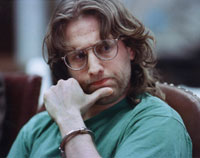
caption: In 1994, Ralph Tortorici walked into a college classroom, pulled out a hunting knife and high-powered rifle, and announced he was taking the class hostage. A paranoid schizophrenic who believed the government had implanted tracking devices in his body, Tortorici would be charged with 14 counts of aggravated assault, kidnapping, and attempted murder. That Ralph Tortorici was mentally ill was apparent to everyone; what was not so clear was how the courts would handle his case. In "A Crime of Insanity," airing Thursday, October 17, at 9 p.m. on PBS (check local listings), FRONTLINE explores the personal, political, and societal fallout that occurs when the legal and psychiatric worlds collide. For electronic images, contact Jenna Lowe at (617) 300-3500 or e-mail jenna_lowe@wgbh.org, or go Images may only be used in editorial conjunction with the direct promotion of this film in North America. No other rights are granted. All rights reserved. Photo credit top: © Albany Times-Union | |
| |
In December 1994, Ralph Tortorici, a twenty-six-year-old psychology student at the State University of New York at Albany, walked into a classroom, pulled out a hunting knife and a high-powered rifle and announced that he was taking the class hostage. He claimed that he was part of a government medical experiment and demanded to speak to the president, the governor, and the Supreme Court.
The standoff ended after nearly three hours when several students rushed Tortorici and the gun went off. One student was shot and seriously wounded. Ralph Tortorici was arrested and charged with 14 counts of aggravated assault, kidnapping, and attempted murder. His lawyer entered a plea of not guilty by reason of insanity.
That Ralph Tortorici was mentally ill was apparent to everyone. What was not so clear was how the courts should deal with his case. In "A Crime of Insanity," airing Thursday, October 17, at 9 P.M. on PBS (check local listings), FRONTLINE examines the case of Ralph Tortorici, a paranoid schizophrenic with a decade-long history of mental illness. Told from multiple viewpoints--including those of Tortorici's family, defense attorney, and the prosecutor charged with trying the case--the one-hour documentary takes viewers deep inside the adversarial criminal justice system, revealing the personal, political, and societal fallout that occurs when the legal and psychiatric worlds collide.
Prosecutor Cheryl Coleman--in her first in-depth interview--tells FRONTLINE that she knew from the start the Tortorici case would be a tough one to win. Coleman spent over six months searching for a psychiatric expert, but for the first time in her career, she could not find an expert willing to testify that Tortorici was legally responsible for his actions at the time of the crime.
"You can pretty much find an expert to say what you want to be said," Coleman says. "There's a lot of people who make their living consulting [to the courts]. No mental health professional wanted to be involved having his or her name attached to the prosecution of Ralph Tortorici."
Coleman talks to FRONTLINE about the reality of prosecuting a difficult case like this one. With unusual candor, she reveals the strategies a prosecutor routinely uses to undermine a claim of insanity.
"When it's going to be a potential psychiatric defense, the first thing that you screen in your mind is, 'Is there a possibility that we can make the jury think that this guy's faking?'" she says. But Coleman remembers that "...within thirty seconds [of meeting Tortorici], it was patently obvious to us that he wasn't faking it."
Coleman recounts her efforts to persuade Chief Assistant District Attorney Lawrence Wiest to allow her to arrange a plea bargain, which would have sent Tortorici to a secure mental hospital rather than to prison. "I remember telling him, 'Look, we've pushed it absolutely as far as we can go...I don't want to do this and...there is no way that you're going to win this....Put aside the fact of whether or not he really is crazy, if you don't care about that, [but] we're not going to look so good...this is going to be a huge exercise in futility. A huge, public exercise in futility.'"
But Wiest refused, and he explains to FRONTLINE one of the reasons why his office would not agree to plead the case out. "You know, the district attorney, here in New York...is an elected position, and we didn't want to be perceived by the electorate as accommodating somebody that they felt should have gone to prison and not some hospital," he says. "If a jury made that determination, that's fine--that's 12 ladies and gentlemen from the community making that decision."
Cheryl Coleman reveals to FRONTLINE what happened behind closed doors when, despite her recommendations, she was told to take the Tortorici case to trial.
"[Wiest] says, 'I want you to go out there and be Rush Limbaugh.' And I said, 'What do you mean, Rush Limbaugh?' He said, 'Well you've got that way about you. Just go out there and start insulting...psychiatrists and just take a slap at the psychiatric profession...basically like a burn-and-destroy kind of mission.'"
With the trial just about to begin, Ralph Tortorici made a decision that stunned everyone involved in the case. Against the advice of his defense attorney, Tortorici decided that he would not be present at his own trial. The jury that would have to decide whether Tortorici was legally responsible for his actions would reach their verdict without ever seeing him.
"I did over a hundred jury trials in my seven years in county court and handled several thousand major felony criminal cases, and I can't recall of any other defendant that wished to absent himself or herself from the proceedings," presiding Judge Larry Rosen recalls. "But because something is atypical doesn't mean it's insane."
Despite her qualms, Coleman prosecuted the case. In "A Crime of Insanity," she explains to FRONTLINE what happens to a trial attorney once a trial begins. "When you're a trial lawyer, it doesn't even matter what side you're on because you go into a zone and you're into the battle," she says. "You're not thinking about right, you're not thinking about wrong. You're just thinking about winning....And you're just thinking about doing anything that you have to do. Short of...lie, cheat, and steal. But you're doing everything that they said you can do to win. And that's what we were doing... And anybody who says that they don't do that isn't telling you the truth."
After eight days of testimony and over 30 witnesses, the case was finally handed to the jury. In just over an hour, the jury found Ralph Tortorici guilty on 11 counts of kidnapping and aggravated assault.
"I can recall Judge Rosen basically commenting to me that the insanity defense in Albany County...is essentially dead," defense attorney Peter Lynch tells FRONTLINE in his first television interview about the case. "Because, if I didn't win this case on legal insanity, what possible case could you win?"
But Coleman recognized the damage Tortorici had done to his own defense. "The funny thing about it," Coleman says, "if Ralph was a little less crazy--enough to know that he should go to his trial and let people see how insane he was--he probably would have been found not responsible."
Rosen sentenced Tortorici to the maximum allowed by law: 20-47 years in prison. But the time he would spend behind bars would be far less than that. Three weeks after being incarcerated, Tortorici attempted suicide in prison. Over the next three years, he was shuttled back and forth to a secure psychiatric facility. After nearly a year at the psychiatric facility, Ralph was returned, once again, to prison. Three weeks later, on August 10, 1999, Ralph Tortorici hanged himself with a sheet in his prison cell.
Tortorici's death stunned prosecutor Cheryl Coleman. "I was ashamed that morality and what's right--as opposed to what's legal--plays so little a role in the system. And plays so little a role in what we do...I felt responsible for his death," she tells FRONTLINE. "I thought of his parents, I thought of his family and I thought how he didn't have to die. And I remember thinking...there was something wrong with what we did...and we had to really seriously take a look at what we did."
Chief Assistant DA Wiest had no such misgivings: "You know, if people ask, 'Was justice done in this case?' Well, for [the injured student] and his family, yes, justice was done in this case," he says. "For this community as represented by those 12 ladies and gentlemen pulling jury duty, justice was done in this case."
Following the broadcast, visit FRONTLINE's Web site at www.pbs.org/frontline for extended coverage of this story, including:
- Interviews with prosecutor Cheryl Coleman and defense attorney Peter Lynch;
- A report on the role of psychiatrists in the courts;
- Excerpts from the Tortorici trial testimony;
- Background on Ralph Tortorici's struggle with mental illness;
- Statistics on the mentally ill in prison;
- History of the insanity defense in the American judicial system, and more.
"A Crime of Insanity" is a FRONTLINE co-production with Camera One Productions, LLC. The producers are David Murdock, Miri Navasky, and Karen O'Connor.
FRONTLINE is produced by WGBH Boston and is broadcast nationwide on PBS.
Funding for FRONTLINE is provided through the support of PBS viewers.
FRONTLINE is closed-captioned for deaf and hard-of-hearing viewers.
The executive producer for FRONTLINE is David Fanning.
Press contacts:Erin Martin Kane [erin_martin_kane@wgbh.org]
Chris Kelly [chris_kelly@wgbh.org]
(617) 300-3500
FRONTLINE XXI/October 2002
frontline privacy policy · pbs online · wgbh
web site copyright 1995-2014 WGBH educational foundation