

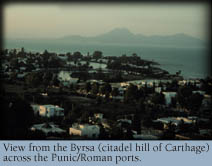
Carthage supplied a commodity upon which Rome's very survival depended: grain. The hinterlands surrounding the capital were not sufficient to supply it with quantities sufficient to feed the population; Carthage served as the port city that collected and shipped the North African grain harvest to the capital. Recent underwater archaeological teams have discovered the remains of large vessels that once criss-crossed the Mediterranean, carrying not only grain but other agricultural products including olive oil.
Many of city's inhabitants had moved there from Italy, so the number of immigrants was relatively high. Christianity in Carthage, and other parts of North Africa reflected the culture of this immigrant community, as well as that of the indigenous inhabitants. The result was a distinctive form of Christianity that reflected a unique cultural synthesis of North African customs and Roman heritage. Among the city's outspoken early Christian writers and teachers were Tertullian and St. Augustine.