Obama’s Concerns Focus Super Bowl Talk On Player Safety
January 29, 2013
Share
Explore our NFL concussion database.
With Super Bowl XLVII just five days away, much of the early conversation around the game is focused not on which team will win, but on the issue of player safety.
The topic has taken on new prominence this week after President Obama voiced his concerns about violence in football during an interview with The New Republic. As the president put it:
I’m a big football fan, but I have to tell you if I had a son, I’d have to think long and hard before I let him play football. And I think that those of us who love the sport are going to have to wrestle with the fact that it will probably change gradually to try to reduce some of the violence. In some cases, that may make it a little bit less exciting, but it will be a whole lot better for the players, and those of us who are fans maybe won’t have to examine our consciences quite as much.
The president’s comments come amid an NFL season in which 170 concussions have been reported on team injury reports. In New Orleans, the site of this year’s Super Bowl, the issue of player safety has spurred a range of reaction from players.
Bernard Pollard of the Baltimore Ravens, told CBS Sports that the emphasis on safety is jeopardizing the future of the NFL.
“Thirty years from now, I don’t think it will be in existence,” said Pollard. “I could be wrong. It’s just my opinion, but I think with the direction things are going — where [NFL rules makers] want to lighten up, and they’re throwing flags and everything else — there’s going to come a point where fans are going to get fed up with it.”
Pollard has been one of the league’s most notorious heavy hitters. He was fined $15,250 for unnecessary roughness during the AFC championship. He also forced Patriots running back Stevan Ridley from the game with a head injury. (Watch the hit here).
Pollard said he understands the drive to make the game safer, but added it’s hard to balance that interest with the desire from coaches for “bigger, stronger and faster” players.
“And that means you’re going to keep getting big hits and concussions and blown-out knees,” said Pollard. “The only thing I’m waiting for … and, Lord, I hope it doesn’t happen … is a guy dying on the field. We’ve had everything else happen there except for a death. We understand what we signed up for, and it sucks.”
When asked about the president’s comments, 49ers linebacker Aldon Smith echoed that point.
“It’s not like we signed up and thought we were going to play tennis,” Smith said. “It’s a physical game. Everybody plays hard. And guys get hit sometimes. That’s what we all know coming into the game. We all signed up for it.”
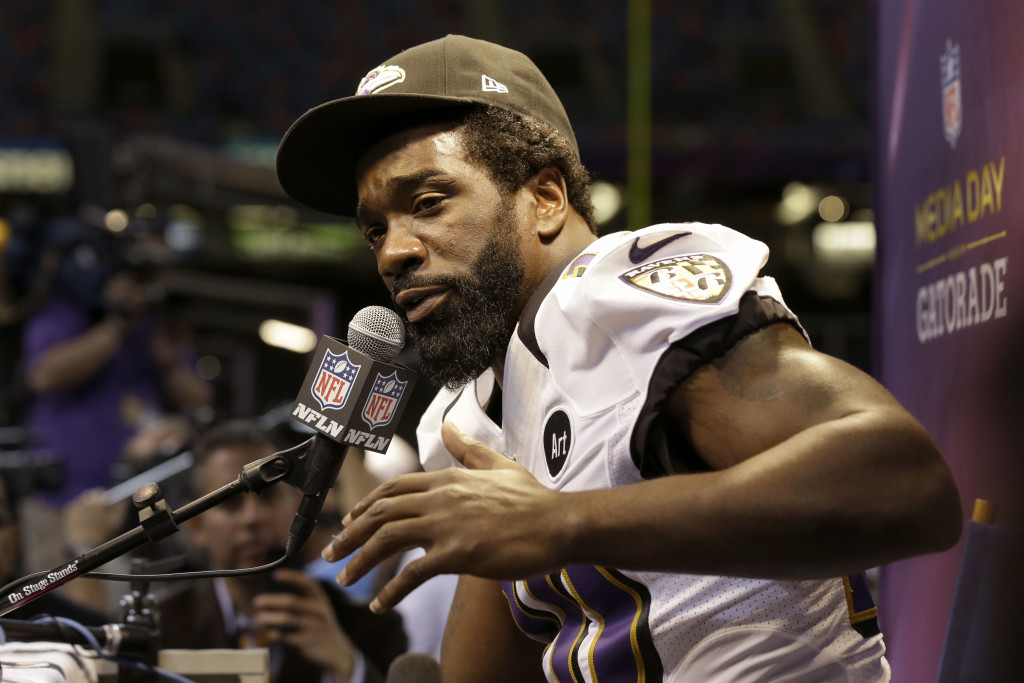
For his part, Ravens safety and nine-time Pro-Bowler Ed Reed said he stood with the president’s take.
“I am with Obama,” said Reed. “I have a son. I am not forcing football on my son.” The truth, Reed added, is that football takes a toll on players’ lives and bodies. “We age faster than everyone (because) of what we do — it makes you think about your livelihood after football, how much you’re going to have to spend on your body.”
Reed is one of several players featured by Esquire magazine this month in an exposé on how players adjust to pain throughout their career. As author Tom Junod notes:
He is playing now with a torn labrum, a shoulder injury that caused the Ravens to incur a fine earlier this season when they failed to report it … But he’s playing, because he’s better hurt than his replacement is healthy, and he’s helping his team more by playing than he would help his team by sitting down and trying to heal. He’s playing because he can, and because — no matter how much attention the issue of injury receives and no matter how many changes the NFL faces — the second cardinal rule of the NFL is that you play unless you can’t.
In an effort to better understand the health risks that accompany a career in professional football, the NFL Players Association (NFLPA) announced Tuesday it was partnering with Harvard University for a 10-year, $100 million study of 1,000 retired players.
To date, at least 80 lawsuits have been filed against the league seeking damages for head injuries sustained on the field. The Harvard study will focus, in part, on repetitive blows to the head and how they contribute to the degenerative brain condition known as chronic traumatic encephalopathy (CTE). The condition, which can lead to dementia, memory loss, and depression, has been found in 50 former football players — including 33 who played in the NFL. And just last week it was announced that CTE was documented for the first time in five living former players.
The Harvard study will also look beyond head trauma to examine everything from knee ligaments and heart function to psychological stress and the effects of long-term exposure to painkillers.
“Our goal is to transform the health of these athletes,” Lee Nadler, the director of the study for Harvard Medical School, said in a statement. “In order to extend the life expectancy and quality of life of NFLPA members, we must understand the entire athlete, all the associated health risks, and all of their interactions,” he said.
The NFL said in a statement that it “saluted” attempts to improve player safety and that league officials look forward to “learning more about the Harvard study and hope that it will play an important role in advancing medical science.”

Former Digital Editor
Related Documentaries

Latest Documentaries









Explore
Policies
Teacher Center

Jon and Jo Ann Hagler on behalf of the Jon L. Hagler Foundation
Corey David Sauer
Koo and Patricia Yuen
FRONTLINE is a registered trademark of WGBH Educational Foundation. Web Site Copyright ©1995-2025 WGBH Educational Foundation. PBS is a 501(c)(3) not-for-profit organization.
Funding for FRONTLINE is provided through the support of PBS viewers and by the Corporation for Public Broadcasting, with major support from Ford Foundation, and The Fialkow Family Foundation. Additional funding is provided the Abrams Foundation, Park Foundation, John D. and Catherine T. MacArthur Foundation, Heising-Simons Foundation, and the FRONTLINE Trust, with major support from Jon and Jo Ann Hagler on behalf of the Jon L. Hagler Foundation, and Corey David Sauer, and additional support from Koo and Patricia Yuen. FRONTLINE is a registered trademark of WGBH Educational Foundation. Web Site Copyright ©1995-2026 WGBH Educational Foundation. PBS is a 501(c)(3) not-for-profit organization.