Visit Your Local PBS Station PBS Home PBS Home Programs A-Z TV Schedules Watch Video Donate Shop PBS Search PBS
Go
April 23rd, 2009
The Film
Watch the Documentary

Two years after the country was rattled by the Virginia Tech shooting that left 33 dead, THIRTEEN takes a critical look at the issues surrounding teen depression and suicide in Cry for Help, premiering Wednesday, April 29 at 9 p.m. on PBS (check local listings). If you miss the premiere, you can watch the full program below:
Get the Flash Player to see the wordTube Media Player.

Behind the acts of violence and rage of both the Virginia Tech and Columbine shootings is a larger issue of mental illness in teens that is rarely addressed. For instance:

  • The rate of teenage suicide has tripled over the last 60 years –28 teenagers a week now die by suicide.¹
  • Depression and anxiety in adolescents often go unrecognized or untreated for years, and the results can be fatal – over 90 percent of adolescents who die by suicide have a diagnosable mental illness at the time of their death. ²

While school shootings are rare, signs of mental illness in the perpetrators of these crimes are not. School shooters often have a history of suicide attempts, suicidal thoughts or depression³ – which makes identifying those conditions through mental health screening critically important.

Cry for Help takes an intimate look at the efforts of two high schools to identify adolescents at risk. Hamilton High School in Ohio and Clarkstown North High School in New York have both been affected by teen suicide and have launched powerful new programs to prevent future tragedies.

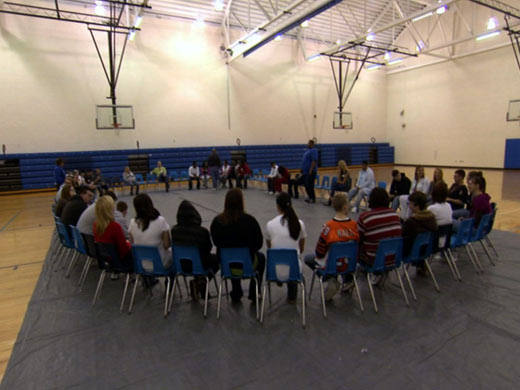
Following the unrelated suicides of four students that shook the Hamilton community, school officials are taking a direct approach with “Character Day” – a raw, emotional, and honest program designed to motivate students to open up and ask for help. In Clarkstown, school officials are taking advantage of the time their students spend on the Internet by creating an online community – one where teens can anonymously air their problems and seek support from their peers and professionals.

Cry for Help also examines the often difficult transition from high school to college through a first-person account of a young woman who has battled mental illness. Stacy Hollingsworth, a straight-A student and gifted musician, was by all appearances a well-adjusted and accomplished young person. When Stacy phoned home from a campus psychiatric hospital during her freshman year at college, it was then that her parents realized things were not as perfect as they seemed. She had been hiding depression, suicidal thoughts, and feelings of paralyzing hopelessness for years. Stacy and her parents chronicle the painstaking journey to put her life back together, and how she founded her college’s first on-campus chapter of the National Alliance for the Mentally Ill.

Additionally, Cry for Help looks at the efforts by some parents to tackle behavior and communication issues during their children’s earliest years – before depression, violence, anger or suicidal impulses take over.

Interviewees include Dr. Chris Lucas, professor of Child & Adolescent Psychiatry at New York University; Dr. Frank Robertz, co-founder of Institute for Violence Prevention and Applied Criminology in Berlin, Germany; and Dr. Nolan Zane, Director of the Asian American Center on Disparities Research.

THIRTEEN’s Cry for Help is funded by the Estate of Marya Sielska; Members of THIRTEEN; the Irene Ritter Foundation; Judy Collins; the Leon Lowenstein Foundation; Donna and Phil Satow; the Marion E. Kenworthy-Sarah H. Swift Foundation.

Cry for Help is a production of THIRTEEN for WNET.ORG. Mary Murphy is producer and Scott Davis is senior producer. Edie Magnus is reporter and executive producer. Neal Shapiro and Stephen Segaller are executives-in-charge.

¹ Campus Mental Service, Recommendations for Change. Vastag et al, 2001.

² Nejm 2006. Study from Velez et al, American Academy of Child and Adolescent Psychiatry 1988.

³ Secret Service Threat Assessment Study for the U.S. Justice Dept.

77 Responses to “Watch the Documentary”
  1. Margaret says:

    The problem with children of today is the overindulgence of parents to children and the conditions of children to be unprepared for the whole world and its disappointments in life. Mothers and Fathers cannot protect their children from everything that hampers their lives and that is what today’s parents try to do to their children from infancy. They must learn to deal with adversity from an early age without parental or day care supervision. The word “NO” is not in anybody’s vocabularly. This is something that the infant learns when he goes near a stairway or dangerous circumstance (like touching a hot oven). The word “No” has to be in the vocabularly throughout childhood. The children do not know this word!!!

  2. Emily says:

    Please I am looking for a referral with an experience professional, my son is 16 years old and suffers from agoraphobia. We will travel a reasonable distance. We are located in Astoria,NY,11106 tel: 718-626-0968

  3. Esther says:

    This Sunday, May 3rd at 7pm at The United Methodist Church in Manasquan, NJ will have a play about just this. It is called “Bang Bang, You’re Dead” which deals with teen violence, suicide, bullying, depression, anxiety and more. Very powerful play for middle school & above. Message is simple “YOU CANNOT REWIND LIFE – THERE ARE CONSEQUENCES TO YOUR ACTIONS.”

  4. Julia says:

    Margaret you are an idiot. Most of us young people with depression were never “overindulged” by our parents. We are straight A students, we have jobs, we are in school, and we respect our elders. I was never “spoiled” as a child and my depression is a chemical imbalance caused by the under production of serotonin in the brain. My family also has a history of depression and I have seen my parents cry before in private, I think THAT had a greater impact on my feelings of sadness then being “over indulged” did. You think being spoiled can cause thoughts of suicide? And today’s youth are not “sheltered” in fact we are probably exposed to more at an early age than any other previous generation. Most of my anxiety and depression comes from feeling anxious about my future and feeling disconnected from my peers. If anything a person’s age group has more of an impact on their mood swings than parents do, especially for young teenagers.

  5. Maryse says:

    Overindulgence is not the cause of teen age suicide. I cannot believe that someone would actually suggest that as the reason for the ills of teenagers. Suicide is brought about by depression and feelings of hopelessness. I have two teenagers and am known as a strict parent. We say “no” to our kids all the time — that doesn’t stop external pressures from school and friends from affecting them daily. When I went to school, we didn’t have the tons of homework my kids have every night. We didn’t have the week long state tests every year that my kids have to endure. My 9th grader has approximately 1 1/2 hours of biology homework every night. And that’s just one course. High school is now extremely competitive. When I see what my kids have to accomplish every day, I feel SORRY for them. To blame the social and academic stress that kids feel to the overindulgence by their parents shows that you are an uninformed, intolerant individual.

  6. April says:

    Looking forward to watching the program. My 17 year old son attempted suicide twice this year. He is now on his meds and seems his depression and anxiety are being controlled. He’s talking and journaling , too. He is anxious about his future and has few friends b/c he is so shy. I had no idea until I was faced with it. Smiles are deceiving. Parents of teens need to fully educate themselves about adolescent depression and this program is so timely.

  7. Carol says:

    I’m am dealing with these issues with my daughter and it is heartbreaking. Her older brothers didn’t have these problems but life has changed. She is a good kid with good friends who is battered by her high school and life. Her school is a toxic environment of over-achieving high schoolers pushed to choose a life track at 15, questing to be physically perfect and with a disturbing mix of sex and drugs. And this is a suburban school that is rated “Excellent”. There is so much pressure, it’s hard to believe. A kid on the International Baccalaurate is the gold standard. Honors class kids are not quite up to snuff and those in the ordinary classes are considered “stupid”. If you want to be on a sports team, forget it unless you’ve been doing club sports since you were 10 and have a personal coach. Great message. Is it any wonder our kids drink, do drugs and cut? I look forward to watching this program.

  8. WINKIE MITCHELL says:

    some of the schools in our school district concerns me in avoiding dialogue about suicide with our student, even though we have had several suicides the adult in charge feel if you talk about it then they will do it. there are many student dealing with depression and presures in life that become so over whelming they feel they have no other choice the disconnect between the adults and our youth provides for a death trap. there is a large elephant(DISPAIR AND HOPELESSNESS) loud and crying out EVERYBODY TALKING ABOUT OUR KID,YET IS ANYBODY LISTENING THANK YOU FOR AIRING THIS IMPORTANT MESSAGE

  9. shane smethers says:

    overindulgence may not be the cause of teen suicicides in todays society, but it is cause for many of our children not being prepared for the let-downs of their day to day activities. we as a society have become lazy and rely on the “electric babysiter”(t.v./nintendo) to do all of our child-rearing for us.what happened to good old fashioned child raising? if we spent more time focused on our kids and what they do and not on the meaningless things like 6 hours of television aday, maybe we would see the signs a little faster if thing were amiss with our children.they are our greatest resource.

  10. Jeff says:

    Haven’t heard the word “gay” yet — and on a show about teen suicide. Must I wait for a show about teen murder?

  11. Peter says:

    Dear Producers,

    I am a little surprised at this show because I am in my 50’s and I knew this behavior when I went to NYC public school in the 1960’s. I knew numerous children who slit their wrists. I knew children (my age then) who ended up in psychiatric wards.

    I was finally diagnosed as bi polar last year. I now am able to sleep which I had not for half my life.

    I had to go live with my father when a violent and abusive man moved in with my mother. My sister had to put up with sexual abuse until she was a teen and made an escape.

    My father sent me to boarding school and left the country right after I was arrested for the selling of drugs. I was 15 and it was a divorce. I did not see my father for 25 years although he paid for some of my education. In this boarding school each child was put on medication and medication that was arbitrary. I saw the psychiatrist once.

    I was lucky to live after I got out of boarding school. I was living in an extremely violent world. I was in a car accident where 2 friends died, hitchhiked with a girl and watched her get raped while I was beaten severely, and on and on.

    I’m not saying that what you say is wrong, but it started a long time ago and I thought until recently an American problem. Sonic Youth called an album “Daydream Nation” which I thought described the syndrome.

    Lately I have been working with several animal rescue groups and I see how people just drop their pets off and feel no responsibility or grief. I think I am attracted because I see my own background in the drop.

    Yes, pay attention to your child, Peter

  12. Carolyn Marie says:

    Starting when I was 8 until I was 21, I spent most every day thinking how to kill myself. Watching this program was hard because I knew what everyone was talking about in it. For me, it started when my best friend told people to ignore me, that I had germs, and all but a few students took it up. No one wanted to work with me, and they spent the entire time telling me I was dirty. When I tried to get help from my parents, I was told everyone was just jealous of my redhair. When what I really needed was a hug.

    It has nothing to do with overindulgence; my parents told me “no” quite often and spanked me quite throughly when something happened. My parents kept a heavy hand with me. They tried to make me independant from a young age. My brother and I were latchkey since I was 9, and we would even spend the summers with just the two of us. I’m sure if my parents had indulged me just a little bit, things would be different. But to this day, they do not. My dad is still violent with me, and I’m 29, having lived on my own for 10 years.

    This is not a modern problem. It is a continuing problem. We have a broken society, and it’s not from overindulgent parents. It’s still very hard for me to overcome the persistant anxiety and panic disorder I live with, and with our broken healthcare system and current recession, trying to work forward for myself is more difficult than a year ago when I could receive help.

    These problems have existed for as long as humans have existed. It’s not a new problem, but as we as a people start to care, as we learn more, we’ll help more people. And for this, I rejoice for future generations but still fear for my own.

    Thank-you so much for this program!

  13. Nan says:

    This isn’t a new problem, but FINALLY the stigma and silence are breaking down and schools, families, and the medical profession are talking and paying more attention. Folks are realizing that depression is more than just a bad hair day. Suicides have been under-reported for years and not talked about. Folks suffering from depression and mental health isues were treated as if the illness were their own fault. The more attention this subject gets, the more awareness, the more funding we can get for research- the sooner we can change the statistics, just as medical breakthroughs have done for many cancer and AIDS patients. As the stigma is demolished, more people suffering from mental health issues will be able to come forward and ask for help. Mental health issues are physical illnesses and need to be treated as such.

  14. Henry Altenberg,MD says:

    My first training in child/adolescent psychiatry began in 1951. I am still a practicing psychiatrist, and still studying new approaches to helping people find more happiness, or decrease their unhappiness. I was very moved by seeing the film. I missed part of the beginning but will plan to watch it online.
    There are never any “simple” answers, and many truths. I would strongly commend anyone, parents and teenagers, to read “Choice Theory” by William Glasser,MD, apsychiatrist who ha been practgricing for the past 50+ years, the author in 1965 of “Reality Therapy” as well as 10-12 more books, including “Between parent and Teenager.” He doesn’t claim to have all the answers by any means, but does offer some uncommon “common sense” to the world.

  15. Erica Clinch says:

    I am now 26 years old and in my school days I know that it was rough but children these days have it about three times more difficult than I could have ever imagined. I have been diagnosed with a mental illness called Borderline Personality Disorder. I know that if this was diagnosed in my early teens and something was done about it then I would probably be able to handel life more effectively without having to feel like resorting to self destructive behaviors. I unfortunatly did not have the priviledge to have parents that “overindulge” me with attention. In my family nobody speaks about mental illness and they kept me in their “closet” and over the years I have gotten worse. My main reason for writing this is because I am practically begging parents to try to understand their children and not let anything slide under a rug. Maybe if someone had been there for me as a child, I would be doing better now. It is NEVER to late to let your kids know how much you care because believe it or not….their waiting to hear you let them know that they are okay and that things will get better. Sit down and talk to them learn the right questions to ask and the right words to say and you never know….you might actually save their lives.

  16. Nicole Anonymous says:

    I arbitrarily ran across this program today. I found it very sad to hear the sadness of others and seeing the Hamiliton High made me wish our schools worked like that. They don’t. I’m a Senior in High School. My father is a Narcissist, my mother has Complex PTSD. I have Complex PTSD. I was a abused child, I’ve been in treatment facilities, foster care, and now I live with an emotionally abusive mother. My counselors know about my severe depression and the abuse. Their general response is that they can’t do anything. They don’t care. They are there to earn a paycheck. It is their JOB. I’m not the only student who falls through the cracks either. So many of my friends go through similar difficult situations. Nothing is done. No help is given. Adults pretend to care about what happens in the world, however it is a shallow view that has no deeper roots or substance. We can’t all be Hamilition High. Not all adults care that much.

  17. [...] a cry for help documentary Here is a documentary made by producer Edie Magnus who I had the honor of being interviewed for the making of this program. Its about depression and suicide. Have a look. The Film: Watch the Documentary | Cry for Help | PBS [...]

  18. JoAnne Deibert says:

    How sad the stories of those who have commented and even sadder that some who watched the program have the idea that parenting is the problem. I was a psychiatric social worker in a county mental health center 25 years ago…my job was to follow up on individuals with chronic mental illness when they were discharged from the hospital. How little I really understood until we became the full time parents of a toddler, when my youngest biological son was 17. Very quickly we knew something was very wrong…I know observers saw her melt downs in public and must have judged our parenting. We thank God that we were given some help when she was five years old…but the diagnosis was a shock. I was instructed to keep a log for a month before the appointment. I recorded behavior, our intervention, and our daughter’s response to our intervention. I wrote until my hand hurt…What the log revealed was that this beautiful child had a mood disorder. She was an exceptionally insightful child. She was able to tell me what was wrong…in between her episodes of rage, sobbing, or laughing..She told me how angry she felt and that it scared her. We moved when she was 8, with her illness becoming much worse as she adjusted to a new home and school. The moods became more drastic, with rapid speech, singing, running in circles, alternating with screaming and kicking, and sobbing. Her first hospitalization came at age 9 when she cut herself with a pen knife she knew her Dad kept in his dresser drawer. Immediately she told me, feeling scared at her desperation. The struggle each year to get through each day of school, homework, and the huge amount of anxiety she had is hard to describe. Only those who have lived through it would understand. If there is anything I can advise others to do it is to listen to your child, and let them know you love them no matter what! Today our daughter is 21 years old. She is a junior in college and has a 3.8 gpa. She takes medicine twice a day, and needs to follow a regular sleep schedule and a diet similar to one for a diebetic. She wants to make a difference in the world by helping children who are struggeling alone. As a culture we need to accept that mental illness in kids and adults is a reality. No one is to blame, they are biological brain disorders, and are treatable. When we put aside the stigma and start screening children the same was we screen for poor eyesight and hearing, we can make a differnce that can change the lives of many! It is easy for us to judge when a tragedy happens becaseu no one gave teenagers the treatment they needed. We Thank God that someone told us about NAMI, an advocacy group of family members who educate and support other family members to help the person they love. There are groups in every state. You can support in your area at: http://www.nami.org

  19. Kathy Reim says:

    Over my forty years as an educator I have seen us push kids harder and faster, increasing the pressure, attaching their success to the adult society and turning it into political decisions that contradict developmental research and common sense. The entire system is built to fail- scores must always increase and success is measured in how much we can manipulate lives at an earlier age.
    It is not about them, and they know it. It is about making everyone else look good. Nothing is unconditional- especially love. We wanted to duplicate the “high” standards in French and Japanese systems who had a higher rate of teen suicide 15 years ago. My guess is we have succeeded with the suicide rates, and now we have school assaults to go with it. Notice suicide tends to be a white, middle-class phenonmenon. We are burning out a generation.
    This is absolutely not about lower standards and dismissing groups of young learners to some lower track. It is about paying attention to not only the intellectual skills needed to work with kids but also the emotional skills and opportunities required to really be in anyone’s life. Smaller schools, smaller class loads, more stability and time to know one another. That is what private schools are able to do. That is what all our young people deserve.
    They will organize, and they will fight back- with our guidance or without it. I love their spirit and determination. The system needs repair- young people want us to be there for them.

  20. Gregory says:

    Margaret you are so wrong and truly an idiot. Margaret I hope you do not have any children of your own, and if you do I feel sorry for them and hope they will find someone in there lives who will invest in who they really are and who will listen to them.
    I am glad schools are starting to listen to students and really caring about what happens to them. I grew up poor in Los Angeles in the 1970s in a world where if you were a student/child you did not have a right to be depressed, you were told things like “life is not fair” and “welcome to the school of hard knocks”. That sort of “common sense” help didn’t help, many of the kids I knew as a teenager are now as adults suffering from depression and many went to prison for anger related issues. Our children are our greatest asset and its about time we stop the lip service about love and caring and started actually being the example and showing them by example what listening and caring is all about.

  21. Barbara says:

    I would be the first to admit, I to have said “kids today are spoiled, and have no respect for anything. It takes a program like this, and I thank PBS (as usual) for airing this program. I colunteer twice a week at a publc school. This is where this type of program needs to begin. I see alot of children in the school with anger problems,depression I am a grandmother and worry everyday about them growing up.I would love to start something like this in there school, I ask that someone help me to get started.

  22. Kimberly Hacktt says:

    A long time ago, parents, teachers and city officials realized they had a problem – that children can’t and don’t learn when they’re hungry. It was in 1853 when the Children’s Aid Society of New York City began the movement to offer hot meals at school for children who might not eat again that day. We realized then that children can’t grow and learn when they’re physically hungry. Now we are realizing that children don’t grow and learn well when they are emotionally hungry.
    By only emphasizing left brain (academic) work, we neglect and invalidate the deep human work of being and feeling. This they must do on their own, in their spare time, without adult support, mentoring or guidance. From the parent side, it is like sending your child off to school without lunch or money, expecting he/she will somehow get fed that day. From the school side, it is assuming each child is being fed, or worse, ignoring the truth, that many students are going hungry each day.
    That is a haphazard approach and puts all children emotionally and developmentally at risk.
    Children and youth need to be emotionally fed, supported and need opportunities to practice the art of being them – in school.
    Some are lucky. Some schools are beginning to pay attention and make changes, while most still insist that academics are what school is all about.
    Developmentally adolescents have one job – to answer the “who am I?” question. “Becoming” is what children and adolescents do and if we neglect the emotional and creative aspects of becoming for a menu of left brain work, we grow a child who is unbalanced and unhappy.
    Creative social emotional learning curriculum must be in all schools (CSEL). What is CSEL? It is time offered in school for students to explore, process and express what is going on emotionally and socially. It is for all students, not just those who are already at risk, in trouble or following tragedy. It is preventative but more importantly it is essential developmentally.
    We must feed our children so they can learn. adolescentwork.wordpress.com

    A long time ago, parents, teachers and city officials realized they had a problem – that children can’t and don’t learn when they’re hungry. It was in 1853 when the Children’s Aid Society of New York City began the movement to offer hot meals at school for children who might not eat again that day. We realized then that children can’t grow and learn when they’re physically hungry. Now we are realizing that children don’t grow and learn well when they are emotionally hungry.
    By only emphasizing left brain (academic) work, we neglect and invalidate the deep human work of being and feeling. This they must do on their own, in their spare time, without adult support, mentoring or guidance. From the parent side, it is like sending your child off to school without lunch or money, expecting he/she will somehow get fed that day. From the school side, it is assuming each child is being fed, or worse, ignoring the truth, that many students are going hungry each day.
    That is a haphazard approach and puts all children emotionally and developmentally at risk.
    Children and youth need to be emotionally fed, supported and need opportunities to practice the art of being them – in school.
    Some are lucky. Some schools are beginning to pay attention and make changes, while most still insist that academics are what school is all about.
    Developmentally adolescents have one job – to answer the “who am I?” question. “Becoming” is what children and adolescents do and if we neglect the emotional and creative aspects of becoming for a menu of left brain work, we grow a child who is unbalanced and unhappy.
    Creative social emotional learning curriculum must be in all schools (CSEL). What is CSEL? It is time offered in school for students to explore, process and express what is going on emotionally and socially. It is for all students, not just those who are already at risk, in trouble or following tragedy. It is preventative but more importantly it is essential developmentally.
    We must feed our children so they can learn. Take a look at my blog where I write about adolescence and the need for CSEL here and now.
    adolescentwork.wordpress.com

    adolescentwork.wordpress.com

  23. Esther says:

    Watched the documentary last night. These 2 schools are leaders implementing “Character Day” at Hamilton and the “Step” program at Clarkstown. Now, we need a PART 2 that address other issues affecting our kids today like alcohol (could start as young as 11 years of age), drugs (including stealing prescription drugs from medicine cabinet and having these crazy parties where drugs are placed in a punch bowl and they grab a handful and swallow a bunch of pills which they have no idea what they are putting in their bodies which is followed by alcohol), sexting (which in several cases the person submitting photos of themselves have committed suicide as the photo(s) travel from cell phone to cell phone)plus others which I’m sure we all can contribute our thoughts and suggestions. Our kids need to realize we love them and that comes thru nurturing and spending some time with them. It is not quantity, it is quality.

  24. Karen Barncastle says:

    Oh, wow! Margaret’s remark is so facile that I had to laugh. What a simple, accusative stance to take, which involves nothing from her but judgment. Oh, my – and we wonder why these problems continue to grow. I’m finding this discussion interesting, because I rather thought the focus was on MENTAL ILLNESS. For those who don’t know, the key word here is “illness”. Physical things are happening in the brain that cause these behaviors and emotions, and they need treatment. I realize it is uncomfortable to think that the very feelings so many people steer their lives by are dependant on the chemicals in the brain, but they are. My own story is a violent, short marriage to someone who is bi-polar, and raising a teen girl who has inherited this illness from her father. If you have not coped with this, then you cannot understand what it means. At best, this a very imperfectly understood area, but a good step would be for other humans to grasp that this is a physical illness as much as diabetes or muscular dystrophy is. I wouldn’t argue that parenting by my generation often leaves a lot to be desired, but we are talking about illnesses here, and all the parenting skills in the world won’t cure it. There is no cure – my daughter will be on her meds and seeing psychiatrists and therapists to try to treat her genetically induced physical illness of her brain for the rest of her life. We can only hope it will be enough to prevent the tragedies that are afflicting so many others.

  25. Jane Johnson says:

    Emily – and others – we finally found the best help when my son was 35 at McLean Hospital in Waltham, Mass.

    There is lots of help out there – all I can say is do it NOW -Get Help!!.. don’t wait and hope it will go away.

    Every year that goes by adds layers of problems upon the initial ones. Society/life is difficult for these kids.
    My son was exhibiting problem behavior almost from birth. There wasn’t much awareness in the 70’s.

    We tried lots of things before McLean Hospital. Peter was self medicating (alcohol & pot, finally crack) and unable to work.. though after about 10 years he did finish college. He went to treatment programs,a special high school.. but they didn’t address his bi-polar issues (they were so mild no one noticed) and depression/anxiety
    My story is a very long one and on-going.

    Get help – join a support group and talk to everyone! It is illness and the people helping need help and support too.

  26. Leslie Kuerbitz says:

    I commend WNET/PBS for bringing this sad problem to public awareness. As a retired counselor from a municipal police department, now in private practice for 9 years, I have worked with officers and their families, and with the families of citizens and/or crime victims, experiencing their suffering firsthand. Nevermind, that I grew up in an abusive family and through counseling and self-direction was able to realize personal happiness. At the police department, I worked in the midst of crisis, trying to help families cope with the initial shock and grief. When I could no longer work in crisis mode, I retired to my private practice, where I hoped to inspire new beginnings, and help others achieve balance, calm and inner peace. I also realized I wanted to give young people the one thing they craved…that someone would LISTEN to them and listen WITHOUT JUDGEMENT. I am blessed everyday someone new walks into my office, just as I am blessed to say “goodby” to my patients when they are no longer in need of our visits. Yes, there are days I wish I could “bury my head in the sand,” but I don’t. I keep coming back to the office, because that one “thank you,” or that one unsolicited hug makes it so worthwhile! Working with people for over 25 years has shown me how precious life is, and I know that each of us is entitled to happiness. When we become self-absorbed, stop caring and numb ourselves to the suffering around us, we are no longer living and cease to be human. Please ask for help and please don’t turn your back on someone in need.

  27. Danyelle says:

    OMG! I can’t believe someone would mention overindulgence as the reason for teenage suicide. I’m going a documentary right now for one of my classes in college on adolescent suicide. I’ve done a lot of research on top of interviewing professionals and fellow students. That is no where near what is going on now a days. Kids are exposed to EVERYTHING today, more then they ever were before in the past. And it happening earlier and earlier. I’m doing this documentary to help people realize and understand it better and not use dumb excuses for this touchy issue. We need to talk with our children and let them know that you will not freak out on them if they become suicidal. The more comfortable your child is with you the more likely they will come to you for help. When someone is feeling this way you need to keep in mind that it’s temporary they can get better, just takes some time and we have to be patient with them. And remember if someone is talking about it or joking about it, take it seriously that is the most common sign of suicide and we often over look it. With all the issues and everyday life teenagers have to go through with school, friends, home, society, or whatever else they may be involved in, suicide could come up and should be handled properly. It definitely doesn’t happen because the parents overindulge their children if anything they aren’t enough because of how busy we have become now a days.

  28. Kenny says:

    When will the documentry be on the web site

  29. dakota LaCroix says:

    My father took his in own life when he was young. http://www.youtube.com/watch?v=dI_TvDUexkU

  30. Shawn says:

    Important to avoid the temptation to “blame the victim,” and when it comes to teen depression, anxiety, suicide, etc. there are plenty of “victims,” and in families of teens dealing with depression and anxiety, nobody is spared. Depression is an equal opportunity disease, while at the same time humans living in toxic environments are more susceptible. My experience has been that our psychological “immune” system can be severely tested, compromised and sometimes disabled in extremely stressful situations. Two films come to mind > “A Beautiful Mind” a few years ago and the recently released “The Soloist” > both stories of briliant, gifted, talented people whose inner life made their outer life amost impossible to maintain.

  31. Blue eyes54 says:

    Maybe Margaret is jealous of those who get attention. A little more for her might lesson her judgemenatal viewpoint. God told us to give love and he never set a limit. Love is: I’ve got your backside and I’m there for you man. If we want our youth growing up well-adjusted we need to love them. Set boundaries yes, but with explantions that are reasonable. The choice system is very helpful. Age appropriate of course, two to three reasonalbe choices of discipline are given the child. They pick the one they think they can handle. They learn to make decisions, feel a sense of empowerment, and learn what works best for them. Less fit throwing,feelings of worthlessness, and less of the need to be controlling. I raised two great men by this method. I hope they carry this method on to my grandchildren.

  32. redric Matteson says:

    Shawn writes: “…people whose inner life made their outer life almost impossible to maintain.” This statement is very true, however the context in which it is true is missing. For the past 23 years I have seen over 15,000 suicidal patients in my role as a group & 1:1 therapist on a 10-bed acute mental health unit within the medical setting of a public hospital. The typical reason for each patient to be admitted is due to suicidal ideation — after an actual suicide attempt or having intense suicidal thoughts. The cliche is true: “Experience is the best teacher.” After seeing so many suicidal individuals the ubiquity of their symptoms starts to reveal underlying core patterns. These common algorithms stand separate from — and need to be differentiated from — the “precipitant” factors, as serious and important as they are, that are identified in the patient’s initial E.R. intake. Whereas it is true that depression and suicide are often linked, it is equally true that not everyone with depression is suicidal, and likewise not everyone who is suicidal is depressed. What I have learned over the years is that something deeper is happening here and needs to be factored in. No amount of looking for the right thing in the wrong place will ever deliver the right answer. The first step in solving a problem is to know what the problem is. Again, to close with another cliche: “What you don’t know can hurt you.” In the case of the suicidal patient, the same cliche becomes: “What you don’t know can kill you.” In this ongoing discussion on suicide, I am hoping to encourage an even wider conversation and a growing curiosity about the “big picture” of the phenomena of suicide. For those interested in more information about this can link to the following web site: ContextualConceptualTherapy.com

  33. beverly says:

    I am a single mother of three sons, the grandmother of six, and an educator of nearly 48 years. My own father committed suicide as did one of my best friends. I intend to return to this link in a couple of days when the video is scheduled to be available, hoping to learn more about how to help those in need without enabling! I am particularly concerned about several teens in my school as well as someone very close to me.

  34. Kat says:

    I am thankful for this documentary and intend to bring it to my health teacher at school so that everybody who watches it is made more aware of the problems discussed in this documentary and can hopefully begin to change and solve those problems.

  35. Kevin says:

    Every individual is different, some may be overindulged and others have nothing material to speak of. It’s not a matter of the kids who commit suicide being spoiled brats. It’s the opposite really. It’s a matter of the child not getting enough emotional connection. If you haven’t come to an understanding of Maslow’s ‘Hierarchy of Needs’ you may want to familiarize yourself with it. If a child isn’t having their basic needs met than nothing else really matters; school, cars, social life are not important to someone who is emotionally distant from the world or someone who isn’t being ‘fed’ figuratively or practically.
    Adolescence is a very tough time in any individuals life regardless of how they’re raised, their feelings about “self” and their perceptions of their environment are underdeveloped. you couldn’t pay me enough to do it over again.
    Teens need our help, not advice, but a person who listens and will shut up long enough to hear what they’re saying. Reading between the lines can help too. Even listening for what isn’t being said is important.
    Someone said that children don’t face enough adversity in their lives. I agree and disaree with this statement. Children need adversity in small bits, not all at once. We can prepare our kids for small adversities by talking with them about what to expect. But we shouldn’t make rules for something that hasn’t happened yet. Don’t make rules preemptively. You can allow your kid to make mistakes, it’s okay. That’s how we all learn. As a parent you play the part most importantly of the supporter first, the disciplinarian a distant second (or third).

  36. Stephanie says:

    NAMI – the national alliance on mental illness is a national grass roots organization. everyone, everywhere should know about NAMI.. it is FREE help for anyone living with and loving a family member with mental illness.. the classes and workshops are professional and accurrate.It will save your sanity and your loved one.. go to http://www.nami.org and find help… PLEASE – NAMI will help you and your family… it saved my life

  37. stephanie says:

    and by the way… the first commentor, margaret is so outrageously ill informed and wrong that i feel sorry for her and her children. she should be embarrassed by her comments

  38. laura barkett says:

    when will we be able to view the documentary?

  39. Debby says:

    My son was so nice, so quiet and alone since birth, so lovely, and so unique. He took his life just March 31, 2009. He was depressed, we knew there was a chance, but he had a doctor at college, and at home. He had a car, a cell phone, and his relatives were all in the city where college was. And yet, here we are. This is an internal struggle for all our beautiful children. Oh, how I miss my son.

  40. Carol Leamy says:

    I was so impressed with Cry for Help. I shared the information with my husband a United Methodist Minister in Reno NV. We would like to show the documentary to families. My family has had five young males take their life. They all strugled to fit in or the loss of love. I wish I had know wome of the signs to look for.
    I will devote myself to a greater understanding of our youth and their needs after watching this program.
    The “Steps” program was most interesting to me. I worked in the field of Drug and Alcohol additions for seven years. I realize that stress, depression, drugs and alcohol are all related. How can I get more information on “Steps”? I am on the Nevada Council for Handicaped which includes PAMI AND NAMI.

  41. Marcie says:

    I have been waiting to watch the documentary online because I missed the 4/29 premiere … today is May 4th and it is supposed to be available for online viewing. Has anyone been able to watch it yet and where is the link on the pbs website to access the program? Thanks to anyone who responds.

  42. Susan says:

    Marcie: I have been waiting to watch the documentary online too. If it does not show up in the next few days, I will call PBS to see what the status is. Wishing you the best. susan

  43. Jeff Damadeo says:

    I also have been waiting to watch it, yet it has not been able to be viewed online. Hopefully they will correct this.

  44. Colin says:

    The documentary will be online by the end of today, 4/5. Due to technical difficulties, there was a necesary delay to post online.

  45. Bill says:

    Is there any other place we can go to for the video?

  46. Kathy Bannar says:

    The documentary was awesome! We need more administrators like these in our high schools. Whether there is a known problem or not, affirmative action is a good thing. In Cherry Hill, New Jersey; we have had too many suicides (including my son). The Hamilton HS program should be instituted in our middle schools and high schools.

  47. Bill says:

    Note to webmaster: The Tab for Segment 5 of your documentary (Called “Early Intervention”) is mislinked – it’s pointing to the “Wake Up Call” video clip. So, viewers can only see 7/8 of the documentary. Please correct this, thanks.

    About the documentary – it’s excellent, and I commend PBS for dedicating the resources to it. Out of curiosity, though, a few questions:

    1) The documentary states that 90% of students who commit suicide had a “diagnosable mental illness” at the time. Where did this “fact” come from? In all reviews of teen suicides that I know of, the vast majority of parents, teachers, and the victim’s friends (over 90%) had no clue whatsoever that the victim was in any distress at all. If the majority of suicide victims showed no symptoms before their death that anyone noticed, how can you say that 90% of them had a mental illness at the time? (Or, are you just making a value judgment, that “they must have been crazy or they wouldn’t have committed suicide”?) Where is the science (and the reference) for this “mental disease fact” that you are quoting here?

    2) Also, every study of teen suicides I have read shows that the vast majority (almost 100%) of the victims were severely bullied at the school before the suicide, some for long periods of time. Most suicide notes of teens document this clearly. Yet, why didn’t your documentary mention this bullying-suicide connection? Again, out of curiosity, is Hamilton High School being sued for violating the civil rights of the dead students (for failing to protect them from bullying?) Is that why the documentary did not mention this bullying – suicide connection?

    The bullying – suicide link is perhaps the most significant fact about teen suicides,yet your documentary failed to mention it.
    WHY?

    3) The program being adopted by Hamilton High School appears very well considered. Did they just “dream this up themselves”, or did they adopt a clinically tested / validated anti-suicide program? (If so, what program did they adopt?) Is the anti-suicide program they have connected with an anti-bullying program at the same time, or no?

    In either case, where can I go to get more information about the techniques / programs they are using? I’m asking because the high school in my city has a higher suicide rate than Hamilton did, yet they are doing nothing to correct it. I’d like to be able to point them in a direction that will save some lives. It’s sickening to read about one student after another dying by suicide in this community.

  48. Kevin says:

    Thanks so much for making this available!

  49. jim says:

    margaret was right

  50. Mike Russo says:

    All too aften teachers don’t recognize the call for help. Teachers and administraters not trained to see beyond the classroom, Teachers not willing to take the responsiblity to get to know their students and what makes them tick. Perhaps a student profile given out the first week of school to each student can help teachers get to know their students on a personal level. Remember we were once students too.

Produced by WNET.ORG   ©2012 Educational Broadcasting Corporation. All rights reserved.