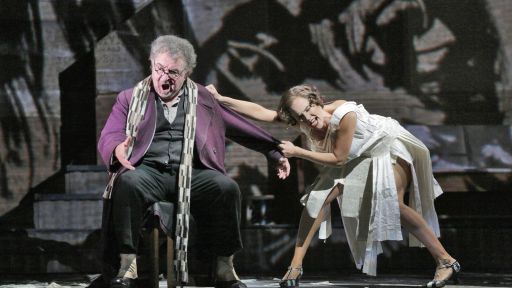
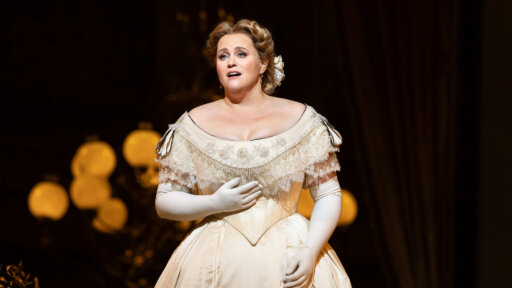
Ken Howard/Metropolitan Opera |
Composer: Pyotr Ilyich Tchaikovsky
Librettists: Pyotr Ilyich Tchaikovsky and Konstantin Shilovsky, after Alexander Pushkin’s poem
Production: Robert Carsen
Conductor: Valery Gergiev
Performers: Renée Fleming (Tatiana), Elena Zaremba (Olga), Ramón Vargas (Lenski), Dmitri Hvorostovsky (Onegin), Svetlana Volkova (Mme. Larina), Larisa Shevchenko (Filippyevna), Sergei Aleksashkin (Prince Gremin), Jean-Paul Fouchécourt (Monsieur Triquet), Richard Bernstein (Zaretsky), Keith Miller (Captain), and Linda Gelinas and Sam Meredith (Dancers)
Synopsis:
Act I
Scene 1: The widowed Madame Larina and her servant Filippyevna listen as the Larin daughters, Olga and Tatiana, sing. The peasants come from the fields, celebrating the completion of the harvest with songs and dances. Olga teases Tatiana for avoiding the festivities; pensive Tatiana prefers her romance novels. When the peasants leave, Olga’s suitor, the poet Lenski, arrives with his worldly friend Eugene Onegin. Lenski pours out his love for Olga (“Ya lyublyu vas”). Onegin strolls with Tatiana and asks how she doesn’t get bored with country life. Unnerved by the handsome stranger, Tatiana answers with difficulty. The two couples go inside for dinner as night falls.
Scene 2: In her bedroom, Tatiana persuades the reluctant Filippyevna to tell her of her first love and marriage. Tatiana admits she is in love and asks to be left alone. She sits up the entire night writing a passionate letter to Onegin. When day breaks, she gives the letter to Filippyevna for her grandson to deliver.
Scene 3: A group of women sing as they work in the Larins’ garden. They leave, and Tatiana appears, nervous, followed by Onegin. He asks that she hear him out patiently. He admits that the letter was touching, but adds that he would quickly grow bored with marriage and can only offer her friendship. He coldly advises more emotional control in the future, lest another man take advantage of her innocence.
Act II
Scene 1: Some months later, a party is under way in the Larins’ house for Tatiana’s name day. Young couples dance while older guests comment and gossip. Onegin dances with Tatiana, but he is bored by these country people and their provincial ways. Annoyed with Lenski for having dragged him there, Onegin dances with Olga, who is momentarily distracted by the charming man. Monsieur Triquet, the elderly French tutor, serenades Tatiana with a song he has written in her honor (“A cette fête conviée”). When the dancing resumes, Lenski jealously confronts Onegin. Madame Larina begs the men not to quarrel in her house, but Lenski cannot be placated and Onegin accepts his challenge to a duel.
Scene 2: Lenski waits for Onegin at the appointed spot at dawn. Lenski reflects on the folly of his brief life and imagines Olga visiting his grave (“Kuda, kuda”). Onegin finally arrives. He and Lenski admit to themselves that the duel is pointless and they would prefer to laugh together than to fight, but honor must be satisfied. The duel is marked off and Onegin shoots Lenski dead.
Act III
Several years later, a magnificent ball is being given in the Gremin Palace in St. Petersburg. Onegin appears, reflecting bitterly on the fact that he has traveled the world seeking excitement and some meaning in life, and all his efforts have led him to yet another dull social event. Suddenly, he recognizes Tatiana across the ballroom. She is no longer a naïve country girl, but is sumptuously gowned and bearing herself with great dignity. Questioning his cousin, Prince Gremin, he learns that Tatiana is now Gremin’s wife. The older man explains that he married Tatiana two years previously and describes her as his life’s salvation. When Gremin introduces Onegin, Tatiana maintains her composure, but excuses herself after a few words of polite conversation. Onegin is surprised to realize he himself is in love with Tatiana.
Tatiana is distressed the next day after she receives an impassioned letter from Onegin. He rushes in and falls at her feet, but she maintains her control. Does he desire her only for her wealth and position? She recalls the days when they might have been happy, but that time has passed. Onegin repeats his love for her. Faltering for a moment, she admits that she still loves him, but she will not allow him to ruin her. She leaves him regretting his bitter destiny.
Opera synopsis courtesy of the Metropolitan Opera.
Funding for GREAT PERFORMANCES AT THE MET: “Eugene Onegin” has been provided by Toll Brothers, the National Endowment for the Arts, the Corporation for Public Broadcasting, Mr. and Mrs. Sid R. Bass, and The Annenberg Foundation, and PBS.
Related Web Sites
- Renée Fleming
- Dmitri Hvorostovsky
- Ramón Vargas
- The Metropolitan Opera: Elena Zaremba
- Mariinsky Theatre: Opera: Svetlana Volkova
- Mariinsky Theatre: Opera: Larisa Shevchenko
- Naxos.com: Jean-Paul Fouchécourt
- Allied Artists: Sergei Aleksashkin
- Richard Bernstein
- ADA-Artists.com: Keith Miller
- Decca Classics: Valery Gergiev
- Tchaikovsky