Metropolitan Opera Archives |
“Che gelida manina”
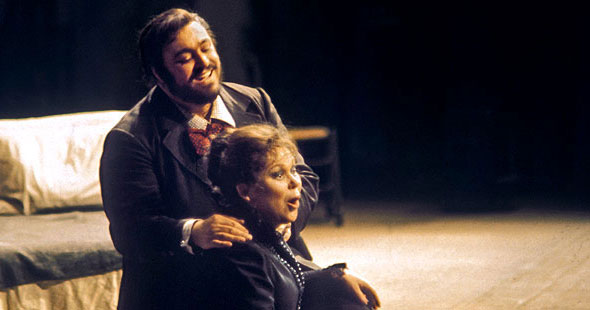
“Che gelida manina” (“Your tiny hand is frozen”), from Puccini’s La Boheme (1896), stacks high in any tenor’s repertory, but none higher than Pavarotti’s. The role of the romantic poet Rodolfo fits him like a glove and was the first he sang on stage, in hometown Modena. Also his debut role at the Met, it remained a calling card through much of his career. His recording of the opera, with Mirella Freni and led by Herbert von Karajan, was an instant bestseller.
“Pour mon ame”
“Pour mon ame” (“For my soul”) is the loopy, grandstanding aria that Donizetti wrote to wow the French in his comic opera La Fille du Regiment (1840). Boasting nine high C’s (count ’em), its seemingly effortless execution by Pavarotti drove audiences and critics to a frenzy.
“Panis Angelicus”
“Panis angelicus” (“The bread of angels”), the penultimate strophe of St. Thomas Aquinas’ Sacris solemniis, has been set to music by many composers, most famously by Cesar Franck in 1872. Closely associated with the singer, it was sung often by him as a young man in duet with his father in the Modena Cathedral. His performance of it with Sting was a highlight of 1992’s Pavarotti & Friends.
“Questa o quella”
“Questa o quella” (“This girl or that one”) is the lecherous Duke of Mantua’s opening aria in Verdi’s Rigoletto (1851), in which he explains that all women attract him. Pavarotti’s rendition in Jean-Pierre Ponnelle’s 1985 film version became an instant iconic image of decadence.
“Nessun dorma”
“Nessun dorma” (“None shall sleep”), from Puccini’s Turandot (1926), is probably the aria most associated with Pavarotti. Its lush sweeping melody and brilliant orchestration virtually defines the composer, while revealing the singer at his most exalted and thrilling.
“E lucevan le stelle”
“E lucevan le stelle” (“And the stars were shining”) is another of Puccini’s most famous arias. Written for the opera Tosca (1900), it is the forlorn lament of the painter Cavaradossi, lover of the beautiful Floria Tosca, on the eve of his execution. The aria was a particular Pavarotti favorite and sung by him in his final appearance at the Met, as Cavaradossi, in 2004.
“Ingemisco”
“Ingemisco tamquam reus” (“I groan, as the accused”) is the exquisite tenor solo in Verdi’s monumental Requiem of 1874. A plea for divine rescue, it is an integral part of the composer’s famous musical setting of the Catholic funeral mass. Pavarotti filmed the work at La Scala, Milan, with von Karajan conducting, in 1967, the same year he recorded it in Vienna, under Georg Solti’s baton.