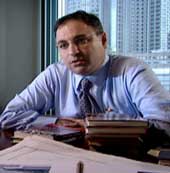
Bashar Altabba, a structural engineer with HNTB Engineering in Boston
Altabba’s career of engineering and designing buildings, tunnels, bridges, and other large structures did not spring from a childhood fascination with building blocks and LEGO sets. “It’s not a very interesting story,” says Altabba, now a structural engineer with HNTB Engineering in Boston, “but I was just good in math and physics, so it was a natural thing to go to engineering school, where I found I liked structures. The work was very mathematical and it was very analytical. I liked the black and white. In most cases there is a clear and correct solution, with all others being wrong.”
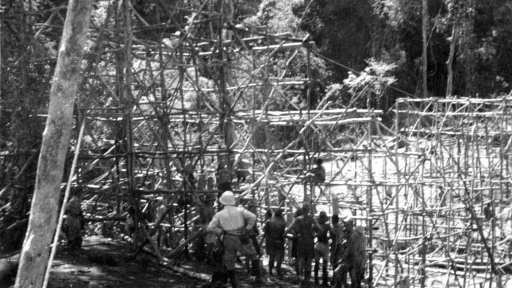
Altabba’s technical expertise has led him to work as a consultant on documentaries about historic engineering feats, such as the construction of the ancient Rainbow Bridge in China, cathedrals in Normandy, France, and now the Thailand-Burma Railway. “It is very rare that the program is something I am specifically knowledgeable about, so I end up doing a lot of my own research,” he says. “I read everything I can get my hands on historically. Usually there is very little technical stuff because engineers are typically not interested in reviewing history and commenting on previous work. They are so bogged down with their current projects that they rarely reflect back.”
In that sense, Altabba is an atypical engineer: “One of the main reasons why I’ve been asked to do these films is that I tend to get very involved in a story. I take it on. It becomes my problem. I need to figure it out. I also don’t hold anything back, so whatever I think, whatever I feel, it comes out for the cameras. The producers like that, so they try to play to it more. They really want as much of my natural, initial reaction to seeing or experiencing things so they typically keep me sheltered and limit the amount of exposure I have of the facts and the sights until I am in the middle of it, and then ‘Boom!’, on camera, I wonder, ‘My God! What are you guys putting me into?'”
During the filming of SECRETS OF THE DEAD: “Bridge on the River Kwai,” a surprise announcement by the film’s independent producers almost led Altabba to quit the project. “They did not tell me that they were going to bring in the Japanese officers [who participated in building the railway] and that I was going to be their prime interviewer,” he recalls. When I learned about it, I considered pulling out. This story, for me, was an engineering question. I was the engineering consultant and I was going to view it from an engineering perspective. I thought I should have been told, that I should have been prepared.” And yet, Altabba stuck it out. “For a day I was very upset, but then I got over it. I thought, ‘Okay, if that’s the way you want to do it, that’s how we’ll do it,’ and I went all out. I am a little on the crazy side, so I asked them the questions that were on my mind.”