|
 |
|
 |
CASE FILE: Dogfight Over Guadalcanal
THE SCENE: Guadalcanal, South Pacific
LEAD DETECTIVE: Ralph Wetterhahn, U.S. Air Force (retired) crash site investigator
 |
 |
 |
 |
 |
 |
 |
Deep in the jungles of Guadalcanal lie clues that help experts to reconstruct one of the most epic air battles of all time.
|
 |
 |
 |
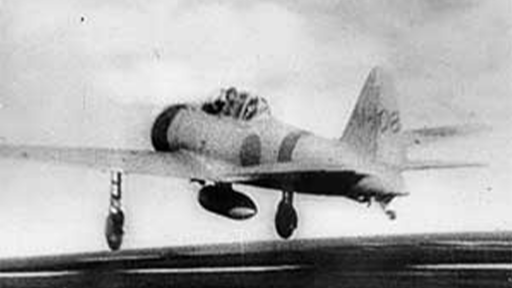
Deep in the jungle of Guadalcanal in the South Pacific, scattered among tall trees and thick, razor-sharp grasses, are the rusting remains of a World War II-era fighter plane. A fragment of the tail still bears traces of the light blue paint of U.S. Navy aircraft of the period, and the number 5192. Research has confirmed that the plane is the doomed Wildcat flown by James "Pug" Southerland in one of the most heroic and legendary dogfights in aviation history. Now, a new episode of SECRETS OF THE DEAD, "Dogfight Over Guadalcanal," examines and re-creates every dramatic moment of the showdown between 30-year-old Southerland in his Wildcat, and Saburo Sakai, 25, in his Mitsubishi Zero.
"The memoirs of the pilots, who both miraculously survived, make this the best-documented dogfight of the Pacific arena, but there are still some mysteries we are trying to solve," said Jared Lipworth, executive producer. "Breaking down the dogfight itself lets us explore the capabilities of the two planes and the skills of the pilots, and the forensic investigation of the Wildcat wreckage reveals some truly amazing finds."
When intelligence reports indicated that the Japanese were building a strategic landing strip on Guadalcanal that would pose a major threat to Allied shipping lanes, the United States responded with its largest invasion force ever. On August 7, 1942, Southerland and Sakai flew into the fray.
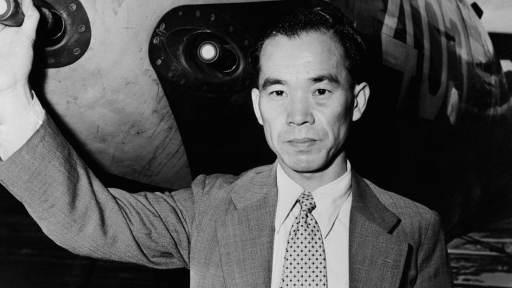
Southerland was a young pilot groomed as an officer at the elite U.S. Naval Academy in Annapolis, Maryland. In the film, David Richardson, who served in the same unit with Southerland, recalls how his friend earned the nickname "Pug" because he was such an aggressive -- pugnacious -- boxer. Sakai came from an impoverished family with samurai ancestry and followed strict codes of family and military honor. World War II historian Osamu "Sam" Tagaya, who appears in the film, describes the Draconian methods of the Japanese military at that time. "Physical punishment was a fact of life in all of Japan's armed forces," he says. "Being punched in the face, being hit in the buttocks with baseball bats." Sakai graduated first in his class at the Imperial Navy's flying school. Despite their differing backgrounds, the pilots had two things in common: unflappable courage and exceptional skill. Yet when each had a clear opportunity to kill the other during their battle, neither did. Southerland had Sakai in his sights but didn't fire, and Sakai opted to aim for the Wildcat's engine, giving Southerland the chance to bail out and save himself. Why?
 |
 |
 |
 |
 |
Investigators examine the moss-covered remains of the Wildcat on the jungle floor of Guadalcanal. Here the rusted and twisted propeller shows signs of the battle as investigator Ralph Wetterhahn pokes his finger rthrough a bullet hole.
|
 |
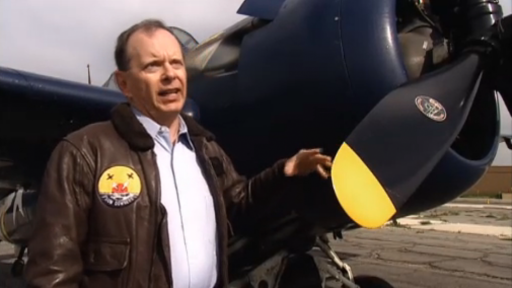
To find the answers, "Dogfight Over Guadalcanal" travels to the 2,500-square-mile island with Ralph Wetterhahn, a U.S. Air Force crash site investigator and retired fighter pilot. Wetterhahn meets Bruno Nana, who explains how he helped rescue an exhausted and dehydrated Southerland after he parachuted into the jungle back in 1942. Wetterhahn also joins Justin Taylan, who specializes in tracking down aircraft wrecks in the Pacific, and Edilon Gii, the local villager who found Southerland's plane, on a trek to the crash site.
Bullet holes found in sections of the moss-covered propeller and engine corroborate Sakai's claim that he was hesitant to shoot and kill the skilled American fighter pilot, and aimed instead at the plane's engine. More incredibly, a damaged bullet from the Wildcat's wreckage convinces Wetterhahn that the plane's gun mechanism had been jammed, rendering at least one of Southerland's guns useless during the dogfight.
"Dogfight Over Guadalcanal" is a testament to human ingenuity, as evidenced by both the Wildcat and the Zero, and to human bravery, resilience, and skill, as displayed by Southerland and Sakai. The film also places this pivotal battleóafter which the American capture of the airstrip on Guadalcanal stopped the Japanese advanceóin historical context as a unique episode in a decisive phase of the war in the Pacific.
Local PBS TV Stations
PBS TV schedules are programmed at your local station, please tell us where you watch:
Don't know the Zip code?
You can look for a local station using the menu below:
|
|
 |