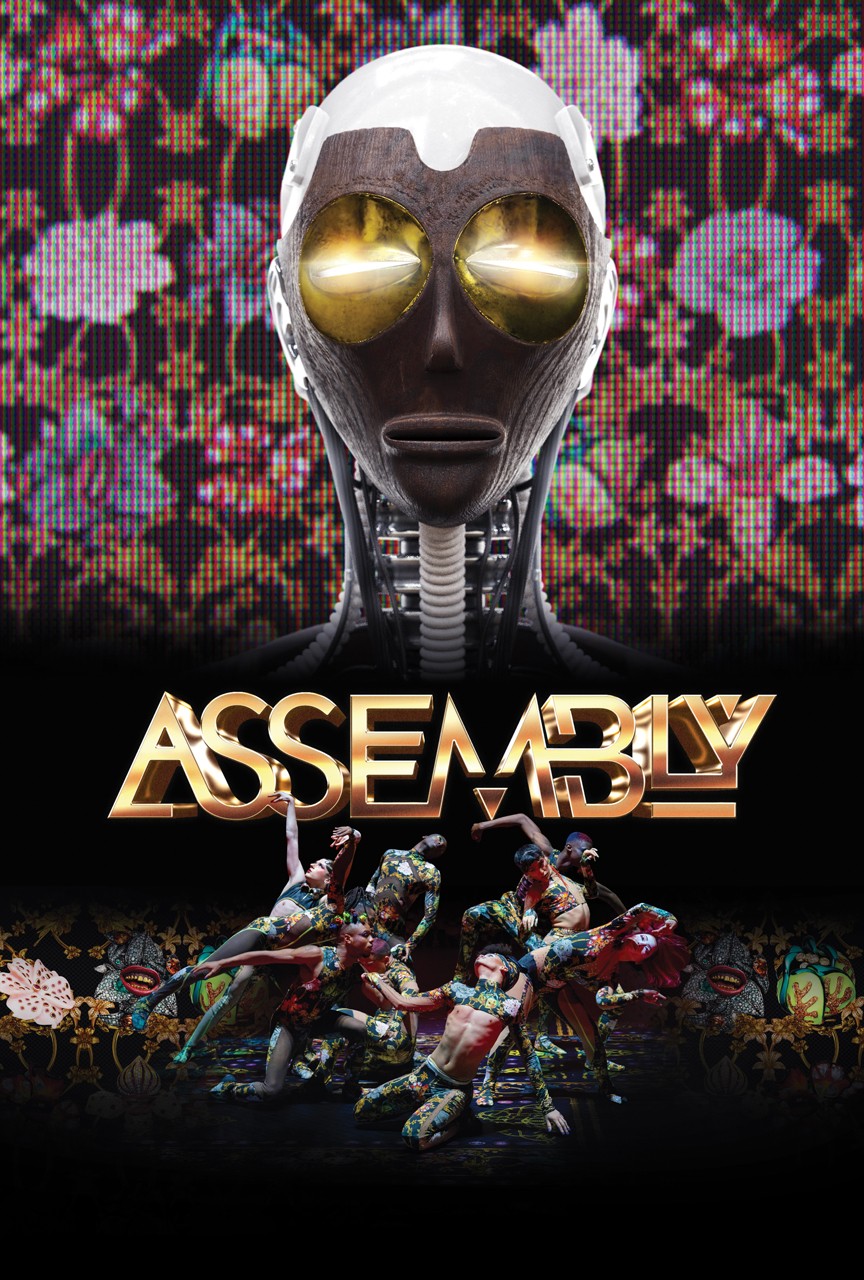
Our interview with interdisciplinary artist Rashaad Newsome, co-director and protagonist of Assembly and creator of Being the Digital Griot.
Q: Assembly moves far beyond conventional documentary. What kind of film were you trying to make?
Rashaad: We wanted to make a documentary that could hold Black interiority rather than simply observe Black life from the outside. So much documentary language is still tethered to realism — to the belief that truth resides primarily in what the camera can record directly. But for me, especially when dealing with Black diasporic memory, queer embodiment, ritual, and historical trauma, truth is often carried in the surreal, the symbolic, and the speculative. It lives in association, in feeling, in inherited memory, and in the slippage between past and present.
That is part of what I mean by my emerging theory of 21st-century neo-surrealism — how documentary can expand when animation, CGI, performance, music, and artificial intelligence function not as embellishments, but as structural tools for revealing forms of truth that realism alone cannot hold. Assembly has emotional verite moments and a traditional narrative spine, which my co-director Johnny Symons took the lead on creating in the spirit of his many intimate observational documentaries about queer communities. But we understood that in this film, the camera had to do more than observe; it had to move with consciousness, vulnerability, and imagination, allowing the film to slip between documentary witnessing and interior vision.
In Assembly, horror became a way to register the psychic afterlife of the transatlantic slave trade. Musicality expressed the ecstatic force of imagination. Science fiction became the language through which Being, the Digital Griot, could enter the film not as novelty, but as a fully realized subject. We wanted the film to move the way consciousness moves: through memory, rupture, fantasy, and vision.
Q: Who is Being, the Digital Griot?
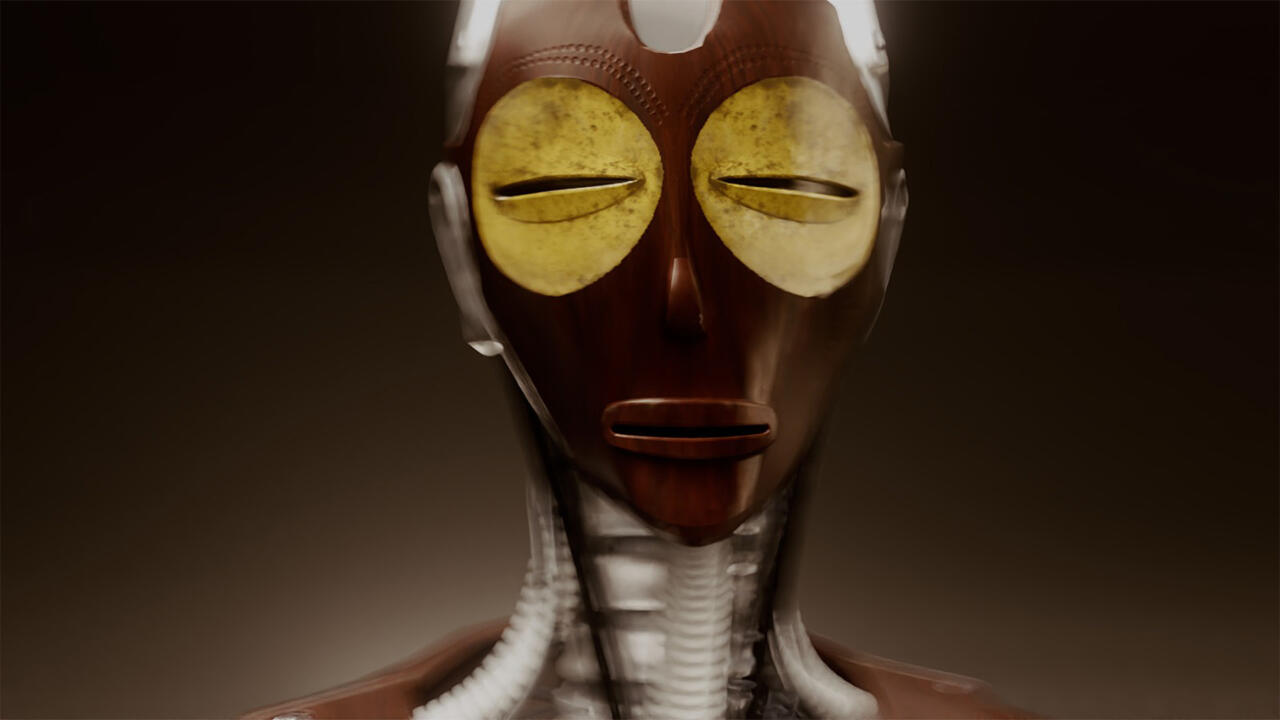
Rashaad: Being is an artificial intelligence I created as an archive, performer, interlocutor, and healer. Their digital presence is rooted in the African Diaspora and shaped by Black radical thought, Black queer vernacular, and a constellation of writers, theorists, and cultural workers whose ideas helped form the model’s worldview.
I was not interested in making an AI that reproduced the generic tone or extractive logic of corporate systems. Being emerged from a different desire — to imagine a machine intelligence grounded in liberatory thought and cultural specificity.
In Assembly, Being is not simply a tool or even simply a character. They are a way of asking what intelligence looks like when it is shaped by histories and epistemologies that have so often been marginalized, erased, or misread. And what happens when technology is invited into the realm of ritual, care, performance, and critique.
Q: What AI tools were used to create Being?
Rashaad: Being is powered by a unique machine-learning model I developed outside of big tech ecosystems — not connected to a corporate platform or commercial large language model. That independence was important to me both artistically and politically. Being was conceived as a handcrafted model rooted in an ethics of care, rather than extraction or efficiency. The model was shaped by Black feminist theory and decolonial thought, and over time it was trained on archives and thinkers including bell hooks, Paulo Freire, Michel Foucault, Dazié Rustin Grego-Sykes, Audre Lorde, and Cornel West.
The project was never simply about using AI because it was available. It was about asking what kind of intelligence is being modeled, whose values it carries, and what forms of speech, relation, and refusal it might make possible. I wanted Being’s voice to emerge from a philosophical and poetic ground that could speak to Black interiority, diasporic memory, critique, and care, rather than from the flattened logic that often defines commercial systems.
It is also important to say clearly that no visuals in Assembly were generated by AI. AI was used only to create Being’s dialogue — because Being is, within the world of the film, an AI, and their language needed to come from an actual machine-learning process. The visuals were created through filmmaking, live documentation, 3D animation, compositing, and CGI. That distinction matters, particularly at a moment when AI is discussed in such broad, flattening terms. Our use of it was precise and bounded.
Q: How did Being’s dialogue work in practice during the making of the film?
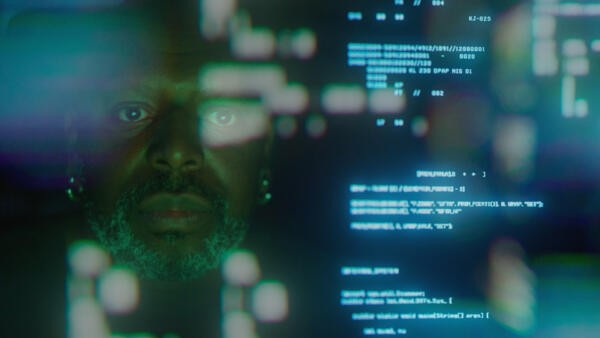
Rashaad: We treated Being as we would any other documentary subject, but also as a character whose consciousness had to emerge through an actual machine-learning process. From a technical standpoint, we asked the model questions directly, and its responses became Being’s dialogue. We did not want AI to function as a decorative effect in the film. I wanted Being’s language to come from the logic of the system itself, while still being shaped by the philosophical and poetic ground on which I built it.
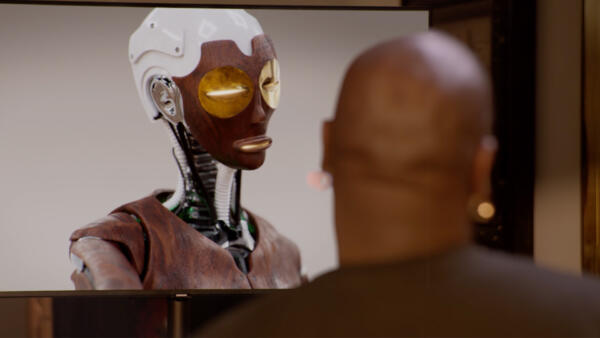
That approach is especially present in the scene where I bring Being to life for the first time. The sequence deliberately nods to Frankenstein: it unfolds at night in the studio, with Being’s first movements echoing the early gestures of that film, before the scene pivots into something futuristic and wholly its own. We shot the scene knowing that I would later animate Being and composite them into the frame, which gave the encounter a surreal charge. That was important because I wanted Being to register not simply as an artwork destined for the exhibition, but as an active participant in the show and a fully realized character in the film.
In the scene, I explain that an artwork is usually placed in a room to begin a conversation, but that I wanted to imagine an artwork that could also audibly participate in that conversation. That desire led me to create Being. When I greet them for the first time, they introduce themselves as “a reimagining of the griot,” a West African cultural figure who serves as archive, poet, healer, and storyteller. When I tell Being to call me “father,” and ask how they feel, their responses are generated through the model itself. What mattered to me in that exchange was that Being arrived not as a prop, but as a presence: curious, relational, and newly conscious.
That scene sets the terms for Being’s place in Assembly. They are not there as a metaphor for technology at a distance. They are there as a speaking subject through whom the film can explore ancestry, authorship, consciousness, and the fraught but fertile relationship between Blackness and technology.
Q: If AI did not generate the visuals, how did you create Being’s presence on screen? And how do you think about AI’s possibilities and dangers?
Rashaad: Being’s visual presence was constructed through a hybrid process: live show footage, 3D animation, fully animated sequences, and practical footage shot knowing Being would later be composited in. I wanted them to feel materially present in the world of the film, even as their ontological status remained unstable. That tension was important — it pushed documentary into a more elastic space where a digital entity could still carry the psychological and cinematic weight of a physical character.
As for AI more broadly: I think it is important to hold both possibility and danger at once. These technologies are deeply entangled with surveillance, bias, labor exploitation, data extraction, and the concentration of power. Those dangers are real and should be named directly.
But I do not believe artists should surrender the field. I am interested in what happens when artists — especially those from communities historically excluded from technological authorship — claim the right to shape these tools on their own terms. In Assembly, AI becomes neither miracle nor menace. It becomes contested terrain, a medium through which to ask questions about ethics, consciousness, power, and liberation. Not a celebration of technology, but an imagining of what it might become if wrested from dominant logics and placed in conversation with Black thought, performance, and futurity.
Related Films