Overview
Damar Hamlins’s mid-game collapse: Learn how to combat online science misinformation using lateral reading by investigating a post about an NFL football player’s collapse on the field. False scientific claims that evoke strong emotions exploit the reward of “sensational claims”, such as the posts connecting Damar Hamlin’s medical emergency during a Jan. 2, 2023, NFL game to the Coronavirus vaccine.
Objectives
Students will be able to answer the questions:
- What is an “echo chamber” on social media?
- How can I break out of a social media “echo chamber”?
- How can I evaluate a scientific claim on social media to determine if it is credible?
Grade Levels
Grades 6-12Downloadable Lesson Documents
Key Vocabulary
- Echo chamber – an environment in which a person encounters only beliefs or opinions that coincide with their own, so that their existing views are reinforced and alternative ideas are not considered.
- Lateral Reading – This is one way to evaluate the credibility of a source. First, leave the site you're on, do a keyword search, open up a bunch of tabs, and find out what other sources say about it.
Before You Watch
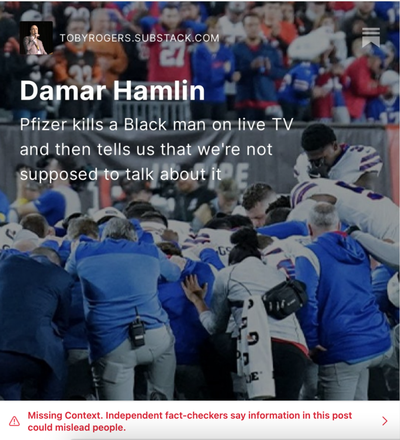
Take a close look at this Instagram post about an NFL player who collapsed during a game. It is designed to create a strong emotional response. How does it create a strong emotional response?
While you Watch
Preview the questions. Then answer them while you watch the MediaWise Teen-Fact Checking Network (TFCN) video. According to the video…
- What are three key pieces of information to know about the Instagram post linking Hamlin’s collapse to the COVID-19 vaccine?
- He is still ________________
- His _______________ _________________ is unconfirmed
- _______________ think his collapse is due to a condition called “commotio cardis”.
- Matthew Martinez said, "To date, I am not aware of a single COVID vaccine-related cardiac complication in professional sports.” What makes Matthew Martinez a credible source?
Martinez is a ______________ _______________ who works with the NFL, NBA, NHL, and Major League Soccer. - Is Toby Roberts, the author of the debunked Instagram post that said the Pfizer vaccine killed Hamlin, a credible source? (circle one) YES/NO Why?
- What three questions should you ask when you see scary scientific claims online (1) Who is behind the ______________? (2) What is the ______________? (3) What do other ______________ say? (source: Stanford History Education Group)
- How can you find out if you are trapped in an “echo chamber”?
Use ______________ ______________ to learn more about the topic from a variety of credible sources.
After You Watch
- Why is it important to be aware of how algorithms choose content for your newsfeed?
- Do you receive different perspectives about events or controversial issues in your social media feeds? Why or Why not?
- How can you avoid becoming stuck in an “echo chamber” in your social media feed?
Extension Activity
Find a scientific claim in one of your social media feeds, a science news article assigned by your teacher or choose one from the HHMI BioInteractive Science News website. Complete the activity in this handout provided in the lesson links.
About the Next Lesson
Be MediaWise Lesson 8: How to make sure Wikipedia sources are legit — Students will learn ways that Wikipedia can be used as a reliable source, how to make sure a Wikipedia article is legit, and tips on how you can make sure you're using the website responsibly
Subjects
social studies, english, ELA, journalism, science
Standards
Next Generation Science Standards (NGSS) Appendix M
APPENDIX M – Connections to the Common Core State Standards for Literacy in Science and Technical Subjects
Common Core ELA CC.8.5.6-8; CC.8.5.9-10.A; CC.8.5.11-12.A
Citing informational text.
College, Career, and Civic Life (C3) D3.1.6-12
Gather relevant information from multiple sources while using the origin, authority, structure, context, and corroborative value of the sources to guide the selection.
ISTE 6-12.1.4.a
Students: know and use a deliberate design process for generating ideas, testing theories, creating innovative artifacts or solving authentic problems.
These lessons were developed by PBS NewsHour Student Reporting Labs in partnership with MediaWise and the Teen Fact-Checking Network, which are part of the Poynter Institute. This partnership has been made possible with support from Google.
Fill out this form to share your thoughts on Classroom’s resources.