Overview
The good, the bad and the ugly of Wikipedia — Students will learn ways that Wikipedia can be used as a reliable source, how to make sure a Wikipedia article is legit, and tips on how you can make sure you're using the website responsibly.
Objectives
- To learn about Wikipedia’s content policies and how they are monitored and enforced
- To explore best practices for using information on Wikipedia
Grade Levels
Grades 6-12Downloadable Lesson Documents
Key Vocabulary
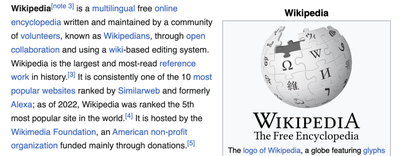
- Wikipedia (new) – Wikipedia is a multilingual free online encyclopedia written and maintained by a community of volunteers, known as Wikipedians, through open collaboration and using a wiki-based editing system. Wikipedia is the largest and most-read reference work in history. (source: Wikipedia)
- Wikipedia “Good Article” – is an article that meets a core set of editorial standards, the “good article criteria”, passing through the good article nomination process successfully. A green plus symbol inside a circle at the top of an article indicates it meets the criteria.
- Wikipedia “Good Article Criteria”– the six standards by which a good article nomination (GAN) may be compared and judged to be a good article (GA).
- Reading Upstream – Follow a link within a news story or claim directly to the original source of information or the primary sources referenced. This can help you answer, “What’s the evidence?” Heading directly to the primary sources linked in an article is a good way to get the unfiltered facts.
Before You Watch
Do you believe Wikipedia should be allowed as a research resource for school projects? Explain.
While You Watch
Preview the questions. Then watch the MediaWise Teen-Fact Checking Network (TFCN) video and answer the questions about using Wikipedia to find credible information. According to the video…
- Where on a Wikipedia article can you check the reliability of the information? (circle one) Topic Summary—Source Links at Bottom of the Entry—Entry—Title
- What are the three Wikipedia content policies?
- How are they monitored and enforced?
- What are three weaknesses of Wikipedia?
- What are some suggestions to use Wikipedia responsibly?
After You Watch
- How effective is the system to monitor Wikipedia content? Provide two specific details from the video to support your opinion.
- Has your opinion about the credibility of Wikipedia articles changed since watching the video? Provide at least two specific examples to support your answer.
- Based on what you have learned from the video, how will the way you use articles from Wikipedia change when you are looking for factual, credible information for a school project?
Extension Activity
Check your sources! Wikipedia includes sources at the end of its articles.
- Pick a topic from history or your favorite class that interests you.
- Look it up on Wikipedia and check out the footnote citations. Do the sources look credible to you? From authors and organizations that you trust? Share what you learned about sources on Wikipedia with a peer or together as a class.
Background Reading
- Sydney Morning Herald: Evidence suggests Wikipedia is accurate and reliable
About the Next Lesson
Be MediaWise Lesson 9: Identifying “Pink Slime” Journalism—Students will be introduced to the term “pink slime journalism” and —by looking into a specific claim from a pink slime news outlet — be able to recognize pink slime websites that spread biased or partisan information online.
Subjects
social studies, language arts, journalism
Standards
Common Core ELA
CC.8.5.6-8; CC.8.5.9-10.A; CC.8.5.11-12.A - Citing informational text
College, Career, and Civic Life (C3)
D3.1.6-8. Gather relevant information from multiple sources while using the origin, authority, structure, context, and corroborative value of the sources to guide the selection.
D3.1.6-12. Gather relevant information from multiple sources representing a wide range of views while using the origin, authority, structure, context, and corroborative value of the sources to guide the selection.
ISTE
6-12.1.4.a Students: know and use a deliberate design process for generating ideas, testing theories, creating innovative artifacts or solving authentic problems.
These lessons were developed by PBS NewsHour Student Reporting Labs in partnership with MediaWise and the Teen Fact-Checking Network, which are part of the Poynter Institute. This partnership has been made possible with support from Google.