by David Cutler, high school teacher
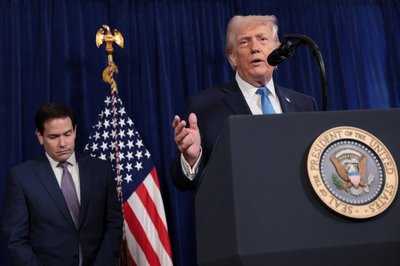
After U.S. forces captured Venezuelan President Nicolás Maduro and his wife on Saturday, President Donald Trump told reporters the United States will “run” Venezuela “until such time as we can do a safe, proper and judicious transition.”
If you teach any subject touching on power and law, this is your curriculum. Not next week. Tomorrow.
In my high school history, journalism and government classrooms, that means we’ll take up Venezuela tomorrow, even if it makes for a turbulent return to school after winter break.
The lesson won’t be about indoctrination. It will be about modeling how informed citizens think when leaders exercise or abuse power.
In college, for a course on U.S. foreign policy since World War II, I wrote a term paper titled “Protecting Democracy by Undermining It: U.S. Cold War Policy and the Destabilization of Chile.”
It examined the failed kidnapping attempt on General René Schneider that eventually led to his death, the money funneled to El Mercurio and the broader apparatus of U.S.-backed regime change. Today, I recall CIA Director Richard Helms’s 1970 telegram, which has remained with me for 20 years: “It is firm and continuing policy that [Salvador] Allende be overthrown by a coup."
That was meant to be covert. Now, Trump’s action is being announced on social media.
At the time, I thought I was studying the past. It turns out I was also learning how to ask better questions about the present and how to help my students do the same, even as a story keeps unfolding.
At the time, I thought I was studying the past. It turns out I was also learning how to ask better questions about the present...
Tomorrow, I won’t pretend this weekend’s events didn’t happen. Nor will I present them as a “both-sides” discussion that treats all perspectives as equally valid, especially when examining existing constitutional powers and legal limits. At the same time, I’ll acknowledge that students bring different perspectives into the room, and that some may have close personal or family ties to Venezuela and may be emotionally affected by these events. Creating space for their reality matters.
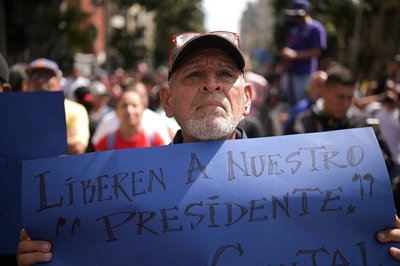
A man holds a sign as government supporters gather, after U.S. President Donald Trump said the U.S. has struck Venezuela and captured its President Nicolas Maduro, in Caracas, Venezuela, January 3, 2026. REUTERS/Gaby Oraa
I also won’t conceal Nicolás Maduro’s record. Without question, his rule has played a role in a humanitarian crisis, an economic collapse and the displacement of millions. Still, accepting the failures and abuses of a foreign leader, no matter the severity, does not answer every question raised by Trump’s action. It doesn’t address what authority the American government has, what role Congress plays or how international law applies. Those questions remain, regardless of how we judge Maduro himself. I want to keep that insight front and center with my students.
More than anything, I want to help my students see how history provides context and, most importantly, questions — crucial tools for careful, thoughtful thinking when current events seem confusing or overwhelming.
It’s unlikely that we will get to everything I have planned, but I prefer to overprepare and leave students thinking long after the period ends. I will also make myself available outside of scheduled class to meet with students about the lesson, and what else unfolds.
My lesson
I’ll begin the session by cultivating a shared expectation that our discussion remain rooted in credible reporting, not TikTok. That doesn’t mean dismissing what students have seen or heard elsewhere before coming to class; it means treating our classroom as a place where we examine claims carefully and assess the legitimacy of sources.
Then, I’ll ask students to consider how they know what they think they know. When did the news break, and what sources did they consult? Who said what and when, and how and where? How can we differentiate between responsible reporting and mere speculation? I want my students to consider how timelines shape their understanding — and how initial reports can differ from later ones.
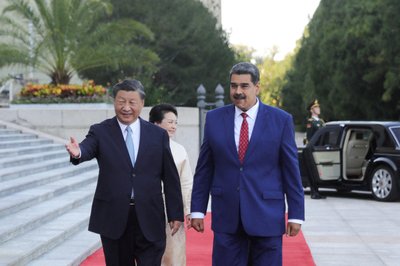
FILE PHOTO: China's President Xi Jinping and Venezuela's President Nicolas Maduro take part in a welcoming ceremony at the Great Hall of the People, in Beijing, China September 13, 2023. Miraflores Palace/Handout via REUTERS THIS IMAGE HAS BEEN SUPPLIED BY A THIRD PARTY./File Photo
With that framework in mind, students will assess the stated motivations behind the U.S. operation by closely analyzing Trump’s Saturday morning address, including illicit drug trafficking. In it, he also said, “We are going to have our very large United States oil companies — the biggest in the world — go and spend billions, fix the badly broken infrastructure, the oil infrastructure, and start making money for the country.”
As we assess breaking reports, we’ll investigate which individuals and institutions appear in credible reporting. What roles do the President, the military, Congress and foreign governments each play? Who has the authority to act, and who has the authority to respond? Where are those powers clearly defined, and where do they seem contested or unclear?
We won’t have all the answers, but we’ll ask the right questions and find out where to look to answer them.
I will zoom in on how the U.S. government justifies its actions. What language do officials use to describe what transpired? What reasons do they give, and what evidence do they cite? What leaves room for interpretation? Throughout, I will ask students to do their best to distinguish between justification, explanation and assertion.
I also want students to consider how the Venezuelan government frames the unfolding events. How do their claims differ from those of U.S. officials? What legal or moral arguments do they raise? What evidence do they present, and how might their political position shape the way they tell the story? How are other countries around the world reacting to the attack?
Tomorrow, the goal isn’t to reach a definite conclusion. It’s to practice slowing down, asking better questions, and recognizing that understanding major events, past or present, calls for patience, evidence and an ability to sit with uncertainty. That’s hard work, especially for a generation that craves immediacy.
In addition, my AP U.S. Government and Politics students will examine how the foundational documents they study for the May exam apply to this moment, especially the Constitution. We will discuss Article I, Section 8, which grants Congress the power “to declare war.” I will also examine Article II, Section 2, which states that “the President shall be Commander in Chief” of the armed forces. From there, students will examine the War Powers Resolution.
Then they will consider whether the Trump administration’s actions constitute law enforcement, hostilities or something else. What does that classification mean for Congressional authorization? Has the War Powers clock begun ticking?
We won’t have all the answers, but we’ll ask the right questions and find out where to look to answer them. That’s what studying history and government teaches us.
It’s about learning how to ask informed questions when something consequential is happening.
When Trump says the United States will “run” another country, students who have studied history don’t panic or tune out. Instead, they ask: Has this happened before? What was the legal framework at the time? What were the consequences? And what questions should we be asking now?
That’s the value of studying history; it’s not shock and awe, but context and questions. Especially questions.
I’m teaching it on Monday. I hope you will, too.
This piece originally appeared on Medium here and has been lightly edited for purposes of length.
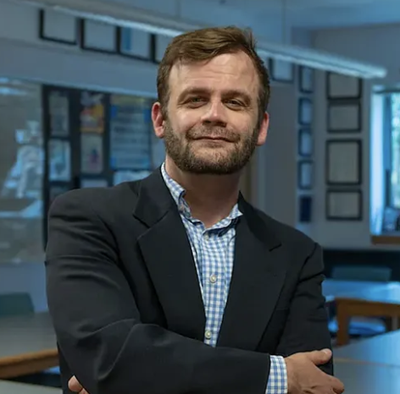
Credit: David Cutler, teacher
About the author
David Cutler teaches American history, government and journalism at Brimmer and May, an independent school in Chestnut Hill, Mass. His writing has appeared in the National Association of Independent Schools, PBS News Hour, Edutopia, The Atlantic and Independent School Magazine. David created the Private School Journalism Association in 2019, and is its executive director. Follow David on Twitter @spinedu.
If you would like to pitch an Educator Voice article to News Hour Classroom, contact education@newshour.org.
Sign up to receive our weekly newsletter with Daily News Lessons and community events.
To provide feedback on News Hour Classroom's resources, click here.