NOTE: If you are short on time, watch the video and complete this See, Think, Wonder activity: What did you notice? What did the story make you think? What would you want to learn more about?
SUMMARY
As temperatures rise, the Thwaites Glacier is melting fast and threatens to raise global sea levels. That’s why a team of nearly 40 researchers is embarking on a two-month journey to study it. Science correspondent Miles O’Brien is with the expedition and reports.
View the transcript of the story.
News alternative: Check out recent segments from the NewsHour, and choose the story you’re most interested in watching. You can make a Google doc copy of discussion questions that work for any of the stories here.
WARM-UP QUESTIONS
- Where is the Thwaites glacier?
- How large is the Thwaites glacier?
- Why is the glacier important?
- What do scientists hope to learn during their expedition?
- How will scientists seek to measure change in the glacier?
ESSENTIAL QUESTIONS
- What do you think the impact on national and international policy will be from this expedition if the scientists find that the glacier is melting more quickly than expected?
- What will be the impact on national or international policy if the melting is less than expected?
Media literacy: In this segment, correspondent Miles O'Brien says that the expedition for him is like a "journalistic Super Bowl." Why do you think this story is important for O'Brien as a journalist? Why do you think he's so excited to visit a melting glacier?
WHAT STUDENTS CAN DO
Examine the graphic below. As a class, discuss the following —
- What does this graphic suggest about the way that the Thwaites glacier is melting?
- If you were part of the expedition, what tools might you use to measure the impact of the forces below? What information would help you understand the rate of melting (and whether or not that rate is accelerating)?
- Can you think of any technology that might help reduce the melting? Sketch out an invention that might help reduce melting, even if it relies on technology that hasn't been invented yet.
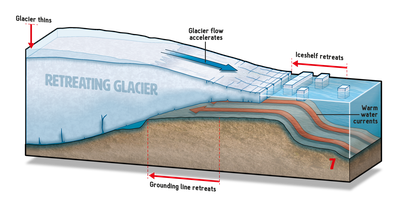
Diagram of how the Thwaites Glacier is destabilizing. Image by NERC, Ben Gilliland
Sign up to receive our weekly newsletter with Daily News Lessons and community events.
To provide feedback on News Hour Classroom's resources, including this lesson, click here.