NOTE: If you are short on time, watch the video and complete this See, Think, Wonder activity: What did you notice? What did the story make you think about? What would you want to learn more about?
SUMMARY
President Donald Trump broke his own record Tuesday night for the longest presidential speech to Congress. The president spoke for nearly 108 minutes in the House chamber, painting a picture of the United States as “bigger, better, richer and stronger than ever before.” Trump also chastised Democratic lawmakers in the chamber as “crazy” for failing to stand and applaud at points during his address. The U.S. Olympic men’s hockey team also made an appearance in the House chamber to thunderous applause after winning an Olympic gold medal.
DIRECTIONS: Students can watch the highlight video above (8 min) or read the brief article 8 takeaways from Trump's 2026 State of the Union address. Students may also watch one of the following clips on Iran, tariffs and immigration, respectively. Then answer the questions below.
WATCH: 'Can't let' Iran have a nuclear weapon, Trump says (war with Iran)
WATCH: Trump says tariffs could replace income tax (tariffs)
WATCH: 'You killed Americans,' lawmaker says as Trump asks Congress to stand for protecting citizens (immigration)
News alternative: Check out recent segments from the News Hour, and choose the story you’re most interested in watching. You can make a Google doc copy of discussion questions that work for any of the stories here.
WARM-UP QUESTIONS
- When and where did Trump deliver the State of the Union speech?
- Why does the the public seem to not share President Trump's view of the economy?
- Who attended the State of the Union speech?
- What did Trump say on the issues of tariffs, immigration or Iran (choose one, if short on time)?
- How did Rep. Ilhan Omar and Rep. Rashida Tlaib react to Trump's statements about immigration enforcement?
ESSENTIAL QUESTIONS
- Do you think Trump's State of the Union speech showed the President working to unify the country or further bridging the divide? Explain.
- What do you currently see as the "state of the union" in America? What would you like to see?
Media literacy: The factchecking organization Politifact was at work during Trump's speech, producing Live fact-checking Trump's 2026 State of the Union address. Why is it important to factcheck politician's speeches and others who hold positions of power?
- Why do you think Politifact offers this opportunity to viewers?: "Was there something Trump said that you think we should check? Send it to us at truthometer@politifact.com so we can investigate." Would you consider sending an email over an issue that you think needed to be fact checked?
WHAT STUDENTS CAN DO
Choose one or two of the following activities to learn more about the State of the Union speech and how lawmakers and the news media responded to the speech. How can you tell if the public's response matches those of politicians and the press? Does it match yours? Explain.
- Choose one or two more clips to watch from the State of the Union speech to watch from PBS News' YouTube page. Why did you choose the clip you did?
- Watch Rep. Al Green's interview, Democratic Rep. Al Green speaks after being escorted from Trump's State of the Union address for holding up a sign that said "Black People Are Not Apes" following this story.
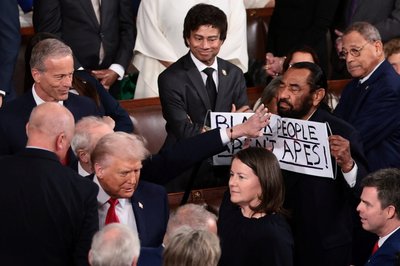
U.S. Rep. Al Green (D-TX) holds a sign as U.S. President Donald Trump arrives to deliver the State of the Union address to a joint session of Congress at the U.S. Capitol in Washington, D.C., U.S., February 24, 2026. REUTERS/Evelyn Hockstein TPX IMAGES OF THE DAY
- Take a look at those who were honored during the speech, including Trump awards Medal of Honor to 100-year-old veteran.
- WATCH: Democratic lawmakers join 'People's State of the Union' rally during Trump's address.
- Watch News Hour's Analysis of Trump's State of the Union address (26 min).
- Watch the Democratic response to the speech by Virginia Governor Abigail Spanberger, including these clips: ‘This is not what our founders envisioned’ Spanberger says after Trump’s State of the Union and We all know' Trump is not making your life more affordable, Spanberger says.
NEWS: THEN & NOW
The News: Then & Now section of the Daily News Lessons allows students to see connections between current and past news events. The activity provides historical context using primary sources from the Library of Congress.
See PBS News Hour Classroom's Journalism in Action website for interactive examples of how journalists covered key events in U.S. history while honing your primary source, civics and digital news literacy skills.
THEN
The State of the Union Address is an annual communication from the President of the United States before a joint-session of Congress. The State of the Union address gains its legal foundations in Article II, Section 3, which states that the “President "shall from time to time give to the Congress Information of the State of the Union, and recommend to their Consideration such Measures as he shall judge necessary and expedient."
George Washington delivered the first State of the Union address, known at the time as the “Annual Message,” on January 8, 1790. It is the shortest State of the Union address to date, at only 1,089 words. George Washington also set the precedent for the State of the Union address to be held annually, as the Constitution does not specify how often the President must address Congress.
The image below shows the final paragraphs of George Washington’s first annual message.
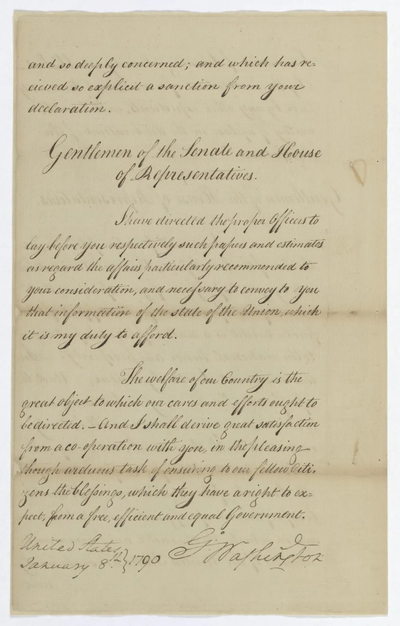
President George Washington’s first Annual Message to Congress, January 8, 1790. (Records of the U.S. Senate, National Archives)
“Gentlemen of the Senate and House of Representatives.
I have directed the proper Officers to lay before you respectively such papers and estimates as regard the affairs particularly recommended to your consideration, and necessary to convey to you that information of the state of the Union, which it is my duty to afford.
The welfare of our Country is the great object to which our cares and efforts ought to be directed. And I shall derive great satisfaction from a co-operation with you, in the pleasing though arduous task of ensuring to our fellow Citizens the blessings, which they have a right to expect, from a free, efficient and equal Government.”
Read the full address at the National Archives website.
Since George Washington, the State of the Union address has changed considerably. While Presidents George Washington and John Adams both delivered their addresses in person, President Thomas Jefferson abandoned this practice and set the precedent of sending written messages reporting on the activities of the Executive branch. It wasn’t until 1913 that this precedent ended when President Woodrow Wilson personally appeared before Congress. Later, President Franklin Roosevelt adopted Wilson's practice of personal delivery, and it has been a tradition ever since.
With the advent of radio coverage in 1923, television in 1947, and live webcasts in 2002, the address has become an increasingly important nationwide platform for the President. President Harry S. Truman delivered the first televised State of the Union address on January 6, 1947, and it was during the Truman presidency that the speech came to be widely known as the State of the Union address rather than the Annual Message.
Watch a one-minute excerpt of his address at this link (you can also click through and watch excerpts from the State of the Union addresses by Presidents Dwight D. Eisenhower, John F Kennedy, and Lyndon B Johnson).
Source: National Archives Records Administration
NOW
On Tuesday, February 24, 2026, President Donald Trump broke his own record for the longest presidential speech to Congress, speaking for nearly 108 minutes (or 1 hour and 48 minutes). In his speech, Trump particularly touted his immigration, foreign policy, and economic policies, making grandiose claims that the economy is “rising fast” and “roaring like never before”. Trump also placed blame on Democratic lawmakers and their policies for causing problems with affordability.
Roughly two dozen Democrats boycotted the State of the Union address, many of whom were at a counterprotest outside of the Capitol. Of the Democrats in attendance, some wore “redacted” pins calling for the release of more of the Epstein files. The most heated moment arose when President Trump chastised Democrats for not standing in support of his immigration agenda and Democrats protested back about the shooting deaths of two American citizens by US ICE agents.
In the PBS News Hour clip, Fact-checking Trump’s State of the Union claims, White House correspondent, Liz Landers, fact checks Trump’s false or exaggerated claims on balancing the federal budget, significant reductions in gasoline prices and SNAP food assistance recipients, and voter fraud by undocumented immigrants.
Discussion questions:
- What do you think is the primary purpose of the State of the Union address? Do you think this has changed?
- What do you think the effect of growing partisanship has had on the State of the Union address? Do you expect this long-held tradition to change in response?
Sign up to receive our weekly newsletter with Daily News Lessons and community events.
To provide feedback on News Hour Classroom's resources, including this lesson, click here.