Video length: 4m:10 seconds
What to know
- Rapper Afroman (Joseph Foreman) won a defamation lawsuit on Thursday filed by seven Ohio sheriff’s deputies.
- The saga began over a 2022 raid on Afroman’s home by the Adams County Ohio Sheriff’s office related to a drug and kidnapping investigation; however, nothing illegal was found in the musician’s home, and no charges were filed.
- Subsequently, Afroman released a series of music videos featuring his home security footage of the raid, including one notable moment when an officer paused to look at a pastry that inspired the popular song, ‘Lemon Pound Cake.’
- The sheriff’s deputies said they were publicly harassed following the videos release and sought nearly $4 million in damages.
Key terms:
defamation — act of making false statements that harm a person's reputation
Why it matters
The case sparked conversations around the constitutional right to free speech and the limits of parody, which Afroman noted in an Instagram video after he emerged victorious, stating, “We did it America! Freedom of speech! Right on!”
Discussion questions
- Do you agree with the court's ruling? Why or why not?
- What do you think the line is between defamation and free speech?
- How does music act as an outlet for protest or expression?
NEWS: THEN & NOW
The News: Then & Now section of the Daily News Lessons allows students to see connections between current and past news events. The activity provides historical context using primary sources from the Library of Congress.
See PBS News Hour Classroom's Journalism in Action website for interactive examples of how journalists covered key events in U.S. history while honing your primary source, civics and digital news literacy skills.
THEN
In 1960, the New York Times published a full-page ad titled “Heed Their Rising Voices” in which it condemned police action against the non-violent student civil rights protests, specifically focusing on events in Montgomery, Alabama.
However, the ad contained several minor factual inaccuracies. LB Sullivan, the city Public Safety Commissioner for Montgomery, believed the criticism of his police officers reflected poorly on him and requested a retraction from the Times. When they refused, Sullivan sued for libel.
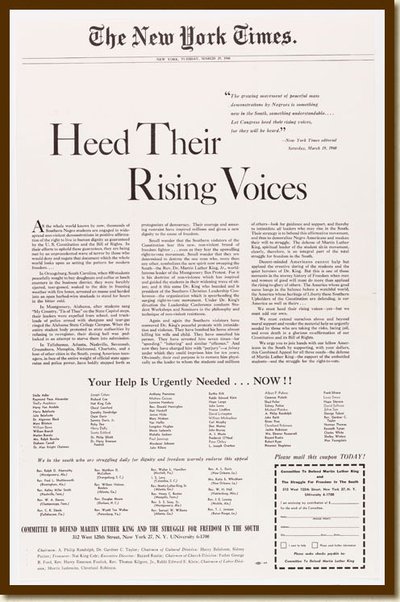
Advertisement, “Heed Their Rising Voices,” New York Times, March 29, 1960. National Archives-Atlanta, Records of District Courts of the United States (National Archives Identifier 2641477) https://www.archives.gov/exhibits/documented-rights/exhibit/section4/detail/heed-rising-voices.html
In the 1964 landmark case New York Times Co. v. Sullivan, the Supreme Court issued a unanimous decision in favor of the Times. In its decision, the court upheld the free speech clause of the First Amendment and limited public officials' ability to sue for defamation. The ruling established an “actual malice standard" which requires that, in order for claims of defamation or libel to be sustained, the person made the statements knowing they were false and with reckless disregard. Further, Justice Brennan, writing the opinion of the court, states:
“We consider this case against the background of a profound national commitment to the principle that debate on public issues should be uninhibited, robust, and wide-open, and that it may well include vehement, caustic, and sometimes unpleasantly sharp attacks on government and public officials…Injury to official reputation affords no more warrant for repressing speech that would otherwise be free than does factual error.”
NOW
The rapper Afroman, whose legal name is Joseph Foreman, released a series of music videos following the 2022 raid on his home by the Adams County, Ohio, Sheriff’s Office, featuring home security footage from the raid. The most famous of which, "Lemon Pound Cake," poked fun at one of the officers staring at a pound cake on the kitchen counter. However, following the release of the music videos, the sheriff’s deputies said they were publicly harassed and sought nearly $4 million in damages.
During the court proceedings, Afroman, wearing a head-to-toe American flag suit, defended his First Amendment rights, saying, “After they run around my house and kick down my door, I got the right to kick a can in my backyard, use my freedom of speech, turn my bad times into a good time.” The jury ruled in favor of Afroman, finding that the use of his home security footage of the 2022 police raid in his music videos was protected under the First Amendment’s freedom of speech.
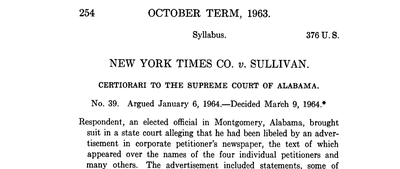
Library of Congress https://tile.loc.gov/storage-services/service/ll/usrep/usrep376/usrep376254/usrep376254.pdf
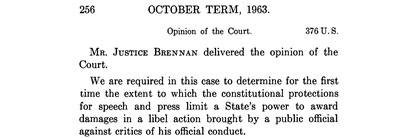
Library of Congress. https://tile.loc.gov/storage-services/service/ll/usrep/usrep376/usrep376254/usrep376254.pdf
Discussion questions:
- Do you think "actual malice" needs to be proven in order for the plaintiff to win a defamation or libel case? Explain.
- How have First Amendment protections changed or remained the same with the advent of new technology or means of expression?
- What similarities and differences can you draw between the 1964 Supreme Court case New York Times Co. v. Sullivan and the 2026 case with Afroman?
Written by Claudia Caruso, PBS News Hour Classroom's intern and sophomore at the University of Southern California, and News Hour's Vic Pasquantonio.
Sign up to receive our weekly newsletter with Daily News Lessons and community events.
To provide feedback on News Hour Classroom's resources, including this lesson, click here.