What to know
(Video length: 52 seconds)
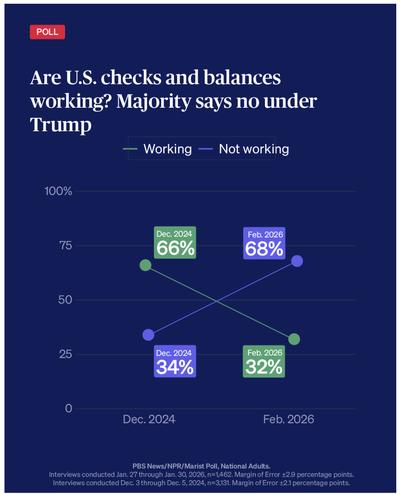
- 68% of Americans say the system of checks and balances that divides power between the White House, Congress and the courts is not working well, according to a PBS News/NPR/Marist Poll (Feb. 23, 2026).
- 78% of respondents in the poll feel the issues that divide the country pose a serious threat to the future of American democracy, a concern shared by a majority of all political parties.
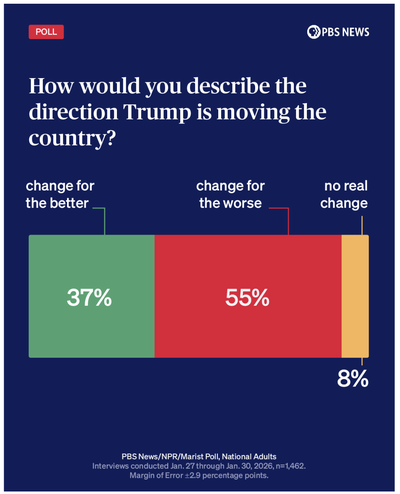
- Trump has pushed his policy priorities at a rapid pace, often bypassing Congress and signing executive actions. The conservative majority on the Supreme Court has allowed many of Trump's executive actions to go into effect, even as lawsuits continue in lower courts, with the notable exception of his tariff policy.
Why it matters
The system of checks and balances is one of the basic pillars of constitutional democracy outlined in the Constitution. The system prevents one branch of government from having too much power over the other branches.
Overall, the Republican-controlled Congress has done little to push back as the president has taken over the spending and war powers that belong to the legislature, a move that is not uncommon when the executive branch and the Congress belong to the same party.
Discussion questions
- Do you think the system of checks and balances is working? Explain.
- Have the Trump administration's policies affected you personally? Explain. Now take a look at the article, Checks and balances aren't working under Trump, growing majority says, to see how poll respondents answered this question (scroll about halfway down). Did the results surprise you? Why or why not?
What students can do
Read PBS News' Checks and balances aren't working under Trump, growing majority says, by Matt Loffman, to learn more about the poll, reasons why Americans feel the way they do and two different viewpoints from political scientists over the issue of checks and balances.
Graphic by Steff Staples/ PBS News
Graphic by Steff Staples/ PBS News
Look back activity: With a classmate, family member or neighbor watch the Short above and the following News Hour video, Diminishing Checks and Balances for U.S. Commanders in Chief Considering War from July 24, 2013, contains an inteview with Marvin Kalb, veteran journalist and teacher, about his book, "The Road to War: Presidential Commitments Honored and Betrayed," about the evolving power of the president to commit the country to military action around the world. It starts off with News Hour correspondent Ray Suarez:
"The Constitution establishes the president of the United States as the commander in chief of the nation's armed forces, but the power to make war is subject to the checks and balances found throughout the Constitution.
The president asks Congress to declare war, and it's congressional approval that clears the way for a state of war. But declarations of war are rare, and American forces have seen plenty of combat without them on the orders of the president."
"The whole idea, as you said at the very beginning, was checks and balances. And, increasingly, with the Congress abdicating its responsibility, with the president having his own army, in effect, and with the media more or less benignly going along with what's happening, you end up with the president having all of the power to do whatever he wants. If he, tomorrow morning, decides we're going to put -- we're going to go into an attack in Iran, who would stop him? No one. You would just learn about it and report it." — Marvin Kalb, News Hour interview, July 24, 2013
Discussion questions:
- How does this video compare with the 2026 video and article above about checks and balances?
- Are the issues and themes (war, presidential power, Congress, news media, etc.) similar or different to today? Explain.
- Do you think the president should have to ask Congress to declare war (this is currently the law)? Why do presidents from both political parties ignore this part of the Constitution and legislation like the War Powers Act?
Fun fact: Marvin Kalb hosted the Kalb Report for 28 years at the National Press Club until the age of 92 (he's 95). Take a look at his final show here in which he is interviewed by another veteran journalist, Ted Koppel.
NEWS: THEN & NOW
The News: Then & Now section of the Daily News Lessons allows students to see connections between current and past news events. The activity provides historical context using primary sources from the Library of Congress.
See PBS News Hour Classroom's Journalism in Action website for interactive examples of how journalists covered key events in U.S. history while honing your primary source, civics and digital news literacy skills.
THEN
The system of checks and balances in the Constitution gives certain powers to each of the three branches of government: executive, legislative and judicial. The system prevents one branch of government from becoming too powerful and asserting too much control over the other branches.
James Madison, one of the founders and a member of a group known as the Federalists, wrote a series of anonymous essays along with Alexander Hamilton and John Jay, attempting to influence the public to support a strong central government. The anonymous essays appeared in newspapers throughout the early republic from October 1787 and May 1788. Federalist No. 51, written by Madison, includes the concept of checks and balances.
"If men were angels, no government would be necessary." — James Madison
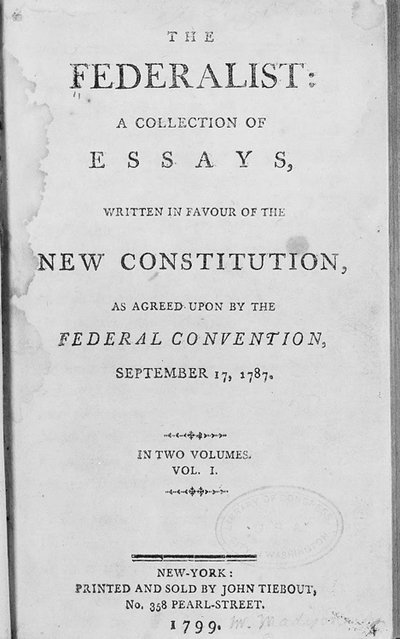
A 1787 newspaper advertisement for The Federalist Papers, an eighty-five-essay series that appeared in the New York Independent Journal and other newspapers. Alexander Hamilton, James Madison, and John Jay wrote The Federalist Papers under the pen name "Publius." Library of Congress
Read the excerpt from Federalist No. 51, "The Structure of the Government Must Furnish the Proper Checks and Balances Between the Different Departments," which appeared in The New York Packet, Feb. 8, 1788. If you get stuck, try using the annotated version (with notes/explanations) of Federalist No. 51 from the Bill of Rights Institute.
"In order to lay a due foundation for that separate and distinct exercise of the different powers of government, which, to a certain extent, is admitted on all hands to be essential to the preservation of liberty, it is evident that each department should have a will of its own; and consequently should be so constituted, that the members of each should have as little agency as possible in the appointment of the members of the others. Were this principle rigorously adhered to, it would require that all the appointments for the supreme executive, legislative, and judiciary magistracies, should be drawn from the same fountain of authority, the people, through channels having no communication whatever with one another…"
NOW
In a PBS News/NPR/Marist Poll (Feb. 23, 2026), 68% of Americans said the system of checks and balances that divides power between the White House, Congress and the courts is not working well.
"Checks and balances have now been replaced by a litany of litigation and legal charges and countercharges as the only ways to place limits on governing power as intended by the Founding Fathers," writes Dr. Michael Kryzanek of Bridgewater State University in Mass., adding that the federal courts were never meant to be bombarded with lawsuits, requiring quick decisions on important policy issues.
Discussion questions:
- Why do you think Madison favored a stronger federal government for the young republic along with a system of checks and balances?
- "The checks and balances system does not make for quick or complete public policy but is rather a means of slowing the process of governmental decision-making so that the result is based on compromise, consensus and bipartisan cooperation," writes Kryzanek. Why do you think the Founders preferred a slower, more deliberate system of decision-making on key policy issues?
Additional resources:
- Federalist 10 (1787) resource — National Constitution Center
- Read Primary Source: Federalist No. 51 Excerpts Annotated or watch Federalist 51 | Primary Source Essentials video — Bill of Rights Institute
- Federalist 51 with study questions — Teaching American History
- Check out In Pursuit's essay on James Madison by Jack Rakove, professor of American History at Stanford University. In Pursuit is an initiative by More Perfect, a bipartisan organization seeking to engage institutions and Americans in protecting and renewing American democracy.
Sign up to receive our weekly newsletter with Daily News Lessons and community events.
To provide feedback on News Hour Classroom's resources, including this lesson, click here.