SUMMARY
The Supreme Court heard a case that could reshape how millions of mail-in ballots are counted in this fall's elections. Some states count mail-in ballots that arrive after Election Day as long as they are postmarked by Election Day. The Republican National Committee is challenging that procedure. Ali Rogin discussed the case with Nate Persily, an election law scholar at Stanford University.
View the transcript of the story.
NOTE: If you are short on time, watch the video and complete this See, Think, Wonder activity: What did you notice? What did the story make you think? What would you want to learn more about?
News alternative: Check out recent segments from the NewsHour, and choose the story you’re most interested in watching. You can make a Google doc copy of discussion questions that work for any of the stories here.
WARM-UP QUESTIONS
- Who is the plaintiff (the side who brought the case) in the case before the Supreme Court?
- Why did the plaintiff sue? What are their core arguments?
- What are the different arguments Justice Samuel Alito and Justice Ketanji Brown Jackson make regarding the meaning of Election Day?
- When is the Supreme Court expected to decide on the case?
- How would the Supreme Court's ruling affect the 2026 midterms, according to Nate Persily?
ESSENTIAL QUESTIONS
- How do you think the Supreme Court should rule in this case?
- Why has the issue of mail-in voting become divided along political party lines?
Media literacy: Nate Persily is a Stanford University election law scholar. What additional experts would you like to hear from? How could you find out where the electorate stands on the issue of mail-in ballots?
WHAT STUDENTS CAN DO
Take a look at the map below. Does your state accept mail-in ballots after Election Day?
Activity: Learn more about what is going on in your state by reading 1-2 stories about mail-in ballots. Start by looking up one of your state capital's main newspapers. You can find a list of newspapers on Wikipedia here. Scroll down to the section "United States newspapers by state and territory." Click on your state and find your state capital's newspaper. When you locate it, visit their website and look for articles about mail-in ballots.
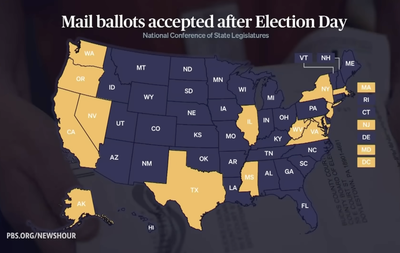
Credit: PBS News Hour screenshot from Supreme Court hears mail-in ballot case that could impact the midterms segment
What did you learn about mail ballots in your state? Did anything surprise you? Did anything you read make you want to write to your elected officials?
NEWS: THEN & NOW
The News: Then & Now section of the Daily News Lessons allows students to see connections between current and past news events. The activity provides historical context using primary sources from the Library of Congress.
See PBS News Hour Classroom's Journalism in Action website for interactive examples of how journalists covered key events in U.S. history while honing your primary source, civics and digital news literacy skills.
THEN
Though mail-in voting has become an increasingly common way to cast a ballot in recent years, especially during the COVID-19 pandemic, absentee voting and mail-in ballots are not new. In fact, they trace their roots far back throughout our nation’s history.
The Civil War marked the beginning of widespread absentee voting, allowing military service members to participate in elections while away from their polling precincts. As seen in the illustration by William Waud for Harper's Weekly in October 1864, some states, like Pennsylvania, established satellite polling stations in the field, while others allowed soldiers to mail in their ballots. Further primary-source evidence of mail-in voting during the Civil War is the Poll Book below, which certified the judges and clerks for the 1864 presidential election held at a camp in Strasburg, Virginia, for the 139th Pennsylvania Infantry Regiment.
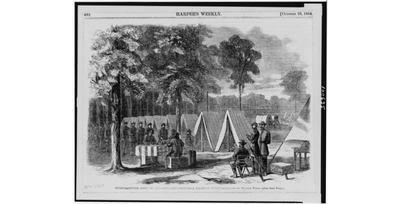
Pennsylvania soldiers voting, Army of the James. Courtesy of the Library of Congress
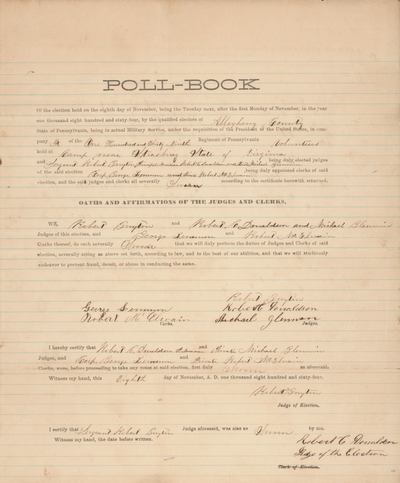
Poll-book naming judges and clerks for the 1864 presidential election held at the camp of Co. F, 139th Pennsylvania Infantry Regiment, near Strasburg Virginia. Courtesy of the Library of Congress
While absentee ballots gained widespread use among soldiers in the Civil War, the opportunity to vote by mail has also long been extended to civilians. However, the laws varied by state. The September 29, 1920, issue of the Evening Star reports on the National Women’s Party's efforts to educate female voters about their absentee-voting options based on the state they live in, coming just one month after women won the right to vote.
For more: Voting by Mail: It’s Nothing New | Teaching with the Library
History 1861-2022 | National Postal Museum
NOW
On Monday, March 23, 2026, the Supreme Court heard arguments in a case that could dramatically change the way mail-in ballots are counted. While 14 states and the District of Columbia allow ballots to be received after Election Day, as long as they are postmarked by Election Day, the Republican National Committee is challenging that procedure, arguing that it undermines trust in elections. As Nate Persily, an election law scholar at Stanford University, explains in the News Hour segment above, the RNC is arguing that the federal law sets the date for the election as a particular day and thus takes precedence over any state laws that allow for ballots to be received after that day. While the law at issue in this particular case is a Mississippi law, the decision will have wide-ranging implications for how ballots are counted across the country.
The decision, expected in June, is likely to affect the midterm elections this November. If the court sides with the RNC, states would be unable to count any ballot received after Election Day.
Discussion questions:
- How has the practice of mail-in voting changed from its inception during the Civil War to today, particularly as a result of the COVID-19 pandemic? How has trust in mail-in voting changed?
- Do you agree or disagree with the arguments proposed by the RNC? Does the history of mail-in ballot usage justify its continuance?
Sign up to receive our weekly newsletter with Daily News Lessons and community events.
To provide feedback on News Hour Classroom's resources, including this lesson, click here.