What to know
(Video length: 55 seconds)
- A majority of Americans oppose military action in Iran and don’t like the way President Donald Trump is handling the issue, according to the newest PBS News/ NPR/ Marist Poll.
- The survey found 56% of Americans oppose U.S. military action in Iran, while 44% support it.
- A plurality of Americans — 44% — see Iran as a major threat to U.S. security. Another 40% of Americans consider Iran a minor threat and 15% see no threat at all.
Why it matters
In a Constitutional republic, the people's voice matters. "A constitutional republic is a form of government where citizens elect representatives to make decisions on their behalf, governed by a constitution that sets forth the fundamental principles and laws of the state." (Source: EBSCO)
Discussion questions
- Do you think the Trump administration and Congress are taking the American people's thoughts about the Iran war seriously? Explain.
- Take a look at the three main graphics included in the PBS News/ NPR/ Marist Poll below. If you were the pollster, what additional questions would you have asked? Take a look at other polls on this issue. How important is wording (the way the question is asked) when polling people? Do you find the wording of the questions below to be fair? Explain.
What students can do
Read PBS News' Majority of Americans oppose military action in Iran, new poll finds, by Matt Loffman, to learn more about how Americans feel about the war.
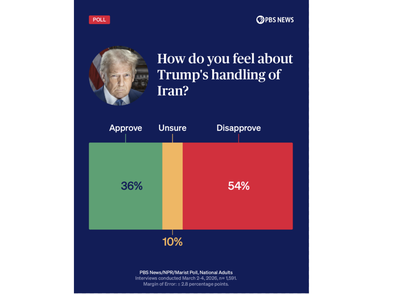
A majority -- 54% -- of Americans disapprove of how Trump is handling Iran. Another 36% approve and 10% are unsure, according to the latest PBS News/NPR/Marist poll. Graphic by Steff Staples/PBS News.
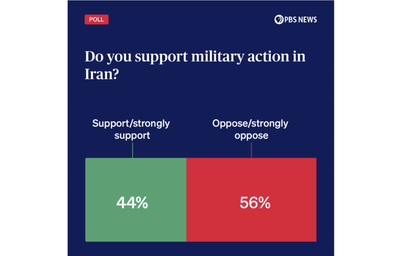
A majority -- 56% -- of Americans oppose U.S. military action in Iran, according to the latest PBS News/NPR/Marist poll, while 44% support it. Graphic by Steff Staples/PBS News
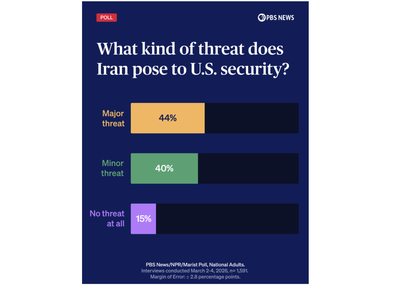
A plurality of Americans – 44% – say Iran is a major threat to U.S. security, according to the latest PBS News/NPR/Marist poll. Another 40% see the country as a minor threat, while 15% see it as no threat at all. Graphic by Dan Cooney/PBS News.
NEWS: THEN & NOW
The News: Then & Now section of the Daily News Lessons allows students to see connections between current and past news events. The activity provides historical context using primary sources from the Library of Congress.
See PBS News Hour Classroom's Journalism in Action website for interactive examples of how journalists covered key events in U.S. history while honing your primary source, civics and digital news literacy skills.
THEN
Throughout the history of the United States, whenever the country has taken part in foreign wars and military interventions, there have always been people who objected to those policies and actions for a variety of reasons.
The American Anti-Imperialist League was founded in June 1898 to oppose the U.S. annexation of the Philippines during the Spanish-American War. Over the course of that war, the League also weighed in against U.S. actions in Cuba. Some of the high-profile members of the League included author Mark Twain, industrialist Andrew Carnegie and labor organizer Samuel Gompers.
Two excerpts from the platform of the American Anti-Imperialist League, explaining the group’s position (click here for a longer excerpt):

Schurz, Carl. The Policy of Imperialism; Address. Chicago, American Anti-imperialistic League, 1899. Pdf. https://www.loc.gov/item/08003852/.

Schurz, Carl. The Policy of Imperialism; Address. Chicago, American Anti-imperialistic League, 1899. Pdf. https://www.loc.gov/item/08003852/.
The American Anti-Imperialist League and its supporters held events across the country where people spoke out against the war. The following is an excerpt of an 1898 anti-war speech by Boston lawyer Moorfield Storey, who would later become the founding president of the NAACP (you can choose to read one or both excerpts below):
https://www.loc.gov/resource/rbpe.2390200h/?sp=4&st=image&pdfPage=12
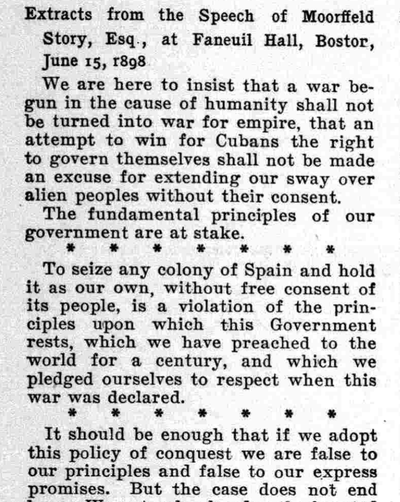
Anti-Imperialist League. Washington, D. C. Save the republic. Anti-imperialist leaflet no. 11 -21 Washington, -99. Washington, 1899. Pdf. https://www.loc.gov/item/2020785012/.
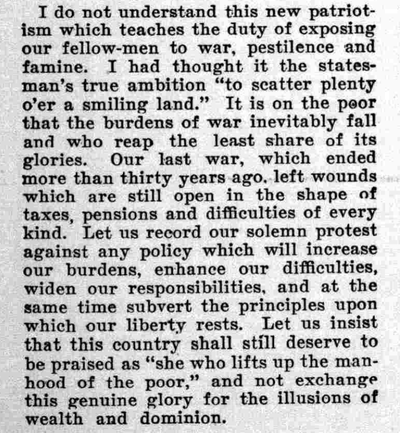
Anti-Imperialist League. Washington, D. C. Save the republic. Anti-imperialist leaflet no. 11 -21 Washington, -99. Washington, 1899. Pdf. https://www.loc.gov/item/2020785012/.
NOW
Just as the American Anti-Imperialist League and its members expressed different reasons for opposing U.S. actions in the Spanish-American War, Americans today have a variety of objections to the U.S. war on Iran — some people and organizations that had supported President Trump have called it “a betrayal,” while others’ concerns boil down to how much the war may cost the nation and the average consumer.
Discussion questions:
- What are some of the American principles that the Anti-Imperialist League and its members said were violated by U.S. annexation of the Philippines and intervention in Cuba? How do those objections compare with those offered by Americans today across the political spectrum against the war on Iran?
- What were some of the practical reasons people had for opposing the Spanish-American War? How do those compare with the reasons most Americans do not support the current war on Iran?

Credit: Screenshot PBS News Hour Classroom, Iran backgrounder article
Dig deeper: To better understand the current conflict, read PBS News Hour Classroom's Backgrounder: History of Iran — Late 19th century to present, contributed by World History Association educators.
Sign up to receive our weekly newsletter with Daily News Lessons and community events.
To provide feedback on News Hour Classroom's resources, including this lesson, click here.