SUMMARY
Since the dismantling of USAID, the Trump administration has been revamping aid policies, focusing on smaller deals with recipient governments. Countries receiving American aid will be required to finance part, and eventually, the entire program. Fred de Sam Lazaro reports from Kenya and Uganda, two nations that have signed agreements under the new America First Global Health Strategy.
View the transcript of the story.
NOTE: If you are short on time, watch the video and complete this See, Think, Wonder activity: What did you notice? What did the story make you think about? What would you want to learn more about?
News alternative: Check out recent segments from the News Hour, and choose the story you’re most interested in watching. You can make a Google doc copy of discussion questions that work for any of the stories here.
WARM-UP QUESTIONS
- What is Lenacapavir, and what is its relation to the new America First Policy?
- Where will Lenacapavir be produced?
- Who is Marco Rubio, and what role has he played in the implementation of the America First Global Health Strategy?
- How will funding be divided between the U.S. and Kenya in the rollout of the new America First Global Health Strategy?
- Why have some countries resisted accepting U.S. aid agreements?
FOCUS QUESTIONS
- Drs. Kenneth Ngure and Elizabeth Bukusi, leading HIV scholars in Kenya, expressed concerns over the America First Global Health Strategy, noting that African governments burdened by debt and other pressing demands are often unable to fulfill commitments such as actually getting the product into people's hands.
- Discuss ideas for how you would generate public demand and availability for the drug. Some ideas include: making an educational campaign, public service announcement or establishing mobile clinics in local communities. What are the potential benefits and limitations of your proposed solutions?
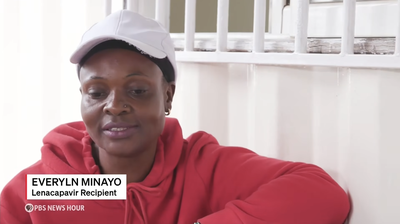
Media literacy: The PBS News Hour segment opened with a story about Everylyn Minayo as she received the Lenacapavir HIV prevention drug at a public health center in Nairobi. Why do you think reporter Fred de Sam Lazaro decided to introduce the topic in this way? What role do personal stories play in our understanding of policy decisions and their effects on the communities they serve?
WHAT STUDENTS CAN DO
Watch this related PBS NewsHour segment: Uganda sees spike in disease-related deaths after elimination of USAID (Part one of Fred de Sam Lazaro's two-part report from the East African nation of Uganda).
- Short Summary: In 2025, the Trump administration dissolved the $40 billion U.S. Agency for International Development, or USAID. Days later, an exemption for "life-saving humanitarian assistance" was issued. But what that included was not specified and aid for health programs has been drastically reduced.
As a class, discuss the following questions:
- In the segment, Fred de Sam Lazaro explains that while formulations of HIV medications were replenished through the exemption, the programs to actually get them to patients were not restored. As a result, communities with high levels of poverty are unable to afford medical care such as testing, medicine or health center visits.
- Why do you think the US only provided exemptions for replenishing life-saving medicine but did not fund the programs that allow the medicine to be widely available?
- Peter Waiswa underscored how the USAID dissolution was a "painful reminder" of the African nations' heavy dependence on foreign aid. While many African governments pledged to spend at least 15 percent of their national budgets on health care, in practice, it's often around 4-5 percent, at most 6 or 7 percent. Waiswa argues that "It's time for African governments to really step up and finance their systems." Similarly, U.S. Secretary of State Marco Rubio said, "True assistance is self-sustainability."
- Do you agree that self-sustainability should be the goal? Why or why not?
- Do you think America has a responsibility to continue supporting the nations it has long aided until they are able to become self-sustaining? Why or why not?
Written by Claudia Caruso, PBS News Hour Classroom's intern, with editing by News Hour's Luke Gerwe.
Sign up to receive our weekly newsletter with Daily News Lessons and community events.
To provide feedback on News Hour Classroom's resources, including this lesson, click here.