Directions: Watch video above (24 seconds) and then watch Dazzling new images taken by Artemis II mission released (1m:01s). And in case you missed it, watch Artemis II's lift-off to the moon on April 1, 2026 (41 seconds).
What to know
- The crew of the Artemis II mission is set to return home Friday, April 10, 2026, following its voyage around the far side of the moon. WATCH LIVE: Artemis II crew splashes down on Earth after historic trip around the moon starting at 6:30 p.m. EDT.
- The crew set a record for traveling further than any astronaut before. They documented their voyage by taking photographs of the Earth disappearing behind the moon's surface and another of a solar eclipse with the sun slipping behind the moon, a view rarely seen by humans.
- On Tuesday, Houston's Mission Control arranged a radio link-up between the Artemis II astronauts and the crew at the International Space Station. It was the first such moonship-to-spaceship radio link-up in history. The previous Apollo missions took place before the space station was built.
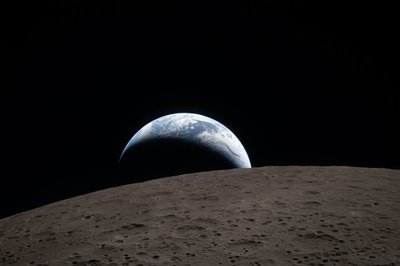
art002e009288 (April 6, 2026) – Earthset captured through the Orion spacecraft window at 6:41 p.m. EDT, April 6, 2026, during the Artemis II crew’s flyby of the Moon. A muted blue Earth with bright white clouds sets behind the cratered lunar surface.
The dark portion of Earth is experiencing nighttime. On Earth’s day side, swirling clouds are visible over the Australia and Oceania region.
In the foreground, Ohm crater has terraced edges and a flat floor interrupted by central peaks. Central peaks form in complex craters when the lunar surface, liquefied on impact, splashes upwards during the crater’s formation.
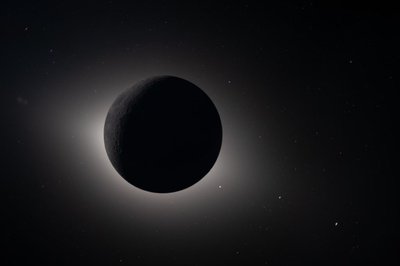
Captured by the Artemis II crew during their lunar flyby on April 6, 2026, this image shows the Moon fully eclipsing the Sun. Photo by NASA
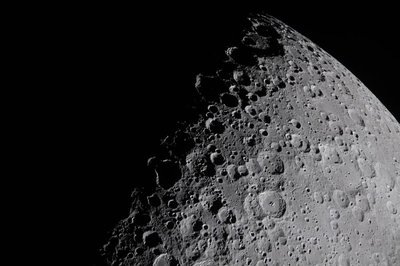
The Artemis II crew captures a portion of the Moon coming into view along the terminator – the boundary between lunar day and night – where low-angle sunlight casts long, dramatic shadows across the surface. Features include Jule Crater, Birkhoff Crater and Stebbins Crater. Photo by NASA
Discussion questions
- Read this quote from the 2023 NASA article "Why we go to space":
- "The reasons to explore the universe are as vast and varied as the reasons to explore the forests, the mountains, or the sea. Since the dawn of humanity, people have explored to learn about the world around them, find new resources, and improve their existence."
- Do you agree with this statement? Why or why not? Should humans should go to space? Explain.
- What questions would you like to ask the astronauts aboard Artemis II?
Sign up to receive our weekly newsletter with Daily News Lessons and community events.
To provide feedback on News Hour Classroom's resources, including this lesson, click here.