SUMMARY
On his first day back in office, President Trump signed an executive order seeking to end birthright citizenship, a cornerstone of immigration policy enshrined in the 14th Amendment and affirmed by the Supreme Court more than 100 years ago. But now the justices are reexamining the policy. Ali Rogin discussed the legal debate with Amy Howe and Amanda Frost.
View the transcript of the story.
NOTE: If you are short on time, watch the video and complete this See, Think, Wonder activity: What did you notice? What did the story make you think? What would you want to learn more about?
News alternative: Check out recent segments from the NewsHour, and choose the story you’re most interested in watching. You can make a Google doc copy of discussion questions that work for any of the stories here.
WARM-UP QUESTIONS
- What does the executive order signed by Trump on his first day back in office say about birthright citizenship?
- Who are Amy Howe and Amanda Frost, and what are their backgrounds?
- What was the Trump administration's argument about birthright citizenship?
- How does the 14th Amendment establish birthright citizenship in its text?
- Why would the rules that the Trump administration is trying to create be difficult to put in place, according to Amy Howe?
ESSENTIAL QUESTIONS
- Why do you think President Trump decided to visit the courtroom during the hearing of this case, becoming the first sitting president at a Supreme Court hearing?
- After watching this segment, how do you think the Supreme Court will rule in this case?
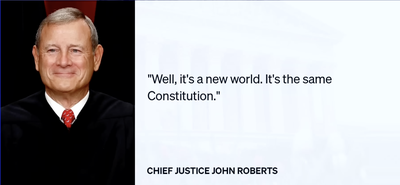
Media literacy: In this segment, the producers play a short exchange that includes Chief Justice Roberts saying, "It's a new world, but it's the same Constitution." What do you think Roberts meant by this? Why do you think this was the one audio exchange included by producers of the segment?
WHAT STUDENTS CAN DO
How does birthright citizenship work? Watch the following video from the Dispatch for an explainer. Then as a class, discuss —
- What is the origin of birthright citizenship?
- What is the essential disagreement about the text of the 14th Amendment?
- What questions do you still have about how people become citizens? How could you find out more?
NEWS: THEN & NOW
The News: Then & Now section of the Daily News Lessons allows students to see connections between current and past news events. The activity provides historical context using primary sources from the Library of Congress.
See PBS News Hour Classroom's Journalism in Action website for interactive examples of how journalists covered key events in U.S. history while honing your primary source, civics and digital news literacy skills.
THEN
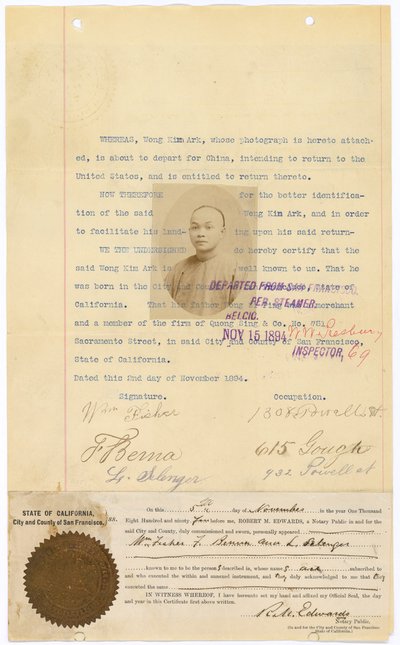
Departure Statement, Wong Kim Ark
Record Group 21
USDC
No. District Court of CA, SF
Admiralty Case File #11198
NRHSA
Job 09-A2-093_010_001
The Fourteenth Amendment, one of the three Reconstruction amendments, was passed by Congress on June 13, 1866, and ratified on July 9, 1868, extending liberties and rights granted by the Bill of Rights to formerly enslaved people. The amendment grants citizenship to “all persons born or naturalized in the United States” and extends the rights of due process and equal protection under the law to both the federal and state governments.
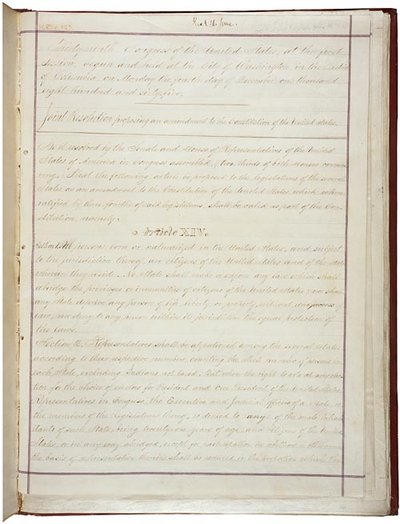
The House Joint Resolution Proposing the 14th Amendment to the Constitution, June 16, 1866; Enrolled Acts and Resolutions of Congress, 1789-1999; General Records of the United States Government; Record Group 11; National Archives.
On June 16th, House Joint Resolution 127, proposing the 14th Amendment to the Constitution, was submitted to the states.
The first clause of the 14th Amendment is known as the citizenship clause and reads as follows:
“Section 1. All persons born or naturalized in the United States, and subject to the jurisdiction thereof, are citizens of the United States and of the State wherein they reside. No State shall make or enforce any law which shall abridge the privileges or immunities of citizens of the United States; nor shall any State deprive any person of life, liberty, or property, without due process of law; nor deny to any person within its jurisdiction the equal protection of the laws.”
Source: National Archives and National Archives Catalog
In 1898, the Supreme Court, in the landmark ruling United States v Wong Kim Ark, affirmed the right to birthright citizenship for the children of immigrants. Kim Ark was born in San Francisco, CA, in 1873, to immigrant parents. When he was 21, Kim Ark returned to China with his parents.
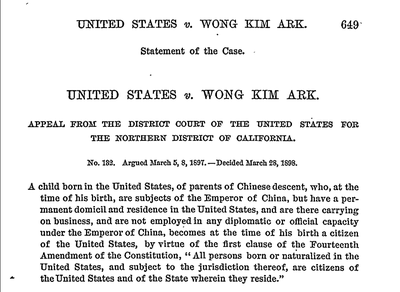
Excerpt from United States vs. Wong Kim Ark. Courtesy of the Library of Congress
In August 1895, upon his return to the United States after visiting with family in China, Wong Kim Ark was denied entry on the claim that he was not a citizen despite his San Francisco birth under the Chinese Exclusion Act of 1882. His appeal eventually went all the way to the Supreme Court. In a 6-2 decision, the Court protected the citizenship of US-born children of non-citizen immigrants.
NOW
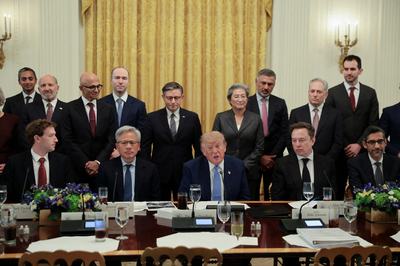
On April 1, 2026, Supreme Court justices heard oral arguments in the ongoing case Trump v. Barbara, which arose from President Trump’s executive order seeking to end birthright citizenship, signed on his first day back in office in his second term. Among those in attendance was President Trump, becoming the first sitting U.S. president to attend oral arguments.
The arguments made centered around the meaning of the amendment’s first sentence, “All persons born are naturalized in the United States and subject to the jurisdiction thereof,” and specifically the notion of “subject to the jurisdiction thereof,” with the government claiming that this excludes children born to undocumented immigrants and temporary immigrants.
The Justices spent considerable time discussing the 1898 case, United States v Wong Kim Ark. The government argued that this case is different as Wong Kim Ark’s parents had lived in the United States for a long time and were domiciled here. However, many of the Justices voiced skepticism about this position, recognizing that, historically, immigration laws have not been as stringent and that categories of undocumented immigrants are relatively new, as well as questioning how it would actually be implemented.
According to Amanda Frost, professor of immigration and citizenship law at the University of Virginia, this decision is expected to have major implications. If the executive order is upheld, it would prevent about a quarter-million children each year from gaining citizenship who would otherwise have under the previous understanding of the citizenship clause.
Discussion questions:
- In your opinion, what is the importance of maintaining legal precedence? When, or under what circumstances, should rulings be overturned?
- How do you understand the meaning of “subject to the jurisdiction thereof’ and do you think its meaning has changed over time?
Sign up to receive our weekly newsletter with Daily News Lessons and community events.
To provide feedback on News Hour Classroom's resources, including this lesson, click here.