SUMMARY
With the U.S and Iran considering a potential deal to end the war we turn to two or our experts. Alan Eyre of the Middle East Institute was a senior member of the Obama administration's negotiating team for the previous Iran nuclear deal. Miad Maleki was born in Iran and is a senior fellow at the Foundation for the Defense of Democracies. They join Aman Nawaz for additional perspective.
View the transcript of the story.
NOTE: If you are short on time, watch the video and complete this See, Think, Wonder activity: What did you notice? What did the story make you think about? What would you want to learn more about?
News alternative: Check out recent segments from the News Hour, and choose the story you’re most interested in watching. You can make a Google doc copy of discussion questions that work for any of the stories here.
Dig deeper: To better understand the current conflict, read PBS News Hour Classroom's Backgrounder: History of Iran — Late 19th century to present, contributed by World History Association educators.
WARM-UP QUESTIONS
- Who are the guests interviewed for this segment, and what are their backgrounds?
- Why do some analysts like Miad Maleki argue Iran is "desperate" to get a deal, while others argue Iran has the upper hand and is no such rush?
- What is being left out of discussions about reopening the Strait of Hormuz, according to Alan Eyre?
- When will an agreement be reached, according to President Trump?
- How long will it take to rebuild Iran's nuclear program, according to Maleki? What is the role of the IAEA (International Atomic Energy Agency), and how could it once again be instrumental in overseeing Iran's nuclear facilities, according to Eyre?
ESSENTIAL QUESTIONS
- What do you think is the likelihood of an agreement in the coming weeks after watching this segment? Why do you think so?
- How do you think this current conflict might transform the world economy and international relations in the long-term?
Media literacy: Why do you think the producers of this segment chose to bring two experts on to interview? What different perspectives do you think they represent, and how do they seem to disagree?
WHAT STUDENTS CAN DO
To learn more about a potential agreement between the U.S. and Iran, watch the segment below. If time is short, you can also just review the infographics below. Then discuss —
- Which detail of the proposed agreement do you think will be hardest to enforce?
- Which details do you think are most likely to prevent a deal without further negotiation?
Outline of proposed deal, in two phases (first graphic represents the first phase):
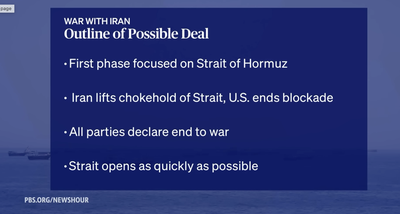
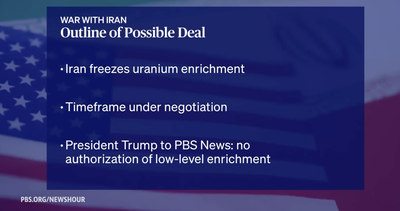
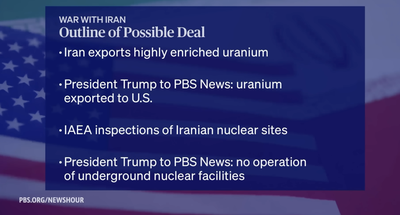
Check out this CFR Education resource from the Council on Foreign Relations for more background in Iran and its decades of conflict with the United States.
Sign up to receive our weekly newsletter with Daily News Lessons and community events.
To provide feedback on News Hour Classroom's resources, including this lesson, click here.