SUMMARY
Blue Origin’s New Glenn rocket exploded on the launchpad during a test in Cape Canaveral on May 28. The company, owned by Jeff Bezos, said no one was injured and all personnel were accounted for. But the rocket has a crucial role in NASA’s Artemis program to return American astronauts to the surface of the moon. Amna Nawaz discussed its significance with science correspondent Miles O’Brien.
View the transcript of the story.
NOTE: If you are short on time, watch the video and complete this See, Think, Wonder activity: What did you notice? What did the story make you think? What would you want to learn more about?
News alternative: Check out recent segments from the News Hour, and choose the story you’re most interested in watching. You can make a Google doc copy of discussion questions that work for any of the stories here.
WARM-UP QUESTIONS
- Who owns the company Blue Origin?
- Why did the New Glenn rocket experience problems?
- What is the purpose of the Artemis program?
- What other company contributing to the Artemis mission recently had a setback?
- How will the setbacks impact the Artemis program's future goals?
ESSENTIAL QUESTIONS
- Why do you think NASA is working with private companies such as SpaceX and Blue Origin to carry out critical functions of its Artemis program?
- What do you think might be the longterm benefits of the Artemis program and a permanent base on the moon? Who do you think would most benefit, and how?
Media literacy: What did you learn about the Artemis moon mission from this segment? What questions are you left with about the mission, and how do you think you could find out more?
WHAT STUDENTS CAN DO
Find out more about the Artemis mission by visiting the NASA website. First, start by examining the following graphic from the NASA website. Then, explore each mission within the larger Artemis project by clicking on each and reading more. As a class, discuss:
- What is ultimately the goal of the Artemis mission?
- What are some of the potential benefits of the mission? Which benefits do you think will be most important or have the biggest impact for people in the United States, or for our understanding of science?
- Which aspects of the mission do you think might be the hardest to achieve?
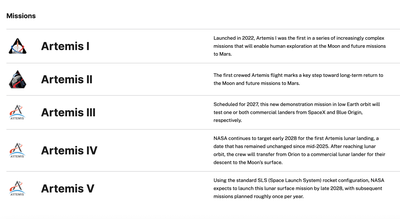
Screenshot from the NASA website
Teachers: Are your students interested in designing spacecraft and other technology for space? Use the lesson plan Learn from NASA how to invent for any environment to better understand the special challenges of engineering for space exploration!
NEWS: THEN & NOW
The News: Then & Now section of the Daily News Lessons allows students to see connections between current and past news events. The activity provides historical context using primary sources from the Library of Congress.
See PBS News Hour Classroom's Journalism in Action website for interactive examples of how journalists covered key events in U.S. history while honing your primary source, civics and digital news literacy skills.
THEN
The US Space Age began on January 31, 1958, when the US successfully launched the first U.S. satellite, Explorer 1, from Cape Canaveral in Florida. Then, on July 29 of the same year, President Eisenhower signed the National Aeronautics and Space Act, which founded the agency the National Aeronautics and Space Administration, more commonly known as NASA.
While the Apollo program was announced in 1960 by NASA under the Eisenhower administration, the goal to send man to the moon was cemented and accelerated by President Kennedy during a joint session of Congress on May 25, 1961. Watch the two-minute clip below.
However, the effort to send man to the moon was not without its tragedies. During Apollo 1, which was to be the first crewed flight of Apollo, a fire swept through the command module and killed astronauts Virgil Grissom, Edward White and Roger Chaffee.
After three uncrewed and four crewed Apollo missions, on July 20, 1969, during the Apollo 11 mission, Neil Armstrong and “Buzz” Aldrin became the first men on the Moon. For a real-time experience of the first manned moon landing featuring historical materials and recordings, take a look at apolloinrealtime.org/11.
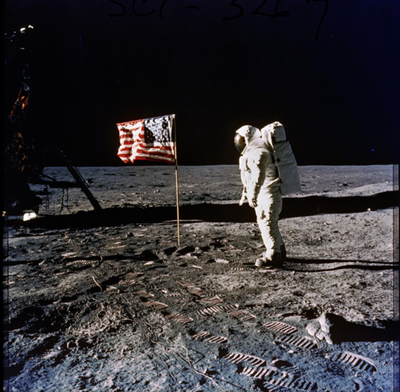
Credit: National Archives
In 1972, the Apollo program officially ended with Apollo 17, its final mission. During the Apollo program, between 1968 and 1972, a total of 12 people walked on the Moon, and 24 orbited it.
NOW
In the fifty years since Apollo, the Artemis program is the first to restart missions to the Moon and even has goals for eventual missions to Mars. Notably, in 2026, as part of the Artemis II mission, four more astronauts traveled around the Moon, including NASA astronauts Reid Wiseman, Victor Glover, and Christina Koch, and Canadian Space Agency (CSA) astronaut Jeremy Hansen.
Ahead of the planned 2027 Artemis III mission, Blue Origin’s New Glenn rocket exploded on the launchpad during a test in Cape Canaveral on May 28, destroying the only launchpad that it has to get to space. The New Glenn rocket is critical to the goals of the Artemis program as it is intended to carry a lander called Blue Moon, which will transport cargo and eventually, people to the moon’s surface. Not only that, but SpaceX's Starship, which is intended to be modified to be a lunar lander, has also experienced problems, mainly with its engines, and is “nonoperational” right now.
PBS News Hour science correspondent Miles O'Brien suspects delays to the Artemis III flight, expecting it to take at least a year or more to build a new launchpad for that New Glenn rocket.
Discussion questions:
- Compare and contrast the Apollo and Artemis programs. What are three similarities? Three differences?
Sign up to receive our weekly newsletter with Daily News Lessons and community events.
To provide feedback on News Hour Classroom's resources, including this lesson, click here.