SUMMARY
Ahead of America's 250th anniversary, author Walter Isaacson has turned his attention to a single sentence in the Declaration of Independence. Judy Woodruff spoke with Isaacson about the enduring power of those words and his new book, "The Greatest Sentence Ever Written." It’s part of her series, Crossroads: America at 250.
View the transcript of the story.
NOTE: If you are short on time, watch the video and complete this See, Think, Wonder activity: What did you notice? What did the story make you think about? What would you want to learn more about?
News alternative: Check our recent segments from the News Hour, and choose the story you’re most interested in watching. You can make a Google doc copy of discussion questions that work for any of the stories here.
WARM-UP QUESTIONS
- Who is Walter Isaacson, and what is his background?
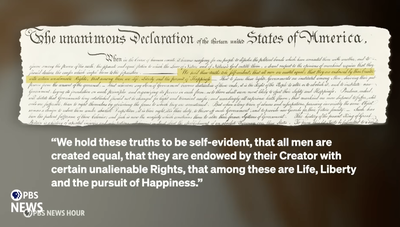
- What does Isaacson consider to be the most important sentence in the Declaration of Independence?
- Where does Isaacson's use of the term "common ground" come from?
- Why was diversity seen as a strength for America?
- How did this embrace of diversity help communities of color?
ESSENTIAL QUESTIONS
- Do you agree with Isaacson that there is a "deep contradiction" between the first line of the Declaration and the early history of the U.S.?
- In what ways do you think the U.S. has lived up to the first sentence of the Declaration? In what ways has it fallen short?
Media literacy: The News Hour segment shows the sentence in the Declaration of independence that Isaacson considered to the best that was ever written. It is your turn to read over this sentence and analyze it. Discuss as a class what stands out about this sentence. Take time to carefully understand its significance.
WHAT STUDENTS CAN DO
Now it is your turn to find a sentence that you consider to be the most important in representing the ideals of the U.S. First, use a resource like the National Archives to examine some of the foundational documents of the U.S. You might talk to your teacher about other documents that might that might apply, from state constitutions or the Declaration of Sentiments to speeches such as the Gettysburg Address or MLK Jr.'s "I have a dream" speech.
After you have found the sentence that you think is critical to your understanding of the ideals of the country, write it down on a piece of paper. Then, write a few lines about why you think the sentence best captures what is most important about American ideals to you. Here are some guiding questions that might help you write about your sentence:
- What made the sentence stand out?
- Can the sentence be applied to a wider range of concepts? If so, what message does it convey?
- Who wrote the sentence?
- When did they write it?
- How does the sentence reflect your own ideals?
Written by PBS News Hour Classrooms Intern Justin Vasquez and PBS News Hour Classrooms Victoria Pasquantonio
Sign up to receive our weekly newsletter with Daily News Lessons and community events.
To provide feedback on News Hour Classroom's resources, including this lesson, click here.