SUMMARY
Thirty-one states are now reporting cases of a parasitic intestinal disease that is making life miserable for those who contract it. While the U.S. has seen outbreaks of cyclosporiasis in the past, the cases this summer are much higher than normal and are raising real concerns about the illness.
View the transcript of the story.
NOTE: If you are short on time, watch the video and complete this See, Think, Wonder activity: What did you notice? What did the story make you think about? What would you want to learn more about?
News alternative: Check our recent segments from the News Hour, and choose the story you’re most interested in watching. You can make a Google doc copy of discussion questions that work for any of the stories here.
WARM-UP QUESTIONS
- What kind of pathogen is cyclospora?
- What are the symptoms of infection? What are the treatment options?
- Which foods are mentioned as being especially dangerous right now?
- Why is this outbreak particularly large compared to past ones?
- How has the federal government’s response to the outbreak been slowed by recent policy changes?
ESSENTIAL QUESTIONS
- What precautions and treatments are discussed in response to the cyclosporiasis outbreak?
- How do you think you could contribute to keeping cyclosporiasis out of your community?
Media literacy: Look over this statistic from the Cleveland Clinic. After reading, answer the following questions:
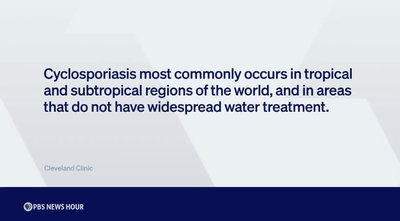
There’s been a lot of concern for how cyclosporiasis is affecting the United States, but it can be more common and devastating in other parts of the world. What treatment and disease prevention options might be present in the United States that aren’t available elsewhere? What does this say about global health and inequalities worldwide?
WHAT STUDENTS CAN DO
While much of the CDC’s reporting and action has been slower than usual, their website still maintains valuable information on current foodborne illness outbreaks. Students can explore this index and the BEAM (Bacteria, Enterics, Ameba,and Mycotics) homepage to find more information on individual outbreaks and see what kind of tools that "disease detectives" use to track down cases. After students are done, they should discuss the pages and identify what key information appears frequently. Some guiding questions can be:
- The CDC monitors countless foodborne pathogens across the entire U.S., but they stopped requiring the reporting of cyclosporiasis last year. Why do you think there’s still so much unknown about cyclosporiasis? Do you think the CDC’s decision to decrease reporting data was correct in response to their shrinking workforce?
- Individual states are discussed as having a better understanding of the amount of cases they’re dealing with versus the federal government. What risk is there with a disconnect of information being shared? How is the CDC’s role affected by them being behind state public health agencies?
Written by Alyssa Tinoco, News Hour Classroom intern, and PBS News Hour's Vic Pasquantonio
Sign up to receive our weekly newsletter with Daily News Lessons and community events.
To provide feedback on News Hour Classroom's resources, including this lesson, click here.