SUMMARY
A progressive who has never held elected office defeated an establishment-backed congresswoman in Michigan's Democratic Senate primary. Abdul El-Sayed defeated Haley Stevens in a race that exposed divisions within the party. He will face Republican Mike Rogers in November's general election. Geoff Bennett discussed the results and more with Democratic strategist Lis Smith.
View the transcript of the story.
NOTE: If you are short on time, watch the video and complete this See, Think, Wonder activity: What did you notice? What did the story make you think? What do you want to learn more about? You can also make a Google doc copy of these general discussion questions.
News alternative: Check our recent segments from the News Hour and choose the story you’re most interested in watching. See the Google doc above for discussion questions.
WARM-UP QUESTIONS
- Who is Abdul El-Sayed and what is his background in politics?
- What was the overwhelming advantage Haley Stevens held over El-Sayed?
- When is the general election and what does Lis Smith think El-Sayed needs to do to defeat the Republican nominee Mike Rogers?
- Where did an establishment-backed candidate beat a progressive challenger on Tuesday?
- Why does Smith think Stevens's "traditional political biography" was the "exact wrong resume" for a candidate in this race?
ESSENTIAL QUESTIONS
- Why do you think attacks on the American Israel Public Affairs Committee (AIPAC) have become such an effective tool for progressive candidates? How has the average Democrat's position on U.S.-Israel relations changed over the past few years?
- What does it say that a progressive candidate was able to win a statewide election in a "purple" state like Michigan?
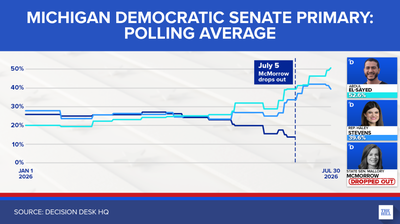
Media literacy: Take a look at the below graphic from The Hill displaying the polling averages over the last seven months of the primary. Then, read a few of the headlines from Wednesday morning and answer the questions that follow.
The Associated Press: Takeaways from Tuesday’s elections: El-Sayed pulls off narrow victory over Democratic establishment
The Hill: El-Sayed clinches narrow win over Stevens in Michigan for progressives: 5 takeaways
The Washington Post: Opinion — Narrow win for El-Sayed in Michigan is a warning for Democrats
- Why do you think so many news outlets are choosing to highlight the narrow margin (less than 15,000 votes) of El-Sayed's victory? How does this align with Smith's concerns about his chances against the Republican nominee?
- Michigan has open primaries, meaning a voter may participate in any one party's primary election — regardless of their own party affiliation.
- If Republicans or Independents were to vote in Michigan's Democratic Senate Primary, who do you think the majority would have voted for?
- Is there a way for pollsters (who targeted likely Democratic voters) to account for this in their methodology?
WHAT STUDENTS CAN DO
Watch this brief advertisement released by El-Sayed's campaign a few weeks ago. After writing down 1-2 ways the advertisement effectively introduces voters to El-Sayed, work with a group of classmates to sketch out either:
a) another advertisement for El-Sayed heading into the general election or
b) an advertisement for Rogers, El-Sayed's opponent
Be sure to visit the campaign websites of both Rogers and El-Sayed to to familiarize yourself with their policy platforms. Remember that this will be one of the most expensive Senate races in the country, so spare (almost) no expense in winning as many votes as possible!
Written by PBS News Hour Classroom's Intern Henry Mode and Vic Pasquantonio.
Sign up to receive our weekly newsletter with Daily News Lessons and community events.
To provide feedback on News Hour Classroom's resources, including this lesson, click here.