SUMMARY
Descendants of David Drake have traced their lineage back to the once-enslaved potter and launched an effort to reclaim their ancestor’s work. They say the effort has not only reconnected them with their family’s legacy but also raised broader questions about art ownership and restitution. Geoff Bennett spoke with Pauline Baker and Yaba Baker for our arts and culture series, CANVAS.
View the transcript of the story.
Short on time? Watch the video and complete the following See, Think, Wonder questions: What did you notice? What did the story make you think? What would you want to learn more about?
News alternative: Check out our recent segments from the News Hour, and choose the story you’re most interested in watching. Then make a copy and answer these general discussion questions.
WARM-UP QUESTIONS
- Where was David Drake enslaved and what was he known for?
- What nickname was Drake known by?
- Why did Drake's decision to write on his pottery add to the power of his story, according to this family?
- Who does Drake’s family hope his work inspires?
- How did the process of returning artwork (restitution) to the Baker family take place? What steps were involved?
ESSENTIAL QUESTION
- Yaba Baker says that “ownership goes in a lot of directions.” What do you think he means by this?
- Suppose you discover an artwork or keepsake belonging to your ancestor is on display in a museum. Would you demand it be returned? If so, what would you do with it?
Media literacy: Did you know the word "medium" is the Latin-singular word for "media"? Art can be a powerful medium to communicate. What makes the message and tone of Drake’s artwork so special given his circumstances?
WHAT STUDENTS CAN DO
David Drake’s story of finding hope while enslaved is one of thousands throughout the history of America. Using the Library of Congress' collection, Born in Slavery: Slave Narratives from the Federal Writers' Project, 1936 to 1938, choose one of the stories by a person born into American slavery who overcame their circumstances and used their talents to make a positive impact despite having every reason to lose faith in the world around them. Answer the following questions and share with a classmate:
- Who was the person you chose to learn about from the Federal Writers' Project?
- What specific circumstances did they have to overcome?
- What did you learn from their story? What additional questions do you have?
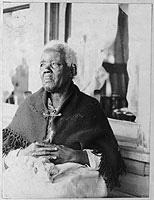
Sarah Gudger, age 121, photo between 1936 and 1938, Library of Congress's Federal Writer's Project, United States Work Projects Administration (USWPA)
Note: Be sure to read A Note on the Language of the Narratives. Why do you think the Library of Congress included this section? If short on time, read this excerpt:
"All the informants were of course black, most interviewers were white, and by the 1930s, when the interviews took place, white representations of black speech already had an ugly history of entrenched stereotype dating back at least to the early nineteenth century. What most interviewers assumed to be "the usual" patterns of their informants' speech was unavoidably influenced by preconceptions and stereotypes.
The result, as the historian Lawrence W. Levine has written, "is a mélange of accuracy and fantasy, of sensitivity and stereotype, of empathy and racism" that may sometimes be offensive to today's readers. Yet whatever else they may be, the representations of speech in the narratives are a pervasive and forceful reminder that these documents are not only a record of a time that was already history when they were created: they are themselves irreducibly historical, the products of a particular time and particular places in the long and troubled mediation of African-American culture by other Americans."
Written by PBS News Hour Classroom's intern Ryan Sowder and News Hour's Victoria Pasquantonio
Sign up to receive our weekly newsletter with Daily News Lessons and community events.
To provide feedback on News Hour Classroom's resources, including this lesson, click here.