SUMMARY
Mandatory cuts from the federal government on water from the Colorado River will soon take effect in Arizona, Nevada, and California. Now, some water managers in the region are spending billions to prepare for a drier future. Special correspondent Ben Tracy with Climate Central reports for our series, Tipping Point.
View the transcript of the story.
NOTE: If you are short on time, watch the video and complete this See, Think, Wonder activity: What did you notice? What did the story make you think? What do you want to learn more about? You can also make a Google doc copy of these general discussion questions.
News alternative: Check our recent segments from the News Hour and choose the story you’re most interested in watching. See the Google doc above for discussion questions.
WARM-UP QUESTIONS
- Which three states will have their water supply cut off from the Colorado River?
- How many people rely on water from the Rocky Mountains/Colorado River supply?
- What percentage of their combined capacity water capacity Lake Mead and Lake Powell are only performing at ?
- Why are megadroughts and water shortages becoming more common?
- What impact will Phoenix's new water recycling plants have on the water supply?
ESSENTIAL QUESTIONS
- After watching this segment, what do you think will happen to Lake Mead? What intervention do you think local officials and the federal government could or should take?
- Kyle Roerink, senior advisor with Great Basin Water Network, said the era of cheap unlimited water is "over." How might rising water prices affect communities living in the West?
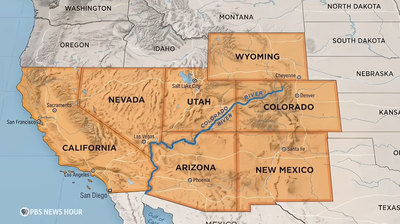
Media literacy: Examine the map below. How do you think it helps viewers understand the scope of the problem with drawing water from the Colorado River? What other questions does the map raise for you about water management in the west?
WHAT STUDENTS CAN DO
Imagine you are the state governor of Arizona, California, Colorado, Nevada, New Mexico, Utah or Wyoming. How would you communicate the urgency of preserving water to the people in your state? How would you balance the needs of people in the cities and towns for drinking water and the needs of farmers for water to produce crops? What ideas do you have for reducing water use or increasing supply of available water?
To help you answer these questions, you may want to watch the following segment on how the state of California is grappling with priorities around water usage.
Written by PBS News Hour Classroom's Intern Sophia Sharaa with editing from News Hour Classroom's Luke Gerwe
Sign up to receive our weekly newsletter with Daily News Lessons and community events.
To provide feedback on News Hour Classroom's resources, including this lesson, click here.